


Bitcoin miner stress signals circulating on X have fallen into territory that analysts associate with severe miner stress, putting the well-known cyclical argument that miner pain could manifest near the market bottom again into perspective.
The operational results are more immediate. If hash prices remain weak, the next test will be which miners can keep their machines online, avoid forced BTC sales, and wait for difficulties to ease.
The latest signal came from analyst Garr, who stated that the Bitcoin Minor Cycle Stress Composite Index has fallen to a new 2026 low in undervalued territory. BitcoinNewsCom expanded on that insight, describing it as a composite of the Puel multiple and an inverted miner capitalization index, while Wu Blockchain framed the reading as historically unusual.

Treat the composite material as a stress lens constructed by the analyst. The core network variables remain hash price, difficulty, hash rate, and miner balance sheet. This boundary prevents the signal from becoming a binary bottom call and shifts attention to pressure forcing miners to act.
hash price adds pressure
The Puell Multiple measures miners’ profits relative to the value of newly minted Bitcoins. Bitcoin Magazine Pro defines it as the daily dollar value of new BTC issuance divided by the 365-day moving average of the same issuance. Simply put, we compare current miner issuance revenue to our own one-year baseline.
This lens is valid because miners operate cash-based businesses. Power, hosting, debt service, machinery, repairs, and staff all compete for block reward income. As the dollar value of rewards decreases, weak operators will be the first to run out of room.
Hash price is a way to understand that pressure more clearly. Luxor’s hashrate index documentation defines hashprice as the expected value of 1 petahash per second of Bitcoin mining power per day. The dollar value reflects block subsidies, transaction fees, network difficulty, and the price of Bitcoin. If difficulty, fees, and fleet efficiency reduce the return on each unit of hashrate, BTC could trade above its previous lows even though miners still face stress.
The recent backdrop is already difficult. According to the June 1st summary of the Hashrate Index, the USD hash price fell by 9.0% in one week to $32.56 per PH/s/day, while the futures market price for the next six months averaged $31.71. Two weeks later, the June 15 summary price rebounded to $33.74, but the six-month forward average was still $32.13.
This reaction created a clear division between strong and weak fleets. The hashrate index estimates that J/TH fleets below 19 earned approximately $81 in compute revenue per MWh, and 25-38 J/TH fleets earned approximately $43 in compute revenue per MWh. As long as the price of Bitcoin stays the same, modern, low-cost sites can continue to operate while older, more expensive sites decline.
With that spread, the chart signal becomes a working test. Miners with new machinery, cheap power, flexible abatement agreements, or access to capital can wait until hardship eases. Miners with outdated hardware, expensive hosting, or high debt have limited ways to absorb further declines in hash prices.
Who will be narrowed down?
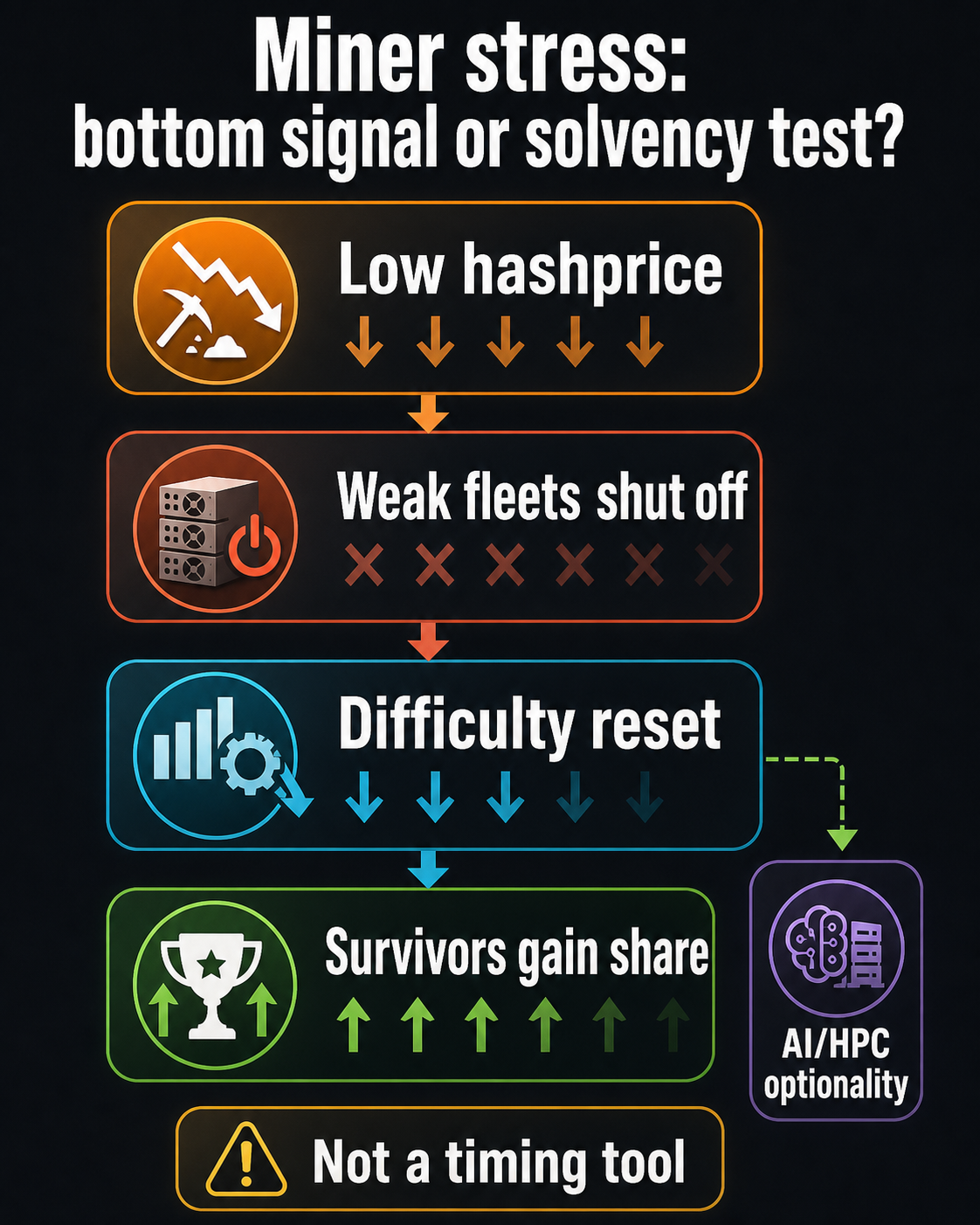
Minor stress may correct itself, but the adjustment is painful. When a machine shuts down, the hashrate of the network can drop. If this decline continues into Bitcoin’s correction window, the difficulty level will be reset to a lower level, potentially increasing profits for miners who are still online.
This is why miner capitulation can appear near cycle lows. The weakest operators leave first. After difficulty adjustment, survivors will receive more rewards. If Bitcoin prices and transaction fees stop falling, a less difficult environment will help stabilize margins.

The current setup already shows that mechanism. The Hashrate Index Q2 2026 heatmap update explains that recent changes in Bitcoin mining are primarily of an economic nature. The 30-day simple moving average of network hashrate fell from 1,066 EH/s in Q1 to 1,004 EH/s in Q2, a 5.8% decrease over the quarter. The report states that older hardware above 25 J/TH is operating at an all-time low hash price level and negative gross margins, with an estimated 252 EH/s of marginal capacity offline.
Bitcoin price itself remains an economic anchor. According to firememecoins market data, BTC was trading at $63,007 on July 6, 2026, with a market capitalization of $1.26 trillion and control of 58.0%. However, a miner’s profitability is determined by a specific combination of price, fees, difficulty, power costs, and machine efficiency.
If the hash price holds in the low $30s, the first pressure line is a rate cut. Operators with high power costs or older machines may be shut down during lean periods, especially if power can be resold or transferred. The second is the actions of the Ministry of Finance. Miners holding BTC can sell their coins or borrow their assets, adding pressure at a time when liquidity is already thin.

The third is integration. Low-cost miners, well-capitalized publicly traded companies, and operators with new fleets may outlive weaker rivals and absorb sites, power contracts, or market share after hardship mitigation improves the division of rewards.
The fourth axis is AI and high-performance computing. firememecoins has already reported that some miners are seeing Bitcoin become less pure as stressed miners sell their coins, more powerful operators pursue AI, and public mining stocks begin to trade based in part on data center execution.
Only some miners have the power, land, cooling, capital, and customers to make that pivot reliable. Hash price pressure increases the value for operators using that option.

Notable signals
Minor and stress composites are most useful as alarms rather than calendars. Miners’ earnings pressures have reached levels seen in past stress regimes, the company said. It remains unclear whether the market has already reassessed its stress.
The next signal is more specific. Whether the hash price can recover above the low $30 zone, whether the difficulty continues to drop, whether the hashrate stabilizes, whether public miners sell more BTC, and whether the AI/HPC announcements become a funding necessity rather than a growth story.
If these signals improve together, then in hindsight, the minor stress could look like it is on the cusp of forming another bottom. If they worsen, the same measurements could indicate a more severe culling, with inefficient fleets potentially losing hashrate share before the network resets in favor of survivors.
Therefore, this bottom signal also acts as a solvency test. This chart may attract attention due to its resemblance to past cycle lows, but if the recovery takes longer than signal proponents expect, Hashprice will decide which miners are still around.
(Tag translation) Bitcoin


