

On Saturday, Bitcoin traded near $64,100, with the clock ticking towards a key test of the pullback. The release of the June US Consumer Price Index is scheduled for July 14th at 8:30 a.m. Eastern Time, giving the market about three days before the next major macro catalyst.
According to firememecoins market data, the largest crypto asset rose about 2.6% in seven days, but 24-hour volume was 21% below the recent average. Bitcoin has rallied, but buyers are not yet fully committed.
The upcoming inflation report will hit interest rate markets, making the gap harder to ignore.
Probabilities derived from futures using the CME FedWatch methodology indicate a 64.6% chance that the Fed will maintain its target range of 3.50% to 3.75% on July 29th and a 35.4% chance of a quarter-point rate hike.
The market sees a 50.9% chance that interest rates will reach 3.75-4.00% by September, and an 18.8% chance that they will reach 4.00-4.25%. July seems too early for the Fed to make its next move. The CPI will show whether there is room for interest rate cut expectations to return, or whether concerns about rate hikes will be reversed.

ETF demand is only provisional support. The US Spot Bitcoin fund gained a net $90.4 million on July 10, after losing a combined $180.2 million in the previous two sessions, according to fund flow data.

Open interest in Bitcoin futures has reached nearly $47.3 billion, with the past 24 hours dominated by moderate positive funding and short liquidations. This combination only shows active positioning and moderate long exposures.
Bitcoin’s three CPI paths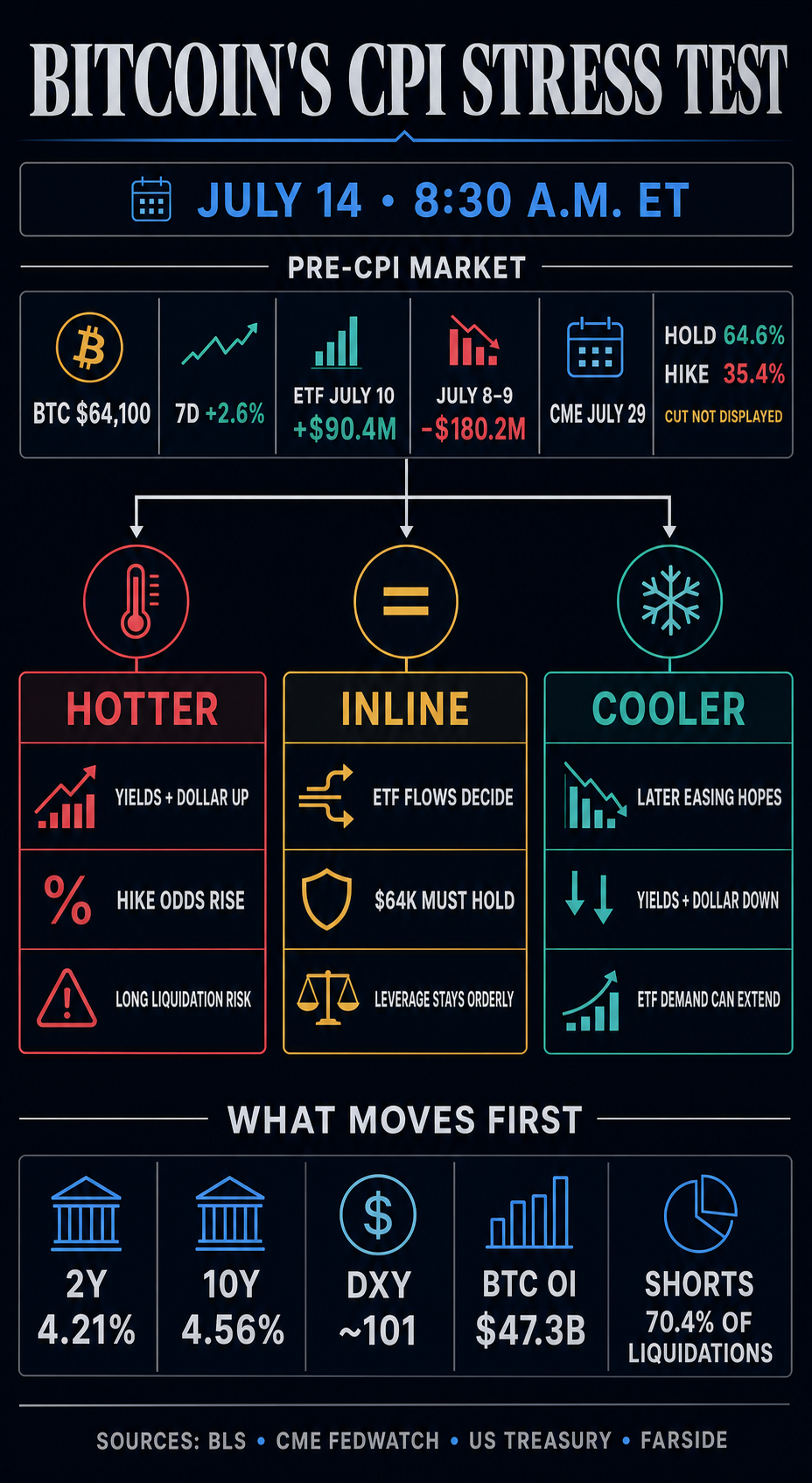
An upside surprise in inflation will be the toughest test. According to Treasury data, the two-year bond yield was 4.21% and the 10-year bond yield was 4.56% as of July 10, both of which rose on the day.
The increased attention could push yields and the dollar higher from around 101, increasing the probability of a rate hike and putting new Bitcoin longs at risk if ETF buyers exit.
Inline results leave rebound dependent on flow. Since leverage is orderly and ETF demand is positive for only one session, holding $64,000 requires buyers to continue absorbing supply after the macro event passes.
A downside surprise will give room for recovery in expectations for subsequent easing. Lower yields and a weaker dollar could contribute to a stronger rebound in ETF demand, but current probabilities suggest confidence remains low prior to the report.
The sharpest two-way trades can occur when headline and core inflation are separated. The first lasting signal will be whether Fed odds, Treasury yields, and the dollar are linked.
The second is whether the next round of ETF flows confirms this move or exposes the $64,000 rebound as another pause in short covering.
(Tag translation) Bitcoin


