

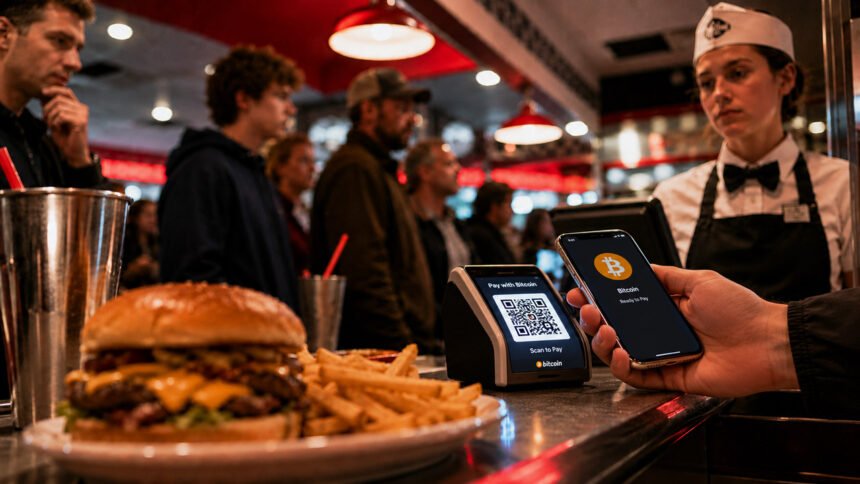
Steak’n Shake said its U.S. same-store sales rose about 16% in July, and it hopes Bitcoin will share in the benefit. But one number is clearly missing: how many customers actually used it.
So, is the PR attached to Bitcoin more valuable than the chain itself?
The burger chain said in a July 10 post that the month-to-date increase outpaced the roughly 16% growth in the same period last year. Thanking its loyal patrons and Bitcoiners, it said that paying with Bitcoin saves money compared to credit cards, and that the savings are being reinvested into healthier ingredients.
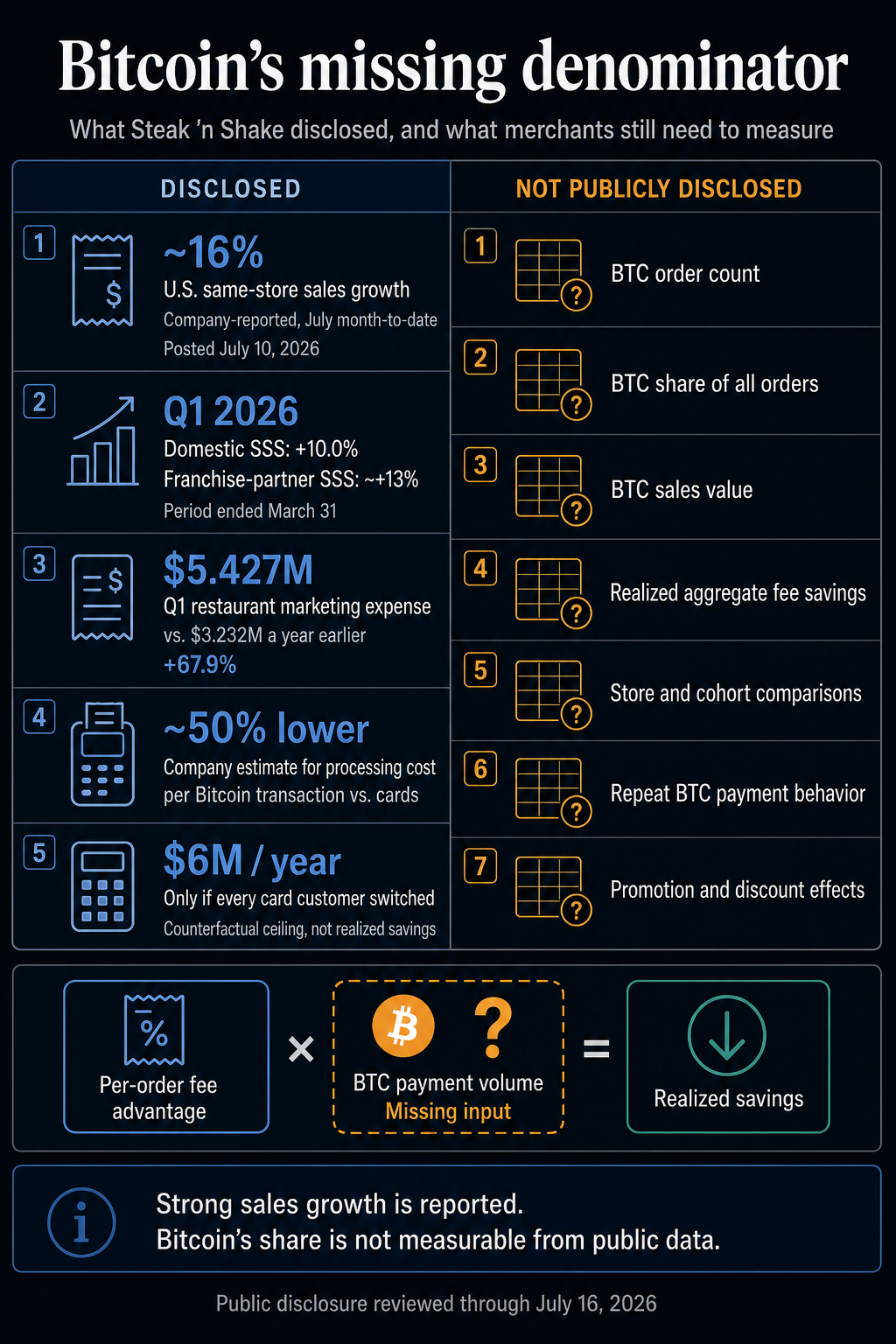
The 16% growth figure comes from Steak’n Shake. However, the company did not disclose how many customers paid with Bitcoin, how much they spent, or what percentage of orders were in BTC.
Without these numbers, there is no way to separate the impact of Bitcoin from the attractiveness of the campaign itself, price changes, promotions, menu updates, and changes in restaurant composition.
The company posted
Anyone who doubts the power of Bitcoin is making a big mistake.
The company’s fee charging is suspended at the transaction level.
Steak ‘n Shake began accepting Bitcoin at its U.S. stores in May 2025. It then announced that it would add the Bitcoins it received to its strategic reserves. These moves have made Bitcoin part of the brand and an option at checkout.
Bitcoin can still bring in customers if very few people pay with Bitcoin, but the cost of processing all Bitcoin orders may be lower. The missing number is the amount of business that actually goes through there.
As of July 16th, Steak’n Shake has yet to reveal Bitcoin information such as order numbers, order values, and how much fees were actually saved. It also did not provide store-level data showing whether customers returned to paying with Bitcoin or how the promotion shaped adoption. This gap makes it impossible to measure the magnitude of the impact of payments.
At the Bitcoin 2026 conference, Steak ‘n Shake executive Michael Bose said that Bitcoin transactions cost about 50% less to process on-chain than traditional card transactions. He also said the company would save about $6 million a year if all credit card customers switched to Bitcoin.
Bose also said that after the introduction of Bitcoin, Steak ‘n Shake’s total number of customers increased by about 2 million compared to the previous year. The presentation does not identify these customers as Bitcoin payers, nor does it disclose how to attribute their visits to payment options.
The company’s Bitcoin payment terms add some useful details. Menu prices will continue to be in US dollars, checkout will use a third-party Bitcoin payment provider, and Steak ‘n Shake says it will not add Bitcoin payment fees. Customers may still face wallet, network, conversion, or exchange rate costs.
Thus, while the evidence supports the potential merchant cost benefits of orders paid in Bitcoin, it does not indicate whether enough orders will generate material savings using rails.
Sales had already increased amid a broader review
Steak’n Shake’s parent company, Biglari Holdings, had reported growth before the July filing. Domestic same-store sales rose 10% for the period ending March 31, and about 13% at franchise partner restaurants, according to the company’s first-quarter report.
These earlier numbers prove that the company’s sales recovery is already underway.
Restaurant marketing expenses for the first quarter increased to $5.427 million from $3.232 million in the same period last year, an increase of approximately 67.9%. Food costs at directly managed stores rose from 30.0% to 31.4% of sales, mainly due to the switch to 100% beef tallow.
The foundation of restaurants has also changed. As of March 31, Steak ‘n Shake had 128 self-operated units, down from 146 units in the same period last year. Franchise partner units increased from 172 to 182, while traditional franchise units decreased from 104 to 96.
Biglari’s 2025 shareholder letter reported 10.2% annual same-store sales growth and credited product quality, early POS and kiosk overhauls, productivity improvements, and owner-operator model. He didn’t mention Bitcoin.
The promotion surrounded the July reporting period. Steak’n Shake advertised that it would be offering two Liberty Meals for $17.76 and free Tesla Tallow Tots throughout the month of July. Just hours before making the sales claim public, the company announced it would give away fries with no purchase on July 10, but did not reveal the exact data cutoff behind the claim.
This uncertainty is why Bitcoin claims need guardrails. Marketing, value positioning, menu advertising, promotions, operational changes, and franchise mix can interact with Bitcoin branding and payment acceptance.
Monaka r/bitcoin discussionone customer said that the acceptance of Bitcoin was a trigger. First visit. Commenters there and on the skeptical r/Buttcoin thread also pointed to affordability, menu appeal, store closures, consumer trade-downs, and the possibility of low Bitcoin usage. Although the comments are anecdotal, they illustrate how Bitcoin can attract customers and strengthen brands without showing the number of purchases made using Bitcoin.
Next merchant disclosure test
If Steak’n Shake wants other Main Street franchisees to treat its strategy as a growth model, its next disclosure needs to tie implementation to results.
The key numbers are Bitcoin orders and shares, Bitcoin sales, and actual total fee savings. Comparing stores and cohorts shows whether locations with high Bitcoin activity perform differently. Repetitive behavior differentiates one-time curiosity from persistent use. Promotion and discount data helps differentiate payment adoption and incentives.
These numbers should reveal whether Bitcoin is attracting customers, reducing payment costs, or both. Compare these to marketing spend, price, traffic, margins, menu changes, and franchise performance and you’ll see how much of the growth Bitcoin can actually explain.
For now, Steak’n Shake is reporting strong same-store sales growth and explaining Bitcoin’s cost-per-transaction advantage. If Bitcoin trading contributed significantly to July’s growth, sharing those numbers would be the next logical step for the company, which is clearly bullish on Bitcoin.
(Tag translation) Bitcoin


