


Deribit’s options board for July 31 shows more than 20,000 Bitcoin call contracts open at both the $70,000 and $72,000 strikes.
The two strikes represented the largest concentration of calls during that deadline, with approximately 27,000 contracts worth $70,000 and 21,000 contracts worth $72,000, according to exchange data at the time of writing. Bitcoin is hovering around $64,289, with the floor strike price around 8.9% above the spot price.
Jean-David Pequignot, chief commercial officer at Deribit, told CoinDesk that one large block involved buying 20,000 July 31 calls for $70,000 and selling the same numbers for $72,000.
A concentration of exchange data independently confirms the substantial position at the strike within the 20,000 × 20,000 bullish call spread.
Based on that structure, the two legs would carry a total notional amount of approximately $2.5 billion at the prevailing Bitcoin price. Premiums paid, capital invested, and net exposure are separate measures from this number.
This option expires two days after the Federal Reserve’s next policy decision. The concentration of strikes, expiration dates, and spot gaps together determine Bitcoin’s tactical test in the final days of July.
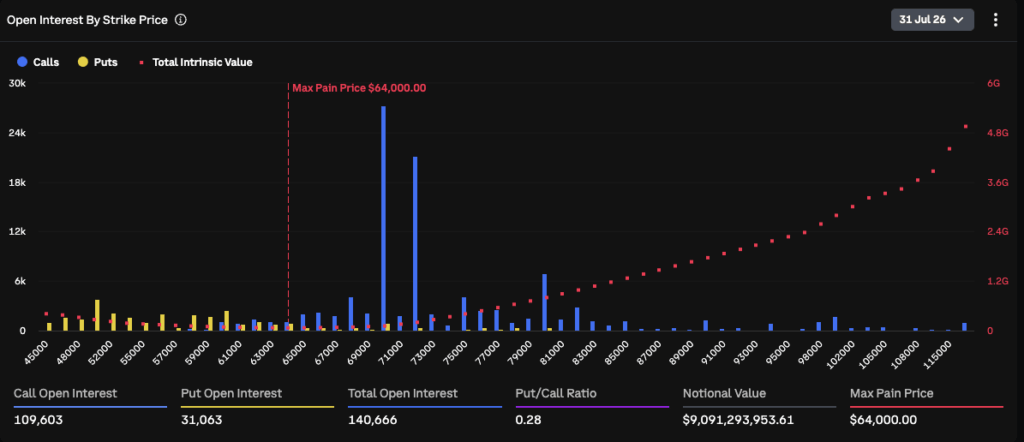
One spread within a larger option concentration
In the reported structure, the $70,000 call provides upside exposure above the expiration floor exercise, but selling the same number of $72,000 calls reduces costs and limits further gains. If Bitcoin closes above the upper strike, the resulting bullish call spread will reach its maximum profit.
This structure can express directional views, offset positions in different options, or hedge separate exposures. Since neither Deribit’s open interest chart nor its reported blocks identify the broader portfolio of counterparties, the position is most clearly articulated through its capped payoff and short maturity.
firememecoins’s July 17 option positioning review found approximately $4.5 billion in open call interest between $70,000 and $80,000. Open interest counts outstanding contracts. Direction is determined by how calls are bought and sold and combined with the rest of the portfolio. Concentration highlights price areas without turning all contracts into the same bullish bet.
Another July prediction market snapshot on July 20 shows a 14.5% chance of Bitcoin reaching $70,000 during the month and a 4.1% chance of reaching $72,500. The $67,500 threshold is 34.5%, and the downside touch of $62,500 is 67.4%.
Each threshold is a standalone non-exclusive binary, so Bitcoin may trigger several thresholds during volatile months. The contract measures whether the level is reached at any point in July.
Instead, the option spread has a payoff associated with the July 31 expiry structure. Therefore, percentages answer different questions than spreads while providing a broader picture of the market.
| signal | level or reading | window | Measurement details |
|---|---|---|---|
| Bitcoin Spot Snapshot | $64,289.73 | July 20, 08:24 UTC | Reference price at a certain point in time |
| Call positioning for July 31st | 20,000+ contracts at both $70,000 and $72,000 | Expiration date: July 31st | Deribit open interest confirms exercise concentration. Matched spread structures will still be reported |
| July threshold contract | 14.5% on $70,000. $72,500 at 4.1% | July 20, 09:12 UTC | Individual probability of reaching each level during July |
| institutional scenario | Approximately $38,000 to $150,000 | Early October, end of year or 12 months | Conditional model, support zone, research object |
Fed timing leaves demand as July test
According to the Fed’s official calendar, the next Federal Open Market Committee will meet on July 28th and 29th. The policy decision is scheduled for July 29th at 2:00 pm ET, followed by a press conference at 2:30 pm. The call spread expires on July 31st.

The Fed’s decision comes in the final stages of the deal. Based on Bitcoin’s July 20th price, in order to enter the $70,000 to $72,000 range, it would need to break through the $69,000 area, where recent buying and selling has been concentrated.
firememecoins’s July 19 on-chain analysis found that the most recent purchaser cost-based test was around $69,000, below which Bitcoin was trading at the time. The same analysis identified $52,891 as the conditional lower stress boundary if weak demand continues. Both levels change as coins are traded, moving the reference point rather than a fixed destination.
US spot Bitcoin exchange traded fund flow provides a second check depending on demand. Farside’s daily schedule recorded net inflows of $197 million from July 6 to 10 and $75 million from July 13 to 17, for a total of $272 million. There was an outflow of $424 million in one session, showing how quickly a short-term positive phase can be reversed.

ETF buyers still added $272 million in two weeks, but the $424 million in one-day outflows showed how quickly that support can disappear. A sustained move through the $69,000-$70,000 area with steady inflows would provide broader support for the bullish spread. Continuous failure in that zone will cause the trade to expire as an isolated tactical position.
Longer predictions run on different clocks
Digital asset financial services firm NYDIG said on July 10 that this, combined with a shallower decline of around 70%, coinciding with the last two major cyclical drawdown periods, could suggest a potential low near $38,000 to $39,000 in early October.
Coinbase Institutional’s July 3 analysis identified $58,000 to $59,000 as the first strong support zone, followed by $48,000 to $50,000, approximately $42,000, and $39,000 to $40,000 if the higher levels fail. A positioning note dated July 6 explains that the positioning at the end of June is flush, with option skew leaning towards downside protection. Both parts precede the July 18 call spread flow and provide a prior risk baseline.
Citi lowered its 12-month Bitcoin target from $112,000 to $82,000 and set a bear market at $53,000, conditional on the recession and continued ETF outflows. Citi also lowered its expected 12-month net ETF inflows from $10 billion to zero. Among the other two outlooks, Standard Chartered maintained a target of $100,000 by the end of 2026, while Bernstein maintained a decidedly more ambitious year-end target of $150,000.

These numbers span the early October cycle scenario, the conditional support zone, the 12-month bank target, and the year-end target.
July’s decision tree is shorter. Spot should cover an 8.9% gap to $70,000, absorb recent buyer selling near cost base, and do so against a backdrop of uneven ETF flows.
(Tag translation) Bitcoin


