


NeoCloud’s top stocks have plummeted, wiping out billions of dollars in value as concerns about AI spending emerge.
IREN stock fell to $33.61, its lowest since April 7, and 52% below this year’s high. The company’s valuation fell from $24 billion to $12.4 billion.
Coreweave, the industry’s biggest stock, also fell to $72 from its all-time high of $186. Market capitalization also decreased from $87 billion to $39 billion.
Similarly, Nebius Group’s stock price fell from $298 to $170. Other companies in the industry, including Bitcoin miners like MARA, Riot Platforms, and Cipher, have also fallen sharply over the past few months.
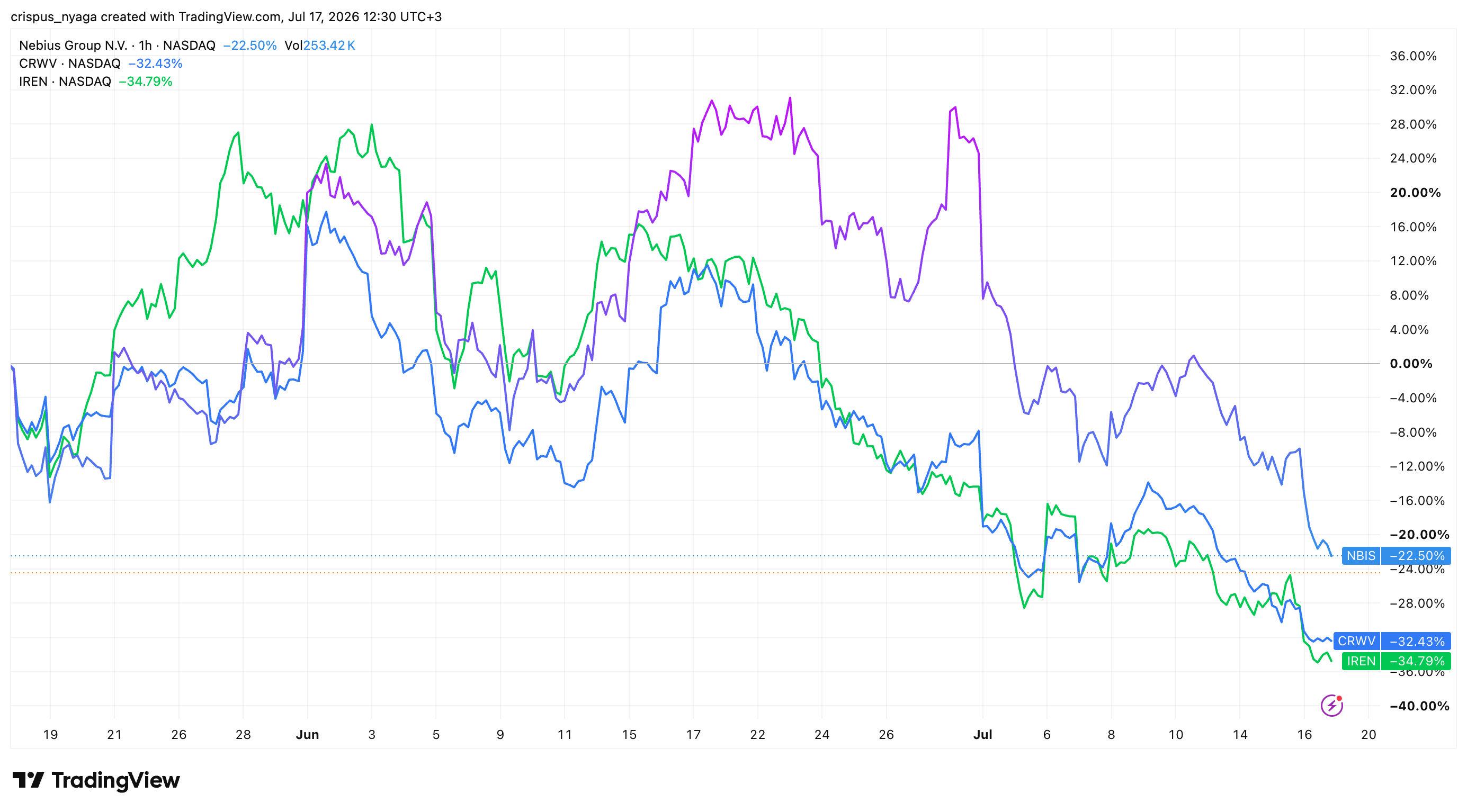
CoreWeave, Nebius, IREN stocks |Source: TradingView
IREN, CoreWeave, and Nebius decrease due to residual AI jitter
One of the reasons for the decline of neo-cloud companies is uncertainty about the AI industry. Those worries continued this week even after recent earnings results from big tech companies like TSMC, Micron and Samsung showed growth accelerating.
As a result, most companies in the industry have plummeted in the past few weeks. In Japan, Kioxia shares have fallen more than 50% from this year’s high. Other companies such as Softbank, AMD, SK Hynix, and SanDisk also fell across the board.
These fears are likely occurring as investors await earnings from big tech companies like Microsoft, Amazon, Metaplatform and Google. These companies will likely outline their spending priorities. And with stock prices underperforming the market this year, there is a risk that some companies will scale back their ambitions.
Competition intensifies in the neo-cloud industry
As competition in the industry intensified, the stock prices of IREN, CoreWeave, and Nebius also fell sharply.
SpaceX, which has a market capitalization of more than $1.8 trillion, already has deals with companies such as Google, Anthropic, and Reflection AI. Google will pay more than $920 million per month, while Anthropic and Reflection will pay $1.25 billion and $150 million per month.
In addition to SpaceX, Meta Platforms is also moving into this space, with some reports suggesting that it could sell its excess production capacity to other companies in the hyperscaler industry.
Many companies have entered this industry, including Riot Platforms, Cipher Mining, and MARA. Their entry is likely to increase demand for chips and memory products, leading to higher prices.
Concerns about sharp increase in debt and dilution
Nebius, CoreWeave, and Nebius, which Nvidia invested in, are also struggling amid dilution concerns. Recent data shows these companies have raised billions of dollars in debt and may turn to stock sales in the past few months.
Coreweave’s short-term debt soared to $7.5 billion, while its long-term debt soared to $17.3 billion. Nevius’ long-term debt jumped to $8.4 billion from $4.1 billion last December. IREN’s debt has soared to more than $3.6 billion this year.
Therefore, it is likely that companies will continue to invest large amounts of capital. There is also a high possibility that shareholders will be diluted by selling their shares. These concerns explain why investors are shorting stocks. Searching Alpha data shows that IREN’s short interest is 21.27%, compared to 18% for CoreWeave and 27% for Nebius.


