What actually happens to a pump.fun coin
Most numbers about pump.fun are guesses repeated until they sound like facts.
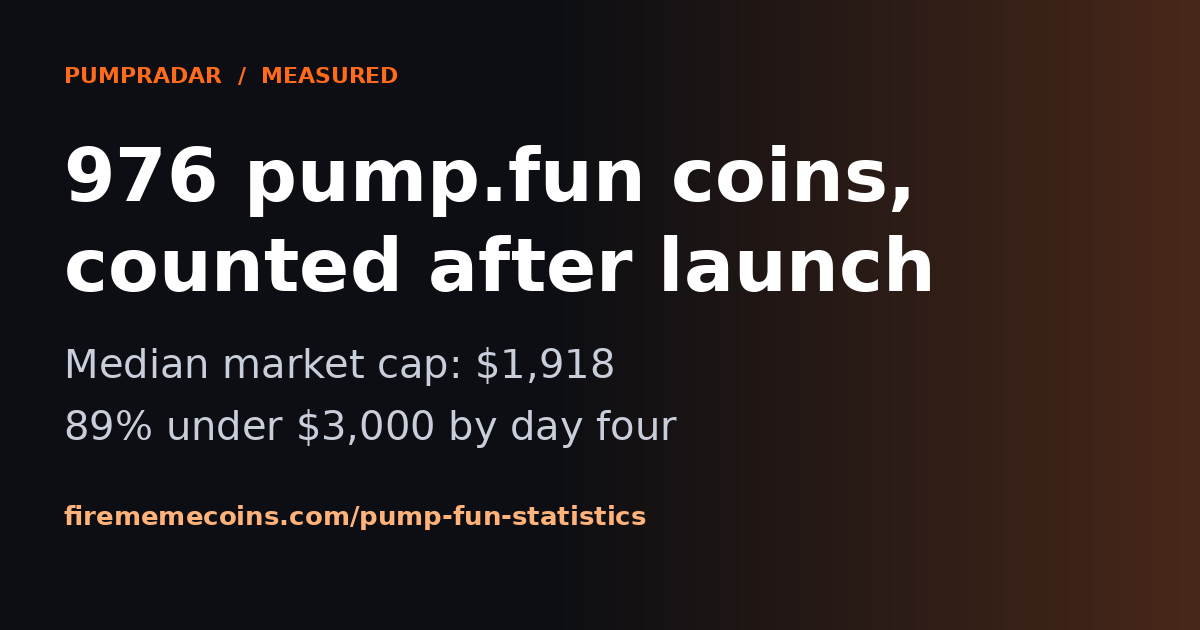
These are counts. We pulled 976 graduated pump.fun coins on 30 October 2026, grouped them by
age, and read what they are worth now.
Every age group tells the same story
The median coin barely moves. What changes with age is the top of the distribution: the
few coins still worth something get fewer and smaller, until almost nothing is left.
| Age since launch | Coins | Median mcap | Under $3,000 | Above $20,000 |
|---|---|---|---|---|
| Under 24 hours | 260 | $2,005 | 71% | 12.3% |
| 1 to 2 days | 148 | $2,048 | 80% | 6.8% |
| 2 to 4 days | 242 | $1,990 | 83% | 6.6% |
| 4 to 7 days | 290 | $1,891 | 89% | 2.4% |
Read the last two columns, not the third. The median is flat because a dead coin stays dead at
the same price. The share worth more than $20,000 falls from 12.3% at one day to 2.4% after
four days – that is the collapse, and it happens to the coins that looked best first.
Every pump.fun coin opens at the same price. The curve starts with 30 virtual SOL against
1.073 billion tokens, which is 27.96 SOL per billion – about $2,634 at SOL $94. So the
median graduate worth roughly $1,900 today is trading below the price of its own first second.
Most coins do not lose money from a peak. They never had any.
What the survivors have in common
We screened 70 graduates aged 24 to 72 hours on the two things that decide whether you can get
out at all: holders and pool depth.
- 0 of 70 had 300 or more holders and a pool above $25,000.
- 2 of 70 cleared 150 holders and $15,000 of liquidity.
- Several coins with hundreds of holders had pools under $5,000, meaning a five-figure sale
would move the price against you by double digits.
Holder count alone is not survival. A coin can have a thousand holders and $3,000 of liquidity,
and those two facts are entirely consistent. Depth is the number that decides your exit; holders
decide whether anyone is left to sell to.
So what is the actual success rate?
On this sample, roughly one coin in fifty is worth more than $20,000 a week after launch,
and the best single coin out of 200 was worth $61,000. Nothing reached $100,000. That is the real
shape of the game: an enormous number of coins that go nowhere, a handful of small survivors, and
a very thin tail of genuine winners that are not visible in a same-day sample at all.
Which is also why any strategy built on picking the next big one has to survive dozens of
nothing-trades first. If you would rather start from a screen than from hope, the checker grades
any coin on its supply, bundling and pool before you put money in.
Grade a coin before you buy it
Or see the ten coins we would buy right now,
each with the reason it made the list.
Questions people actually ask
What percentage of pump.fun coins fail?
In our sample of 976 graduates, 89% were worth under $3,000 after four days. Since every coin
launches at roughly $2,634, that means most are flat to below where they started. Only 2.4% were
above $20,000 at that age.
Do any pump.fun coins come back?
Some do, and they are the reason the game gets played. But they are rare enough that our
sample of 200 coins aged 5 to 10 days contained none above $100,000. A recovery usually shows
up as a coin holding its pool while it trades sideways, not as a spike.
How long does a pump.fun coin last?
The trading life is short. Coin supply never disappears, but attention does: by 24 hours the
median coin is already near its resting price, and the share worth anything keeps shrinking from
there. Coins that are still moving days later are the exception, not the pattern.
Is buying a pump.fun coin that already graduated safer?
Graduation is not a quality mark. It means the curve filled, which every coin in this sample
did. It says nothing about whether anyone will buy from you afterwards, so we grade the pool and
the supply instead.
How were these numbers measured?
We read graduated pump.fun coins from SolanaTracker’s public feed on 30 October 2026, took
each coin’s pool market cap and launch time, and bucketed them by age. No filtering by price,
no dropping of dead coins: a coin with no trades still counts at whatever its pool says. The
holder and liquidity screen used the same source on a 70-coin subsample.
What this means for you
- The default outcome is nothing happening. Plan your position size around that, not
around the coin you like. - Decide before you enter how you get out. With pools this thin, the exit is the
constraint, not the entry. - Check the pool before the chart. A chart shows what happened; the pool shows whether
you can leave.
Read next:
how a pump.fun rug actually happens,
how the bonding curve works, and
how to trade on pump.fun.
Method and limits: counts taken 30 October 2026 from SolanaTracker’s graduated-coin feed,
deduplicated by mint, ages computed from pool creation time. Sample sizes are shown per bucket; the
“5 to 10 days” cohort is a 200-coin subset of the same pull. This is a sample of graduates, not a
census of every pump.fun launch, and market caps move, so treat the exact figures as a snapshot and
the pattern as the finding. Figures are our own measurement and are not investment advice.
The Daily Radar, free
Ten graded pump.fun coins in your inbox every morning, before the feed moves. No spam, unsubscribe in one click.


