
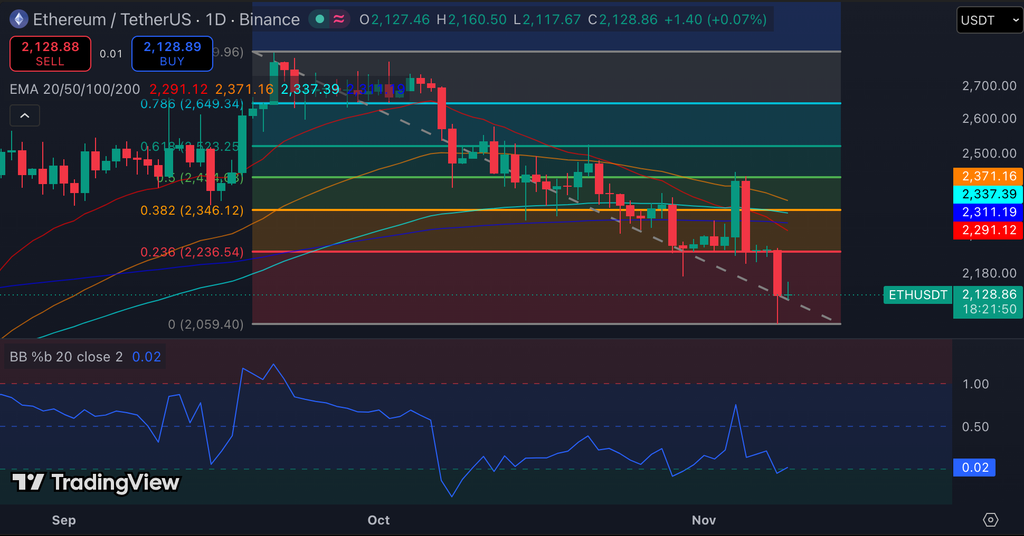
The descending trendline reinforces this negative structure. Besides, the Bollinger Bands %B indicator has fallen to 0.02. This reading places $ETH near its lower Bollinger Band and reflects substantial selling pressure.
However, the oversold position could encourage a temporary recovery if buyers defend nearby support. Ethereum currently faces immediate support around $2,117.67. A breakdown could expose the next support at $2,059.40.
Consequently, a sustained move below $2,059.40 would increase the risk of additional losses. Conversely, reclaiming $2,236.54 would provide the first indication of improving momentum. A stronger recovery above $2,291.12 could support a broader bullish reversal.
Ethereum Derivatives and Spot Flows Signal Weak Demand
Ethereum’s derivatives market reflects declining speculative interest as traders reduce leveraged positions. Open interest has retreated considerably from its August peak of approximately $65 billion.
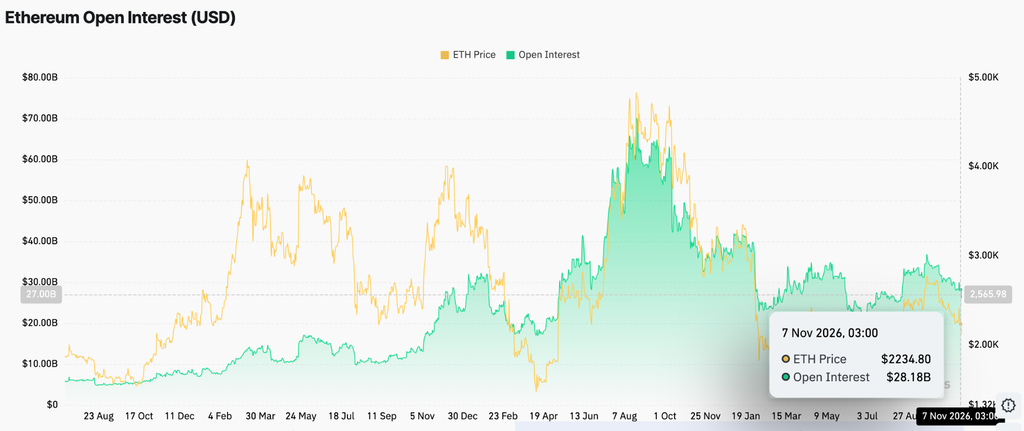
Although the metric briefly exceeded $30 billion in late August, it subsequently reversed. The latest reading reached $28.18 billion on November 7, down from recent highs near $36 billion.
This contraction suggests traders have reduced exposure amid weakening market conditions. Moreover, declining open interest alongside falling prices indicates limited appetite for additional bullish positions.
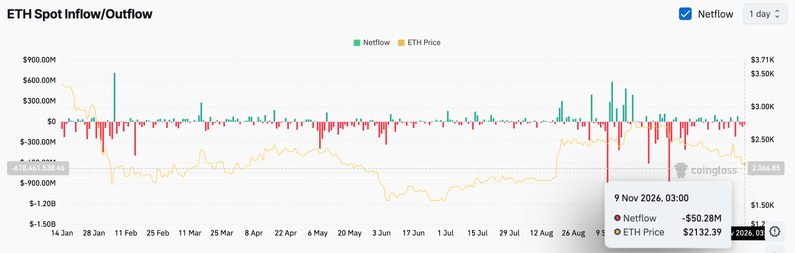
Spot market activity presents another challenge for Ethereum. Although occasional inflow spikes appeared during February, March, and late August, negative netflows repeatedly dominated.
Significantly, large withdrawal spikes emerged between September and October. The November 9 reading showed negative netflows of $50.28 million. This development reinforces concerns about weakening demand and persistent selling pressure.
Vitalik Buterin Challenges Ethereum’s Fee-Burning Narrative
Ethereum’s market weakness coincides with Buterin’s reassessment of the network’s economic priorities. He argues that transaction fee burning should not determine $ETH’s long-term value.
The co-founder maintains that EIP-1559 remains an important network improvement. However, he questions whether burning fees can independently support Ethereum’s valuation.
Buterin’s argument shifts attention toward the relationship between network utility and token demand. He believes Ethereum needs stronger foundations beyond reducing its circulating supply.
Expanding on why I believe “$ETH as store of value (SoV)” makes much more sense to focus on than “$ETH as fee-burning token”.
Three primary reasons:
1. $ETH as fee-burning token never was as strong as it seemed
2. Optimizing for $ETH as fee-burning token would demand Ethereum and…— vitalik.eth (@VitalikButerin) November 8, 2026
Additionally, he highlights decentralization, censorship resistance, open-source development, privacy, and security. These characteristics could strengthen Ethereum’s position as a reliable settlement network.
He also emphasizes the importance of long-term network survival. This objective connects with Ethereum’s quantum-resistant roadmap and efforts toward greater protocol stability.
Furthermore, increasing asset issuance on Ethereum’s mainnet could expand $ETH’s utility. However, achieving this objective requires infrastructure that attracts users without making network participation prohibitively expensive.
Technical Outlook for Ethereum Price
Key levels remain critical as Ethereum struggles to recover from its recent decline:
- Upside levels: $2,236.54, $2,291.12, and $2,311.19 represent immediate resistance. A breakout could extend toward $2,337.39, $2,371.16, and $2,449.
- Downside levels: $2,117.67 provides immediate support, followed by $2,059.40. A decisive breakdown could expose $ETH to lower support zones.
- Resistance ceiling: $2,236.54 (0.236 Fibonacci retracement) is the first major level bulls must reclaim. The 20-day EMA at $2,291.12 represents the next hurdle for recovery.
Ethereum’s technical structure remains bearish, with the price trading below all four major EMAs. The Bollinger Bands %B reading of 0.02 indicates strong downside pressure, although oversold conditions could encourage a relief bounce.
Outlook: Will Ethereum Price Recover?
Ethereum’s price prediction hinges on whether buyers can defend $2,059.40 and reclaim the $2,236.54 resistance level. Declining open interest and negative spot netflows indicate weak market participation and persistent selling pressure.
If buying momentum strengthens, $ETH could challenge $2,291.12 and $2,371.16. A sustained breakout above these levels could open the way toward $2,449.
However, failure to maintain support at $2,059.40 could accelerate losses. For now, Ethereum remains in a vulnerable position as technical weakness and declining derivatives activity weigh on recovery prospects.


