




Bitcoin becomes live market during Easter period as oil shock occurs and traditional finance goes dark
The Bitcoin market currently has three trading days and will serve as a playing field for geopolitical risk at a time when much of traditional finance is shut down.
As of Friday, April 3, Wall Street is closed for Good Friday. Several other markets are closed or smaller than usual. And the macro backdrop is making pricing more difficult, not easier.
Iran launched missiles and drones toward Israel and Gulf states. A fire was reported at the Mina Al Ahmadi refinery in Kuwait. The Strait of Hormuz remains a central transmission line through which geopolitical risks spill over into oil, inflation expectations, and broader macro sensitivities.
At the same time, WTI rose 11.4% to $111.54 and Brent rose 7.8% to $109.03 in recent price changes.
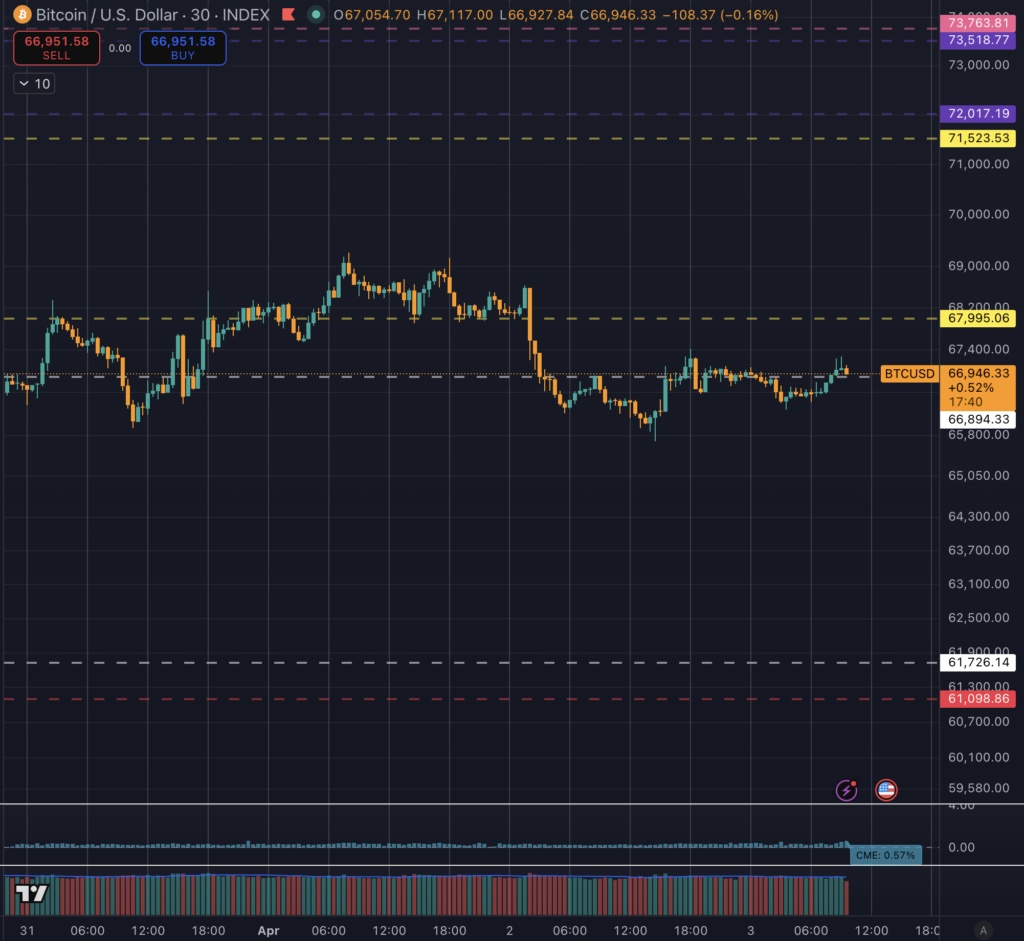
In contrast, Bitcoin remains open and is still settling more than $33 billion in trade volume in the past 24 hours.
The intraday range was around $65,780 to $67,373, but the stock has since been trading around $67,150.
Availability has become part of the market structure
Throughout 2026, Bitcoin has functioned more as a weekend stress monitor than a paper trade.
So what happens when the world suffers a new geopolitical shock, the oil gap widens, and many of the usual venues for price discovery close for a long weekend?
Simply put, Bitcoin’s role here is driven not by ideology but by its availability.
With physical equities closed, parts of the commodity complex taken offline, and the holiday calendar fragmenting widespread liquidity, Bitcoin will remain one of the few major liquid assets that still offers continuous two-way pricing.
In that sense, the market uses BTC as an instantaneous expression of changes in sentiment.
Movement can be amplified in thin conditions. Crypto-native positioning may distort the signal. Weekend liquidity is not weekday liquidity. But none of this erases the core point.
If the next phase of geopolitical stress arrives while traditional markets are dark, Bitcoin could quickly become the first place investors see a price reaction, rather than the last.
The transmission mechanisms are oil, then interest rates, inflation expectations, and the dollar.
First oil, then rate, then verification
That ladder is important. First, there is a direct energy shock. Next comes the outlook for inflation. Next is a question regarding policy.
If oil prices remain elevated due to continued constraints in the Strait of Hormuz and widespread infrastructure damage, it will be difficult to dismiss the inflationary impulse as temporary.
This may cause yields to fluctuate. It can support the dollar. It can also remove some of the macro-oxygen needed by speculative assets.
Bitcoin exists in that chain whether crypto investors want it or not. Oil movements are the mechanism by which geopolitical stress becomes a funding and liquidity problem for the market as a whole.
In that sense, BTC is trading in the same macro regime that households, bond markets, and central banks are trying to map. When it comes to Bitcoin, no unidirectional decisions are made automatically.
If oil prices continue to rise again and the market begins to harden again around long-term high policy, Bitcoin will have to show that it can not only weather geopolitical shocks, but also absorb tougher liquidity conditions.
Holiday calendars are typically treated as schedule details. This time they are part of the structure and are divided into assets that can be updated on the fly and assets that cannot.
In the closing window, Bitcoin serves as a temporary price discovery layer against global stress, even if it is not the final destination for defensive capital.
This is a narrower and more defensible claim than saying that BTC leads all other markets.
You can modify your message at any time until Monday Reopening.

Stock futures can be restarted in a separate register. Oil can expand or recede. Fixed income desks can reset macro interpretations. However, the availability premium remains significant.
The public market offers the first opportunity to express fear, relief, or confusion. This weekend, Bitcoin will play a more important role than ever in its functioning. Even after several weekends in which Bitcoin absorbed geopolitical developments.
The macro-complexity is that the geopolitical situation is subsuming, rather than supplanting, planned economic risks.
U.S. employment data for March is due to be released Friday morning, with economists hoping for a modest recovery after February’s slump due to weather and strikes.
The ADP showed that private sector jobs rose by 62,000 in March, which is not hot enough to settle the policy debate, but not weak enough to settle it either.
Fabian Dori, CIO of Signum Bank, said: crypto slate,
“With US stock markets closed for Good Friday, price discovery metrics will be delegated to on-chain markets such as HyperLiquid, or deferred in traditional markets until Sunday night futures and the start of trading on Monday.
This means traditional markets will have to digest significant failures and setbacks at the same time as the weekend’s geopolitical developments related to the ongoing conflict in Iran. ”
This makes Bitcoin trading a layered setup.
First, there is a real risk of war. Second, there is an oil shock. Third, there will be an influx of labor, which may affect the pace of interest rate easing in the market.
That’s what makes this weekend different from your everyday risk-off period.

What Bitcoin is showing now and what still needs to be confirmed
Bitcoin near $67,000 is a dangerous level for such a volatile weekend.
BTC has already absorbed significant oil repricing movements, a deteriorating geopolitical backdrop, and the closure of major traditional exchanges without losing continued market functionality.
Bitcoin acts as an open circuit to macro stress at the moment when other circuits are partially unavailable.
Being open circuit does not make BTC a safe haven, a good hedging tool, or predictable in a strong causal sense.
That means the asset is temporarily playing a role beyond the normal cryptocurrency story. It is one of the few major markets that is still talked about.
The clear way to value Bitcoin during the Easter period is through three layers: availability, transmission, and verification.
| layer | What it shows now | why is it important |
|---|---|---|
| availability | Bitcoin is still being traded even though many traditional markets are closed or smaller than usual | Become an instant place for price expression |
| contagion; infection | The risk of war comes not only through fear, but through oil and Hormuz. | It ties BTC to inflation, yields and liquidity conditions |
| verification | Monday’s resumption of trading and post-hire reaction among assets will test whether Bitcoin’s market signals are sustainable | First moves are valuable, but acceptance is more important |
Its framework is firstly historical and secondly causal.
It organizes the next 48-72 hours without acting as if Bitcoin has become the oracle of all world assets.
First comes the live signal. Next, a check is made between the assets. The question then arises as to whether this move will be acceptable once the market has fully recovered.
Bitcoin is likely to trade reactively to developments in Iran, Hormuz, and oil, but investors will treat market movements as early signals rather than firm verdicts.
Bitcoin’s resilience through the shutdown could be constructive rather than fragile if there is easing around Gulf infrastructure, fewer signs of direct spillover, and an easing or at least stabilization of tensions as the oil market stops rising prices in an orderly manner.
But if the conflict escalates further, the damage to the refinery worsens, or NATO’s demand for an armed opening of the Strait of Hormuz fails, markets could rally again over the weekend to account for a longer-term inflationary shock.
In that environment, Bitcoin will face a more difficult challenge. Japan will have to simultaneously overcome the rise of the oil regime and the tightening of the macro environment.
This leaves the following tests unchanged: The first move is valuable, but being accepted on Monday is more important.
If Bitcoin continues to absorb the stress of the Easter weekend while oil, war risks, and employment issues remain unresolved, the market will likely use BTC price as a barometer for Monday’s opening price. But whatever happens this weekend, it could easily reverse and change prices shortly after the start of pre-market trading on Monday.
Until then, the market is left with unconfirmed trading signals that are simply play signals rather than conclusions.
The question is, is Bitcoin offering something real, or is it just leaving clues for others to interpret, like the Easter Bunny who may or may not have actually passed?
(Tag translation) Bitcoin


