

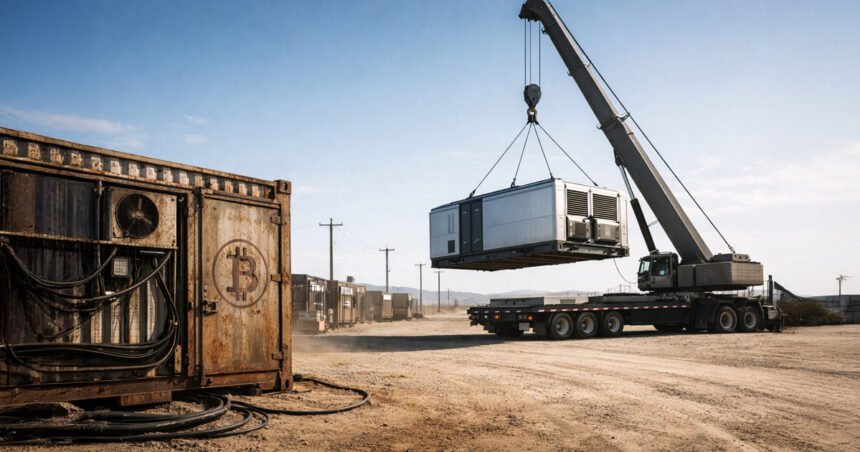
Wall Street is pouring billions of dollars into public Bitcoin mining companies, but this investment thesis has little to do with the future of the emerging industry.
Instead, financial institutions are treating these crypto companies as critical power and permissions infrastructure, a scarce asset in an artificial intelligence boom that is increasingly constrained by a severe lack of available power rather than a lack of advanced semiconductors.
Over the past few months, a series of large financing and leasing transactions have accelerated structural changes across the sector.
Investors and megabank lenders are touting simple arbitrage. Many large-scale Bitcoin miners already manage coveted power grid interconnections, large tracts of land, and operational teams capable of sustaining industrial power loads.
By retrofitting these sites with high-performance computing, miners can trade wild fluctuations in crypto block rewards for multi-year contractable cash flows that traditional lenders can actually underwrite.
This dramatic reappraisal is seen in trading terms that reflect mainstream digital infrastructure financing rather than crypto speculation.
For example, Core Scientific recently closed on the first round of a $500 million 364-day financing facility from Morgan Stanley, with the potential to expand the deal to $1 billion. Lotteries are explicitly allocated to data center development, real estate acquisition, and energy procurement.
Why AI companies seek Bitcoin miners
The macro context driving this convergence is clear. U.S. data center power usage is increasing at a historic pace, but the national power grid is fundamentally unprepared for such sudden bursts of load.
The latest scenario from the Electric Power Research Institute (EPRI) estimates that U.S. data centers will consume up to 192 terawatt-hours in 2024. According to projections, consumption could soar to nearly 790 terawatt-hours by 2030, and data centers’ share of total U.S. electricity generation could rise to 17%.
This wave of demand is colliding with the glacial realities of transmission expansion and utility interconnection queues.
A recent report from Bloom Energy found that the gap between what regional utilities think is possible and what hyperscalers expect is widening, with utilities projecting approximately 1.5 to 2 years longer time to generation than developers expected.
In this severely bottlenecked environment, the competitive edge is no longer in acquiring land or ordering servers. It’s about having the ability to instantly energize.
Basically, Bitcoin miners sitting on fully authorized, grid-connected sites offer exactly this scarcity.
The halving pressure that drove miners to AI
The rush toward AI is not simply opportunistic. It is also a survival strategy by Bitcoin miners.
The economics of Bitcoin mining have deteriorated significantly since the block subsidy was reduced during the April 2024 halving.

The pain is compounded by the steady rise in global network hashrate and relentlessly increasing competition for shrinking rewards.
According to CryptoQuant, the average cash cost to produce one Bitcoin among publicly traded miners exceeded $70,000 in the fourth quarter of 2025. Total production costs can be significantly higher when non-cash items such as depreciation and stock compensation are taken into account.

These margin pressures are especially painful given Bitcoin’s recent price performance. The asset has fallen about 40% from its all-time high of $126,000 in October, softening to about $71,194 at the time of writing.
When hash prices are compressed, as we have seen recently, BTC miners become very sensitive to electricity prices.
They cannot control the difficulty of the network or the price of Bitcoin, but they can control the tenant base.
Therefore, AI computing offers an alternative where revenue is tied to creditworthy customers, guaranteed uptime, and fixed lease terms.

Retrofit reality check
However, the prevailing market view largely masks the brutal execution risks.
Graphics processing units and application-specific integrated circuits both require large amounts of power, but the similarities end there.
Migrating your Bitcoin mine to an AI data center is not a simple hardware replacement.
Traditional crypto mines are often little more than metal sheds or modified shipping containers with basic evaporative cooling and consumer-grade internet connectivity.
If necessary, the grid can power down crypto mines in seconds with minimal financial penalties.
Conversely, Tier-3 AI data centers require pristine weatherproof construction, direct-to-chip liquid cooling systems, highly redundant dark fiber networks, and extensive backup power generation to guarantee 99.999% uptime.

The capital expenditure required to close this infrastructure gap is significant. Theoretical megawatt capacity is worthless to AI developers if miners cannot secure the hundreds of millions in capital investment needed to fund the capital portion of the retrofit.
To bridge this huge capital investment gap, the industry is relying on a new financing mechanism: the hyperscaler backstop.
When miners sign leases with AI infrastructure providers, tech giants like Google can guarantee the underlying payments. Notably, the search engine giant is backing approximately $5 billion worth of these deals.
This guarantee effectively transforms a shaky mining company into a creditworthy landlord, enabling project financing with loan-to-cost ratios of up to 85%.
These proposed transactions would allow AI buyers to secure power infrastructure without having to wait up to seven years to build new substations.
As a result, several publicly traded miners have announced transformations to AI, including Bitfarms, TeraWulf, CleanSpark, and Hut 8. CoinShares estimates that these companies announced more than $43 billion in AI and high-performance computing deals in the past year.

Is this a durable model or a crowded deal?
The ultimate question for Wall Street is whether this becomes a durable business model or a disastrously crowded trade.
If power shortages continue, miners that have perfected renovations and secured good tenants will be able to successfully transition into infrastructure operators.
However, this pivot creates an evaluation identity crisis. The stock market currently values Bitcoin miners similar to high-beta technology stocks, but if these companies successfully transition to predictable landlords who collect fixed rents for their data centers, that multiple is likely to compress to match traditional real estate investment trusts and local utilities.
Furthermore, if AI demand slows, miners that have taken on large amounts of debt to fund expensive transformations could face devastating refinancing pressures.
NextEra Energy’s projection that 15 to 30 gigawatts of power generation capacity will need to be added by 2035 to support data centers highlights that this change is much bigger than the cryptocurrency industry.
Fundamentally, Bitcoin miners were never intended to be the central players in traditional grid planning.
But in an economy now defined by megawatts and artificial intelligence, they’re getting there anyway, and traditional finance is fully willing to foot the bill.
(Tag Translation) Bitcoin


