


Bitcoin falls on President Trump’s truth Social threat turns ceasefire text into new escalation
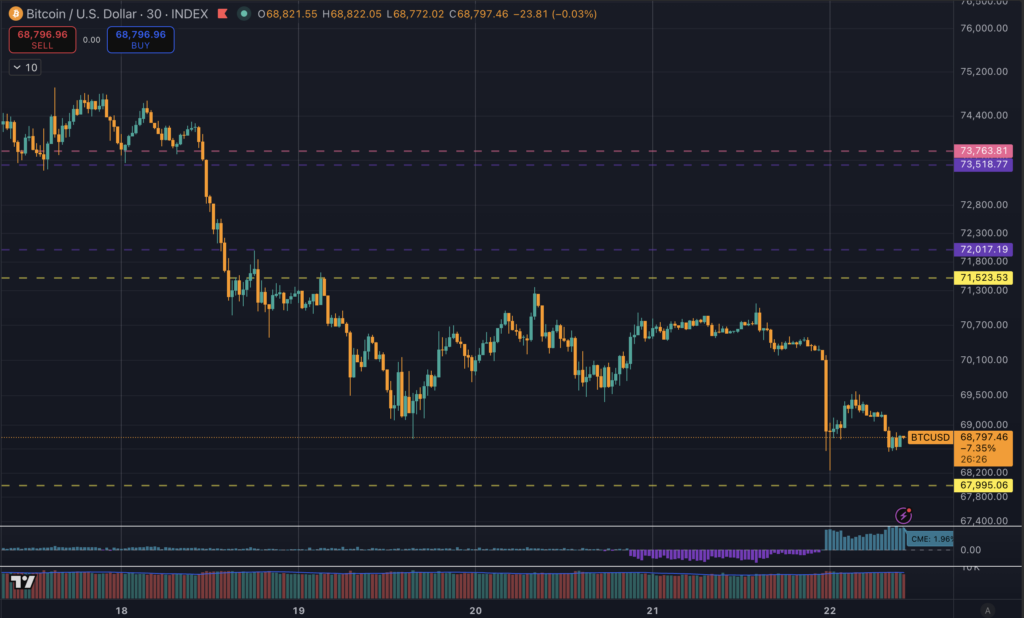
Bitcoin plummeted 2.8% overnight after President Donald Trump made a truth social post threatening to “destroy” an Iranian power plant if the Strait of Hormuz did not reopen within 48 hours.
The decline continued from approximately $70,400 to $68,200 before a partial rebound towards $69,500. At the time of this writing, Bitcoin had softened again to around $68,700. Sequences refer to individual triggers. This was a rapid re-pricing in line with geopolitical developments, widening the escalation path just as the market was beginning to price in a less positive trajectory.
The question at hand is whether this move was a temporary air pocket or a more meaningful change in market structure. This difference carries weight because Bitcoin was not trading like a collapse market.
Over the past two weeks, Bitcoin has shown a pattern of small drawdowns in response to large-scale war-related developments, with Bitcoin outperforming most major assets by last week after an initial sell-off at the start of the conflict. Barron’s also noted that capital flows are beginning to flow into cryptocurrencies as a hedge against Iran-related geopolitical risks.
That’s why President Trump’s posts stand out. The initial panic hit the market, which was already building a recovery case based on the idea that it had been absorbed.
A useful question is whether the post interrupted a recovery structure that is still in effect, or whether it reminded the market that the recovery has not yet been accepted beyond a significant range.
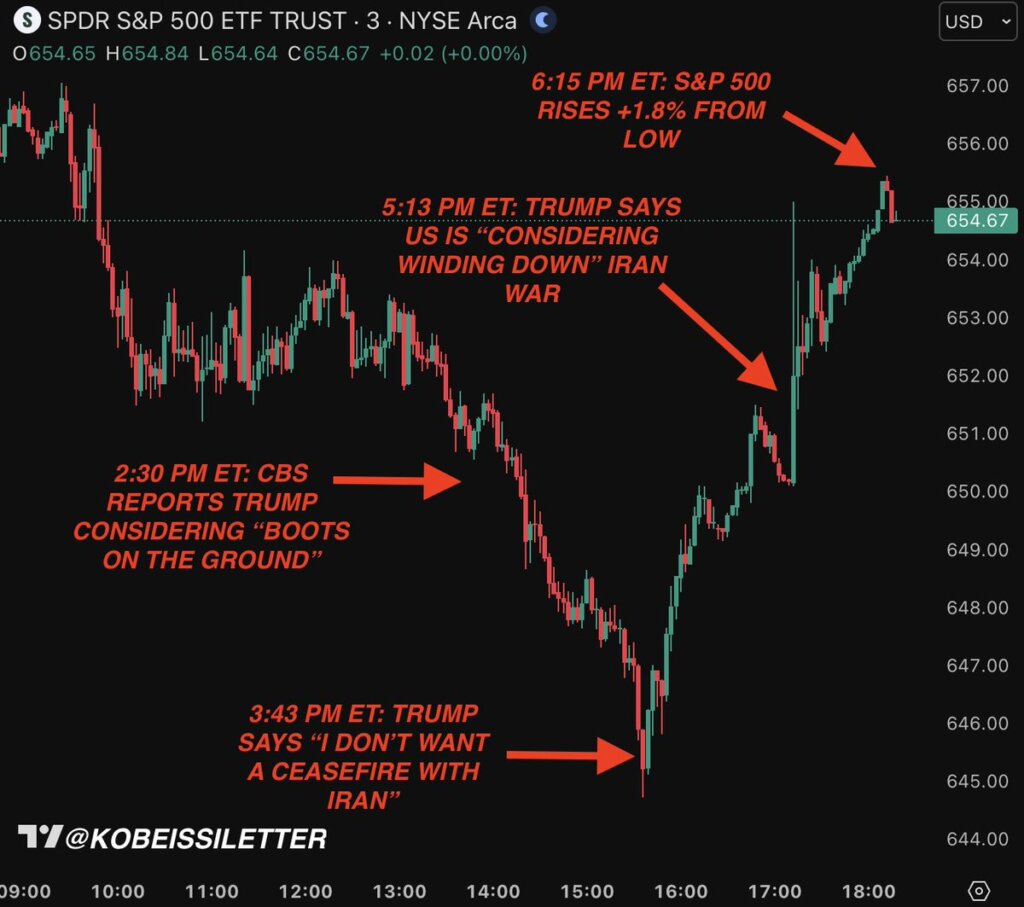
Also, the order around the posts puts extra forces on them. Less than 24 hours later, President Trump was discussing the possibility of ending the war. It did not amount to a ceasefire, and there was little reason for markets to treat it as such.
It still narrowed the expected path of short-term escalation. Overnight, that signal was abruptly reversed with a reversion to the 48-hour ultimatum and threats aimed at Iran’s power infrastructure.
The administration had signaled detente even as it moved toward tougher rhetoric and broader threats. Markets do not require formal policy changes to react to this type of reversal.
Although in the background here, the broader oil and interest rate context remains relevant. Weeks of reports have already covered Hormuz, oil, inflation sensitivity and the ripple effects on broader risk assets. It was the trigger that changed overnight.
The post introduced a more extreme rhetorical stance, pointing to private energy infrastructure and undermining the calmer tone of the previous day. From a market perspective, that was new information. This changed the distribution of possible next moves, and Bitcoin immediately repriced that distribution.
Bitcoin is especially useful in moments like this, as it trades continuously and reacts before other major markets fully reset. In the early stages of the Iran war, Bitcoin was the first to be sold off as it was the only large liquidity market open as the conflict escalated.
As a result, it functions less as a safe haven and more as a high-speed transmission line. Assets often price the shock first and then spend the next session demonstrating whether the initial reaction is fatigue, an overreaction, or the beginning of a deeper reprice.
So, what does that structure show now? Bitcoin continued to consolidate in a wide range between $62,800 and $72,600, with repeated failures above $70,000 and negative return skew prevalent until a definitive hold was established above that level.
Glassnode places a broad market between its realized price of approximately $54,400 and its true market average value of approximately $78,400. Simply put, Bitcoin repaired a significant portion of the damage from the panic, but still fell short of a clean breakout. This limitation still shapes the reading of the latest movements.
This makes post-trigger drops easier to interpret. The drop from $70,400 to $68,200 is significant because it puts Bitcoin below the level it still needs to be accepted. In that sense, the market has not lost a solid breakout. I lost one test. This difference is substantial.
Breakout failure has broader structural consequences. A failed test is one rung lower on the ladder, but it’s still a warning. The data suggests that this move belongs to the second category unless follow-through selling begins to damage the lower end of the range.
The second layer is market composition. While Bitcoin’s dominance remains close to 58%, institutional investor positioning remains concentrated in large-cap stocks. We also found that open interest in options exceeded that in perpetual futures, with traders placing greater emphasis on protection structures following previous deleveraging.
This helps explain why the movement was still violent without becoming anarchy. Even in markets that are more heavily hedged, geopolitical shocks can lead to stronger selling. What changes is the shape of the follow-through. Reactions become more surgical and less indiscriminate.
At the same time, there is little reason to be complacent. The bear case here is simpler than the bull case.
If President Trump’s post proves to be the first step in a new escalation sequence rather than a one-off threat, then no grand macro theory will be needed for Bitcoin to fall. All that is required is for the market to decide that it has become difficult to handicap the dispute path.
The asset would then maintain its familiar role as a liquid shock absorber, pricing in geopolitical uncertainty before traditional markets fully reopen or rebalance.
The base case is more restrained. We assume that the market has already repriced the post itself, but has not yet confirmed a larger structural failure. Under that framework, the intraday low is not the only threshold that matters.
After the escalation of Truth Social pushed Bitcoin away from the $70,000 area, it will be important to see if it regains acceptance. If that’s possible, this move starts to look like a violent but temporary veto caused by the weekend’s geopolitical trends.
Failing that, attention returns to the lower half of Glassnode’s war range and the unresolved question of whether there was a real sponsor behind the recovery.
An escape hatch to the top requires two conditions. First, we need to cool down the rhetoric, or at least stop it from getting worse. Second, Bitcoin needs to turn the recovery into acceptance rather than another short visit to the upper bands. Here, the earlier stories of resilience come back into focus.
Prior to this post, the market had started treating Bitcoin not as a purely speculative beta trade, but as an asset that could stabilize after an initial geopolitical blow. That prediction was shattered by this move. It hasn’t been erased by that.
The broader lesson is straightforward. Trump’s “Truth” social posts triggered an active market. It usurped the market that had begun to normalize the conflict and forced new avenues of escalation to be priced immediately and at scale.
That’s why the 2.8% drop is noteworthy. This move does not prove that Bitcoin is weak. The debate over the role of safe havens is also unresolved.
This indicates that a sudden reversal in rhetoric from the White House could send Bitcoin out of its fragile recovery position within minutes.
While Bitcoin is not structurally broken, it is still not up to the standards needed to ignore this type of geopolitical shock. This post clearly exposed its limitations. The market was repairing the damage. It did not secure acceptance.
So one test remains before the other: whether Bitcoin can regain the upper end of its range after a highly publicized escalation shock, or whether this latest development will be remembered as an event that puts any recovery attempt back into a real test of credibility.
(Tag Translation) Bitcoin


