


Bitcoin Network economist Timothy Peterson says it could rise to $122,000 within the next 10 months. He bases his predictions on historical monthly performance data dating back to 2011.
peterson share His analysis of Social Platform X points out that Bitcoin has finished 12 of the past 24 months in positive territory. Historically, this ratio corresponds to an 88% chance that the price of Bitcoin will be higher after 10 months. Based on that statistical framework, he estimates the average return from current levels to be 82%, implying a price per coin near $122,000.
What the data actually shows
This model measures the frequency of positive months rather than the magnitude of the profit. That distinction is important. Bitcoin could trade sideways or post a slight uptick, and the indicators would still remain statistically favorable.
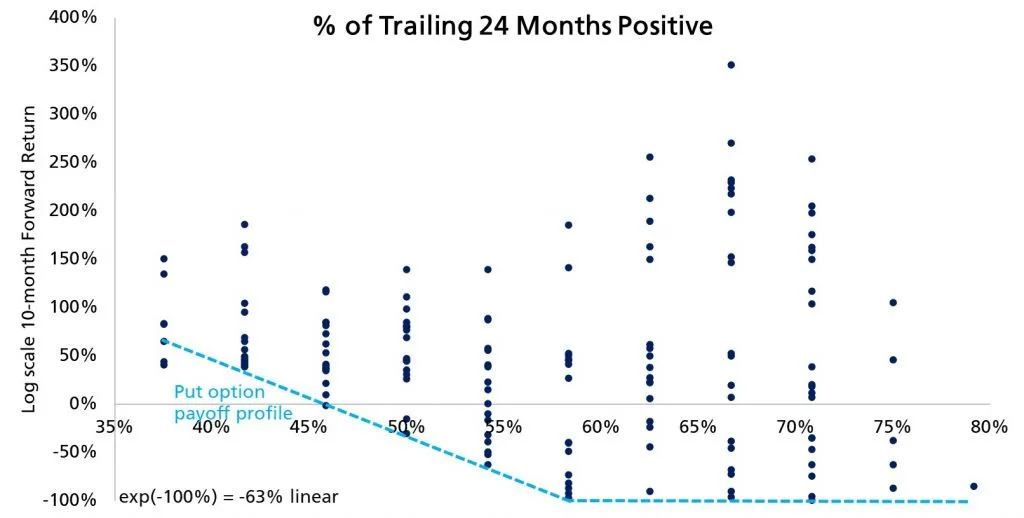
Peterson describes the tool as an “unofficial” reversal indicator rather than an accurate prediction mechanism. This indicates when the odds are tilted in favor of a price increase, but it does not define the speed, volatility, or magnitude of the move.
At the same time, broader sentiment research shows that the market mood is largely cautious. Discrepancies between statistical probabilities and trader sentiment often appear during transitional periods of cryptocurrency cycles.
Despite skepticism, bulls remain confident
Despite recent consolidation, several key institutions maintain a constructive outlook. Bernstein analysts have previously described the current pullback as one of the milder bearish phases in Bitcoin’s history. Maintain goal of $150,000 by 2026.
Meanwhile, Wells Fargo analysts expect significant capital inflows into Bitcoin and equities in the short term due to seasonal liquidity factors and risk appetite trends.
Is this model too simple for today’s market?
Critics argue that Bitcoin’s structure has changed significantly since 2011. Early cycles were dominated by retailer participation. Institutional flows, spot ETFs, and macroeconomic capital rotation are now playing a larger role in price discovery.
From a probabilistic perspective, Peterson’s framework resembles the mathematics of a coin toss. If an event has historically had a 50% chance of occurring in a single trial, the probability of at least one positive outcome over multiple time periods increases significantly. The math may be right, but financial markets evolve.
Bitcoin in 2025 will operate in a different liquidity regime than it did 10 years ago. The key question facing investors now is whether the 88% historical signal will remain equally strong in the institutional era.
For now, the data suggests the odds are tilted to the upside. Whether prices rise towards $122,000 will depend not only on past history, but also on how today’s capital flows react in the coming months.


