


Wall Street has spent months debating when the Federal Reserve will cut interest rates. Traders are now considering whether the next move could be a rate hike.
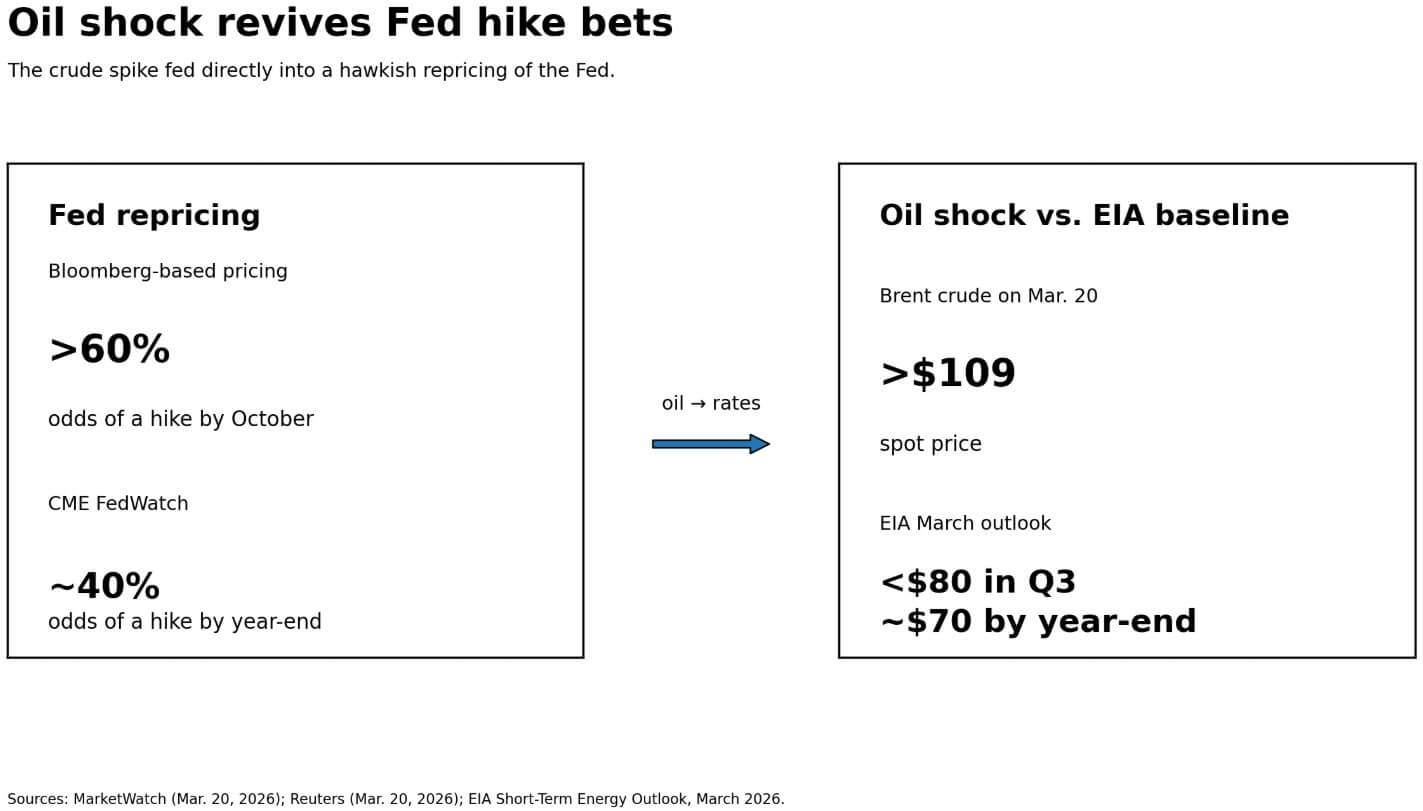
Two days after the Fed’s March 18 decision to keep its target range unchanged at 3.50% to 3.75%, markets moved in the opposite direction. Bloomberg-based pricing had a more than 60% chance of a rate hike by October, and factored in about 15 basis points of tightening by then. CME FedWatch projects the probability of a year-end rate hike to be close to 40%.
The probability of a rate cut next month fell from 17% in February to 0% in April, while the probability of a rate hike rose to 6%.
Both indicators point in the same direction, despite a spread that reflects real disagreements about timing and confidence. Hiking gambling is back after months of hiatus.
The accelerator is oil. Brent crude has soared above $109, hitting $98 for U.S. crude on March 20, as expansion in the Middle East raises concerns about disruption in the Strait of Hormuz, a key hub that handles nearly 20% of the world’s oil supplies.
EIA’s March baseline still assumes Brent prices will fall below $80 by the third quarter and end the year near $70 if the disruption eases. The market now believes that assumption is too optimistic, and that bet is flowing directly into interest rate expectations.
The 10-year U.S. Treasury rose to about 4.37%, the 30-year reached its highest level since September, and the S&P 500 is headed for its fourth consecutive week of declines.
Global equity funds shed $20.3 billion in the week ending March 18, including $24.78 billion in U.S. stock funds alone, while money market funds absorbed $32.57 billion globally.
Cash, which yields nearly 4%, is extracting capital from risky assets in real time.
The contradiction that Bitcoin cannot escape
Bitcoin remained just below $70,000 on March 20th, falling along with QQQ (-1.75%) and GLD (-1.93%).
In the same session that reassessed the Fed’s policy as hawkish, gold also fell, despite a geopolitical backdrop that should support hedging any hard assets.
Gold fell 1.8% as yields and the dollar rose. If standard inflation and war hedging failed to take hold, it’s clear why. Tight financial conditions have caused gold and Bitcoin to fall in tandem, overwhelming safe havens that would otherwise be supported by geopolitical conditions.
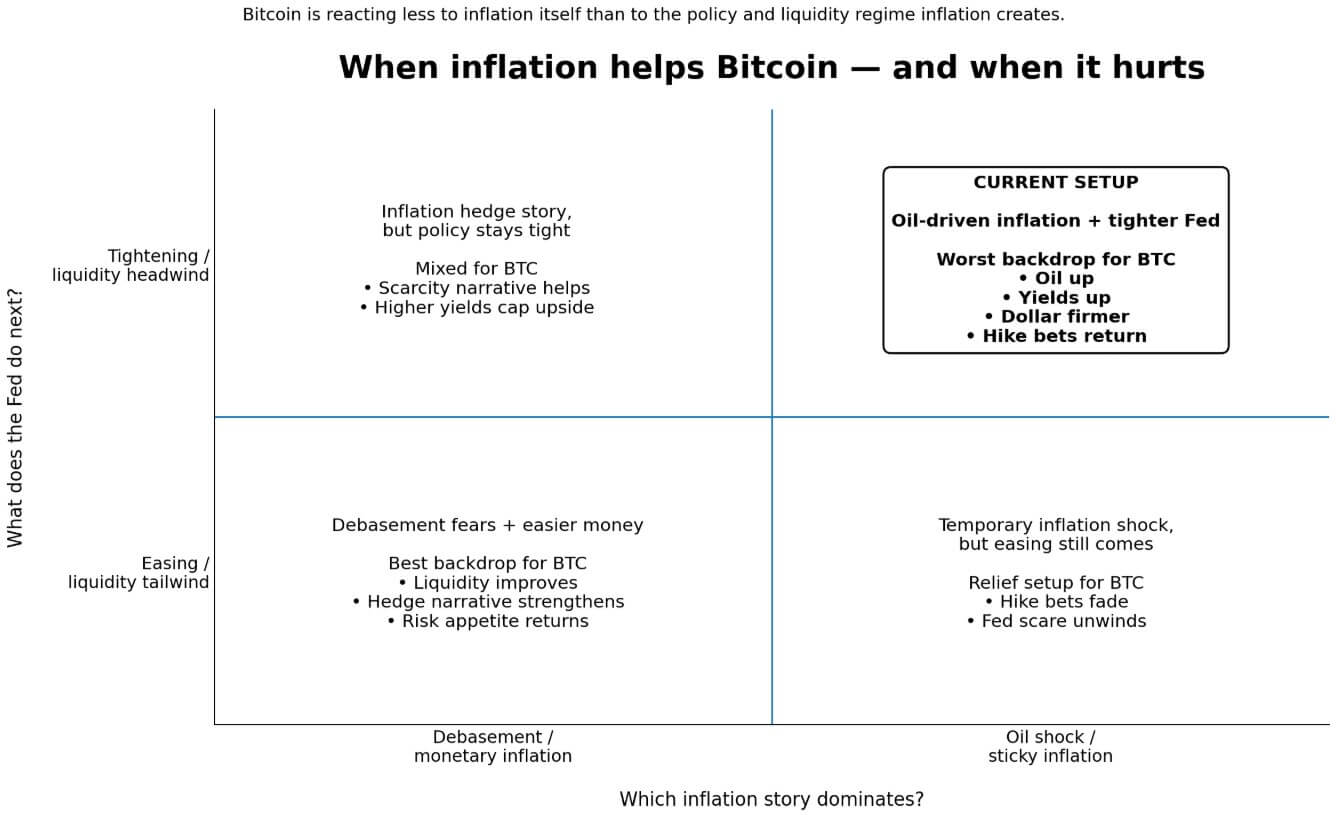
Bitcoin’s inflation hedge pitch faces the same contradiction, as it works when inflation points move toward concerns of falling land prices and easy money ahead. It’s in trouble when inflation is rising, oil is rising, yields are rising, the dollar is firming, and the Fed can’t ease.
Fed Chairman Jerome Powell said at the end of its March meeting that the central bank was watching closely to see whether higher fuel and input costs would spill over into core PCE inflation.
If core inflation exceeds Bank of America’s credible rate hike case threshold of 3.2%, unemployment remains near 4.5%, and oil prices are in the $80 to $100 range, the Fed will face a situation where inflation is strong enough to maintain tight policy.
However, economic growth has not yet weakened enough to force emergency cuts. A mild, non-recession inflationary corridor could be the most hostile macro environment for Bitcoin.
An IMF working paper found that a single cryptocurrency factor explains 80% of the variation in cryptocurrency prices, and that Fed tightening reduces that factor through the risk-taking channel.
Moreover, as more professional capital enters cryptocurrencies, the correlation between Bitcoin and stocks has increased. BIS explained the recent decline in cryptocurrencies, with Bitcoin falling about 50% from its 2025 high amid a sell-off in tech stocks and a widespread exodus from growth assets.
Spot US Bitcoin ETF flows have already shown a shift, going from inflows of $199.4 million on March 17 to total outflows of $253.7 million on March 18 and 19, according to data from Pharcyde Investors.
Bitcoin trades based on which part of the inflation scenario prevails, meaning whether rising prices give the Fed room to ease monetary policy or force it to tighten.
At the moment, the tightening position is firmly in place due to tighter conditions, higher discount rates on speculative assets, and more competitive cash.
Two paths forward
The bullish case is based on holding the EIA baseline. Unless oil prices return sooner than feared, the labor market softens in the April 3rd jobs report, and the February PCE report on April 9th shows no second-round effect seeping through to the core, the chances of a rate hike could fall as quickly as they rose.
One-year inflation swaps hit 3% this week, while five-year forward swaps fell to 2.35%, the lowest in nearly a year. This move suggests that the market still views this as a temporary energy disruption rather than a regime reset.
If that path materializes, Bitcoin will regain its liquidity tailwind. Citi’s 12-month framework sets a base case target of $112,000 and a bull case target of $165,000 under a scenario in which the Fed resumes easing.
| scenario | macro trigger | What are the Fed’s expectations? | What that probably means for Bitcoin |
|---|---|---|---|
| bull case | Oil prices will rebound sooner than feared. The employment statistics on April 3 show a softening of the labor force. February PCE on April 9 shows no secondary effects spreading to the core. | Chances of a rate hike are diminishing. Markets return to lower prices, or at least less hawkish Fed policy | BTC regains liquidity tailwind and can trade more with easing expectations rather than rising fears |
| bear case | oil stays inside $80 – $100 Range until summer. Core PCE exceeds 3.2%;unemployment is around the corner 4.5% | Hiking bets solidify into long-term durable deals | BTC trades as a more duration-oriented risk asset, with tight financial conditions and increased competition for cash weighing on the price. |
| What to watch next | April 3rd: employment report. April 9th: PCE; April 28th-29th: FOMC | Soft data will dampen the rate hike narrative. Sticky inflation and strong labor will strengthen it. | These releases will determine whether Bitcoin’s inflation hedging story regains momentum or whether liquidity headwinds deepen further. |
In the bear case, all that is required is that the EIA be wrong. If oil prices remain in the $80-$100 range through the summer, core PCE rises above 3.2%, and the April 28-29 FOMC meeting issues a statement quietly validating rather than pushing back on the market’s hawkish repricing, bets on rate hikes will solidify into a durable positioning move.
Assets in money markets have already reached a record high of nearly $8 trillion, and the flows that moved into cash this week will not automatically return. Under that scenario, Bitcoin’s bear market during Citi’s recession would set the price at $58,000, and Bitcoin would trade as a duration-heavy risk asset as long as the interest rate cap remained in place.
global frame
Brokers now believe the ECB and Bank of England could raise interest rates as early as April, with traders pricing in 72 basis points and 78 basis points of tightening, respectively, through 2026.
The Hormuz chokepoint also handles about 20% of the world’s LNG trade. If the disruption continues, energy costs will rise simultaneously across Europe and Asia, squeezing the room for major central banks to ease.
The correlation between Bitcoin and global risk appetite, already deepened by the participation of financial institutions, means that tightening impulses can come from multiple directions simultaneously within the same macro regime that drove the cryptocurrency higher.
Long-term inflation expectations have not yet erupted, and their suppression is the only thing separating current repricing from a full-blown stagflation deal.
Nevertheless, suppressed long-term expectations do not invalidate short-term policy calculations.
The Fed’s own dot plot leaves room for a new hawkish stance. Participants’ fair interest rate range for 2026 is 2.6% to 3.6%, with the dispersion at the upper end wide enough to absorb one or two upward inflation surprises before median expectations shift.
Bitcoin now faces a key test to determine whether it trades as an inflation hedge or a focused bet on global liquidity.
(Tag Translation) Bitcoin


