


Coinbase is accelerating its global cryptocurrency push, expanding its vision for Everything Exchange as decentralized trading within the Coinbase app opens up to users in 84 countries and access to millions of on-chain tokens beyond the list of traditional exchanges.
Coinbase takes its “Everything Exchange” vision to the world
Coinbase CEO Brian Armstrong shared on social media platform X on March 6 that the company’s vision to build an “Everything Exchange” is expanding globally as decentralized exchange (DEX) trading becomes available to users in dozens of new markets.
“Everything Exchange is going global,” Armstrong said. “Cryptocurrency creates economic freedom.” This statement followed a Coinbase post on X highlighting that DEX trading within the Coinbase app is now accessible in 84 countries.
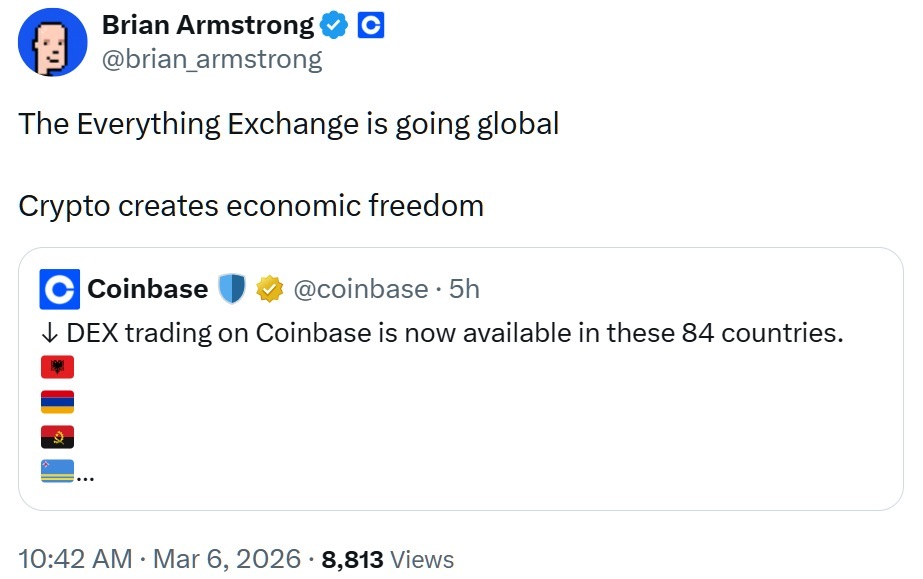
The 84 markets supported are Albania, Armenia, Angola, Aruba, Azerbaijan, Barbados, Bangladesh, Burkina Faso, Bahrain, Benin, Bermuda, Bolivia, Bahamas, Botswana, Belize, and Congo. (Republic), Ivory Coast, Chile, Cameroon, Colombia, Costa Rica, Dominican Republic, Algeria, Ecuador, Egypt, Ethiopia, Fiji, Gabon, Ghana, Guatemala, Honduras, Indonesia, Israel, Jamaica, Jordan, Kenya, Kyrgyzstan, Cambodia, Kuwait, Cayman Islands, Saint Lucia, Sri Lanka, Morocco, Moldova, North Macedonia, Mongolia, Macau, Mauritania, Mauritius, Ludiv, Malawi, Mexico, Malaysia, Mozambique, Niger, Nigeria, Nepal, Oman, Panama, Peru, Papua New Guinea, Pakistan, Paraguay, Serbia, Rwanda, Saudi Arabia, Seychelles, Senegal, Suriname, El Salvador, Togo, Thailand, Tajikistan, Tunisia, Turkiye, Trinidad and Tobago, Ukraine, Uganda, Uruguay, Uzbekistan, Vietnam, South Africa, Zambia.
This deployment extends Coinbase’s integrated on-chain trading by connecting users directly to decentralized liquidity pools through the Coinbase interface. This feature provides access to millions of tokens created at launch on the blockchain network, rather than relying solely on the approximately 300 assets listed on a centralized exchange. The system primarily runs on Coinbase’s Layer 2 network, Base, but also supports Ethereum and Solana. Users transact through an integrated self-custody wallet. This means that transactions occur peer-to-peer on the blockchain while users manage their assets.
This expansion is in line with Coinbase’s broader “Everything Exchange” strategy introduced by Armstrong at the Coinbase System Update 2025 event on December 17th, where he outlined plans to bring assets such as stocks, prediction markets, and real-world assets on-chain. This strategy further expanded in February when Coinbase rolled out commission-free trading of U.S. stocks and ETFs to eligible users through a partnership with Apex Fintech Solutions, allowing them to manage stocks and cryptocurrencies within the same account. Coinbase has also integrated equity research and trading through a partnership with Yahoo Finance. The company has indicated a long-term goal of eventually tokenizing its shares, which could enable continued global trading and allow stock holdings to interact with decentralized finance applications.
FAQ 🧭
- Why is Coinbase expanding decentralized trading to more countries?
Coinbase aims to expand its Everything Exchange strategy globally by directly connecting users to on-chain liquidity and a wide range of crypto assets. - What does Coinbase’s Everything Exchange strategy mean for investors?
This strategy aims to combine cryptocurrencies, stocks, ETFs, and tokenized assets on one platform, potentially expanding trading opportunities. - How does Coinbase enable decentralized trading within the app?
This feature routes transactions through a decentralized liquidity pool while users hold assets in their self-custody wallets. - Why are tokenized stocks important to global markets?
Tokenization enables continuous trading of stocks around the world and allows interaction with decentralized financial systems.


