

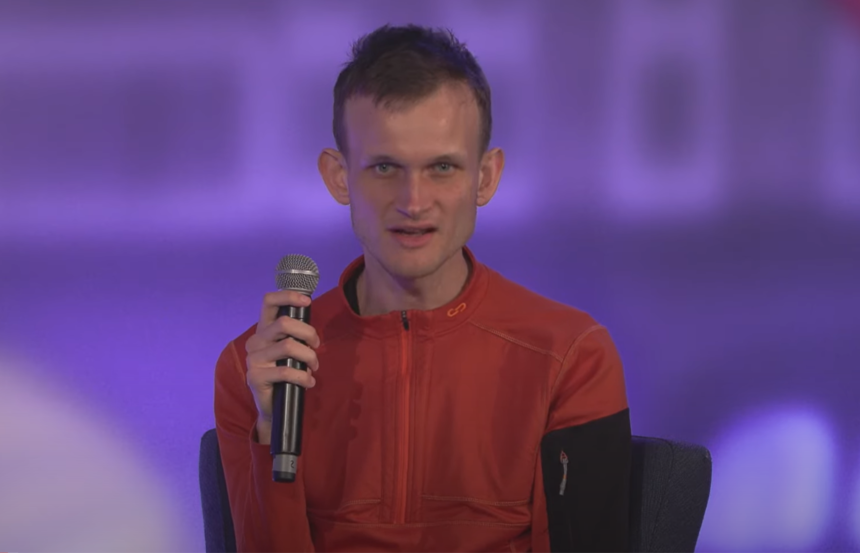

Vitalik Buterin suggests a significant reconfiguration of Ethereum’s Layer 2 story. It’s not the death of rollups, but the end of the idea that L2 is a shard whose primary role is to scale the network. With L1 tariffs currently low and gas limits expected to rise sharply in 2026, he argues that the original assumptions of the roll-up-centric roadmap no longer fit the reality on the ground.
Buterin opened his X-Post on February 3, pointing to two parallel pressures. L2 is moving into “Stage 2” much more slowly than expected, and Ethereum’s mainnet is expanding on its own. He says these trends challenge old mental models in both directions.
“Ethereum needs to scale,” he wrote, summarizing what he had framed as his initial theory. “The definition of ‘scaling Ethereum’ is the existence of a large amount of block space backed by the full trust and confidence of Ethereum… In block space, when you do something within that block space (including ETH), that activity is guaranteed to be valid, uncensored, unreverted, and untouched for as long as Ethereum itself functions. 10000 where the connection to L1 is mediated by a multisig bridge Creating an EVM for TPS does not scale Ethereum.
The punchline is straightforward: “This vision no longer makes sense.” Buterin said L1 doesn’t need L2 to act as a “branded shard” if base layer capacity is growing, and many are increasingly skeptical that L2 can or wants to meet the security and control expectations that the label implies. He cited technical concerns about the safety of ZK-EVM, as well as customer-driven regulatory requirements that “demand ultimate control,” and pointed to at least one L2 that, in his words, “may never want to go beyond Stage 1.”
The need for changes to Ethereum Layer 2
It is presented not as an accusation but as a change in classification. Buterin suggested that if L2 retains ultimate control, it may still be a viable product for users, but it should not be sold as “scaling Ethereum” in the strict sense envisioned by its rollup-centric roadmap. In that context, he argues, “We should stop thinking of L2 as literally a ‘branded shard’ with associated social status and responsibilities.”
Instead, he sketches a spectral model. Some L2s are strictly backed by ETH’s security guarantees, while others can be more relaxed and optional depending on the user’s needs. This spectral framing implicitly allows space for app-specific chains, different trust models, and non-EVM environments without forcing them into a single “roll up as shards” storyline.
For L2 teams, Buterin’s guidance is straightforward. Don’t pin your identity solely on scaling. If you are dealing with ETH or Ethereum issued assets, he argues that “minimum Stage 1” is important. Otherwise, it will effectively act as “just a separate L1 with a bridge.” In his view, the real differentiators should be features and characteristics that large-scale L1s cannot yet offer, such as specialized execution environments, privacy, sequence characteristics such as ultra-low latency, or non-financial use cases.
Buterin said he has become “more convinced of the value of native rollup precompilation,” especially since Ethereum introduced ZK-EVM proof verification, because “we need to extend L1 anyway.” The idea is a protocol-level precompilation that verifies ZK-EVM proofs and is treated as part of Ethereum itself. This means that it will “auto-upgrade along with Ethereum,” and if it ships with a bug, it means that “Ethereum will hard fork to fix the bug.”
This last point is the subtext. He would like to see a path where trustless validation and interoperability can be easily achieved without a “security council” and where custom functionality can be added in rollups while pinning EVM correctness directly to Ethereum. He also mentioned ongoing research on tying this direction with the prospect of synchronous composability, transactions that can safely straddle L1 and L2 liquidity in a tightly coupled manner, combining pre-checks with base rollups and real-time proofs.
Buterin’s conclusions leave room for unpleasant consequences. A permissionless ecosystem would create a chain with “trust dependencies, backdoors, and other insecure” elements that are “inevitable,” he wrote. The job, as he frames it, is to provide readable guarantees to users while strengthening Ethereum’s base layer, suggesting that the next stage of the L2 race may not be about who will “scale Ethereum,” but who can reliably define and prove what they are actually offering.
At the time of writing, ETH was trading at $2,256.
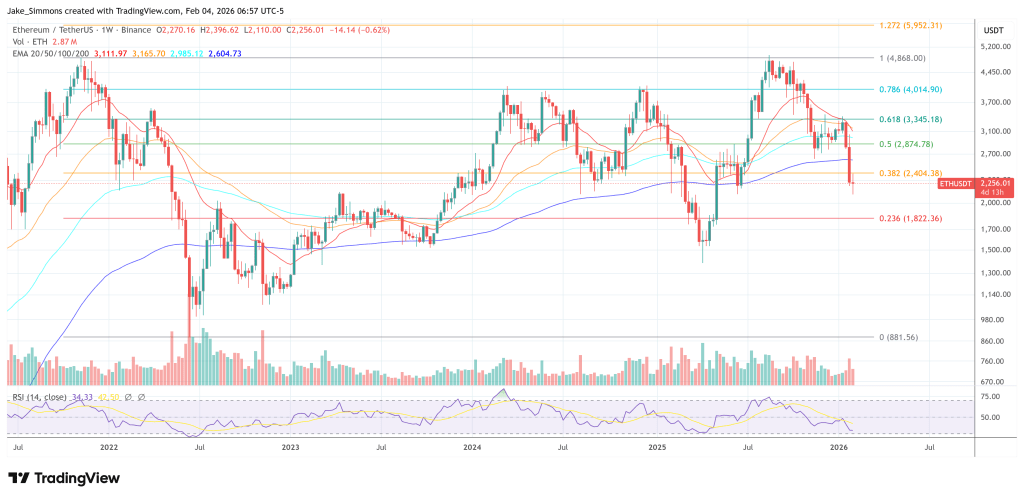
Featured image from YouTube, chart from TradingView.com
editing process for is focused on providing thoroughly researched, accurate, and unbiased content. We adhere to strict sourcing standards, and each page is carefully reviewed by our team of top technology experts and experienced editors. This process ensures the integrity, relevance, and value of your content to your readers.


