


The White House says 2026 tax refunds will be the “largest on record,” but analysts say the projections are tied to retroactive tax cuts and withholding habits that could leave millions of people with larger checks.
White House says record tax refunds expected in 2026
The Trump administration says the 2026 tax refund is on track to be the largest in U.S. history, pointing to retroactive tax cuts, unchanged 2025 withholding rules, and the timing of the legislation that resulted in widespread overpayments for virtually the entire year.
This prediction is based on several analyzes related to the One Big Beautiful Bill Act (OBBBA) passed in July 2025. Because the IRS did not update the withholding schedules mid-year, most workers continued to pay taxes under pre-OBBBA rules, only to discover in 2026 that they had overpaid by a significant margin.
The White House and the U.S. House Ways and Means Committee have cited early estimates showing average refunds would increase by about $1,000, potentially increasing total refunds nationwide by as much as $91 billion. The report also notes that $30 billion in withholding taxes will be cut going forward. This will increase take-home pay but will not affect the upcoming 2026 tax refund wave.
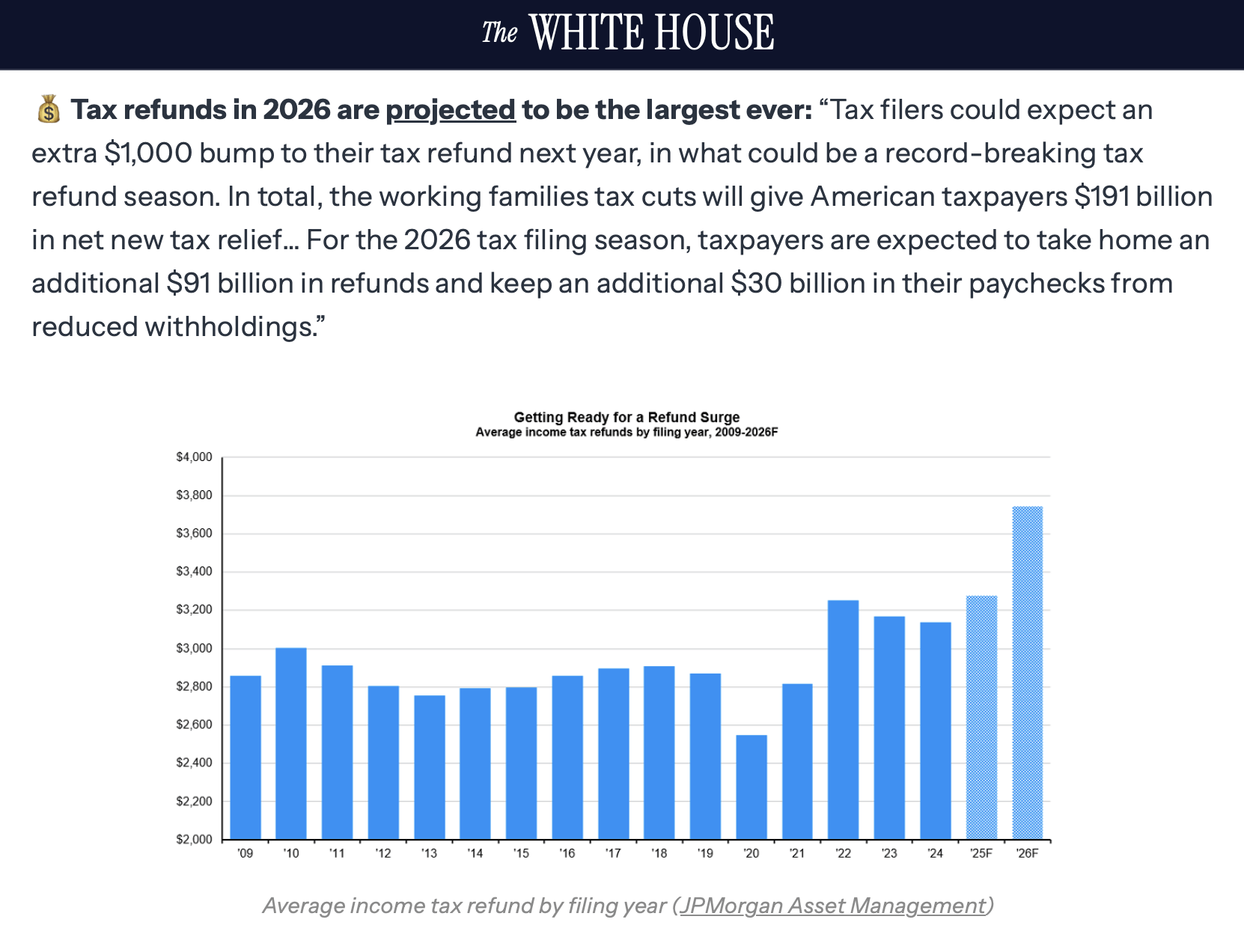
Screenshot source: White House website.
Combined with other tax credit changes, this package totals approximately $191 billion in net tax credits. While this number may sound huge, analysts emphasize that the impact varies widely depending on income, deductions, and filing status. Several OBBBA provisions will cause an expected spike in refunds. Tips and overtime pay would no longer be subject to federal income tax (up to $25,000 for single filers), Social Security benefits would be tax-free for about 88% of seniors, and the state and local tax deduction limit would jump from $10,000 to $40,000.
Households will also get an expanded child tax credit, while the standard deduction and qualified business income deduction will continue under expanded rules first introduced in 2017. While the government frames these changes as relief measures for working families, the distribution model reveals a more layered picture. The news comes on the heels of Treasury Secretary Scott Bessent hinting at a “significant” tax refund in 2026 and President Trump’s statements about Americans receiving checks.
Middle-income and upper-middle income households (approximately $60,000 to $400,000 per year) stand to benefit the most. High-income earners may receive up to 60% of their benefits, but the increases are small for many low-income households, which generally take the standard deduction. Abolition at the stage of income exceeding $500,000 will limit the impact on high-income earners.
read more: Grayscale moves towards first Zcash ETF with SEC filing
Historically, the expected jump is significant. Data shows that average refunds over the past 10 years have ranged between $2,800 and $4,300, with total annual refunds typically between $275 billion and $330 billion. Refunds in 2026 are projected to be around $366 billion in nominal terms, enough to be called the “largest in history” before adjusting for inflation. In real terms, the margin will be even smaller, but analysts agree the total will be even higher.
Cryptocurrency proponents, on the other hand, are enthusiastic about this prediction. Many argue that the early 2026 liquidity wave is exactly the kind of spark that historically drove retail investors toward Bitcoin and other digital assets, citing the stimulus-era buying frenzy of 2020 and 2021 as an example. Advocates argue that the influx of consumers could still act as a spark for a rise in broad-based risk assets, although institutional control in today’s markets may weaken that effect.
Whether refunds ultimately reach record levels will depend on economic conditions, but analysts agree that the ingredients for large refunds are already built in.
Frequently asked questions ❓
- Why is the White House predicting record tax refunds in 2026?
Retroactive tax reductions and changes to withholding schedules in 2025 have resulted in widespread overpayments. - How large can my refund be?
Analysts estimate an additional $1,000 per filer, or about $91 billion in additional refunds. - Who will benefit most from these tax changes?
Middle-income and above-moderate-income households are expected to benefit the most, according to the report. - Why are crypto advocates excited about bigger payouts?
They believe the additional liquidity could increase interest in Bitcoin and other digital assets.


