


Ethereum price has fallen below the $3,000 psychological level and control point, increasing the risk of capitulation as the bearish structure and downside liquidity objective remain in place.
summary
- Ethereum price loses $3,000 psychological support and POC.
- The bearish structure remains, with lower highs and lower lows.
- The risk of capitulation increases towards the $2,500 support zone.
Ethereum (ETH) price is facing renewed downward pressure after losing the key psychological support level of $3,000, which also coincides with the market’s Point of Control (POC). This breakdown indicates a change in market structure, as $3,000 is moving from support to resistance.
Bearish momentum remains firmly in control as price has not been able to regain this area on a closing price basis, increasing the likelihood of a deeper correction move.
Important technical points of Ethereum price
- Ethereum loses $3,000 sentiment level and POCcorroborating structural weakness.
- Market structure remains bearishthere are continuous high and low cuts.
- Downside liquidity is around $2,500the risk of a capitulation-type movement is increasing.
You may also like: Dogecoin price forms bullish reversal setup due to whale purchases and declining exchange balances
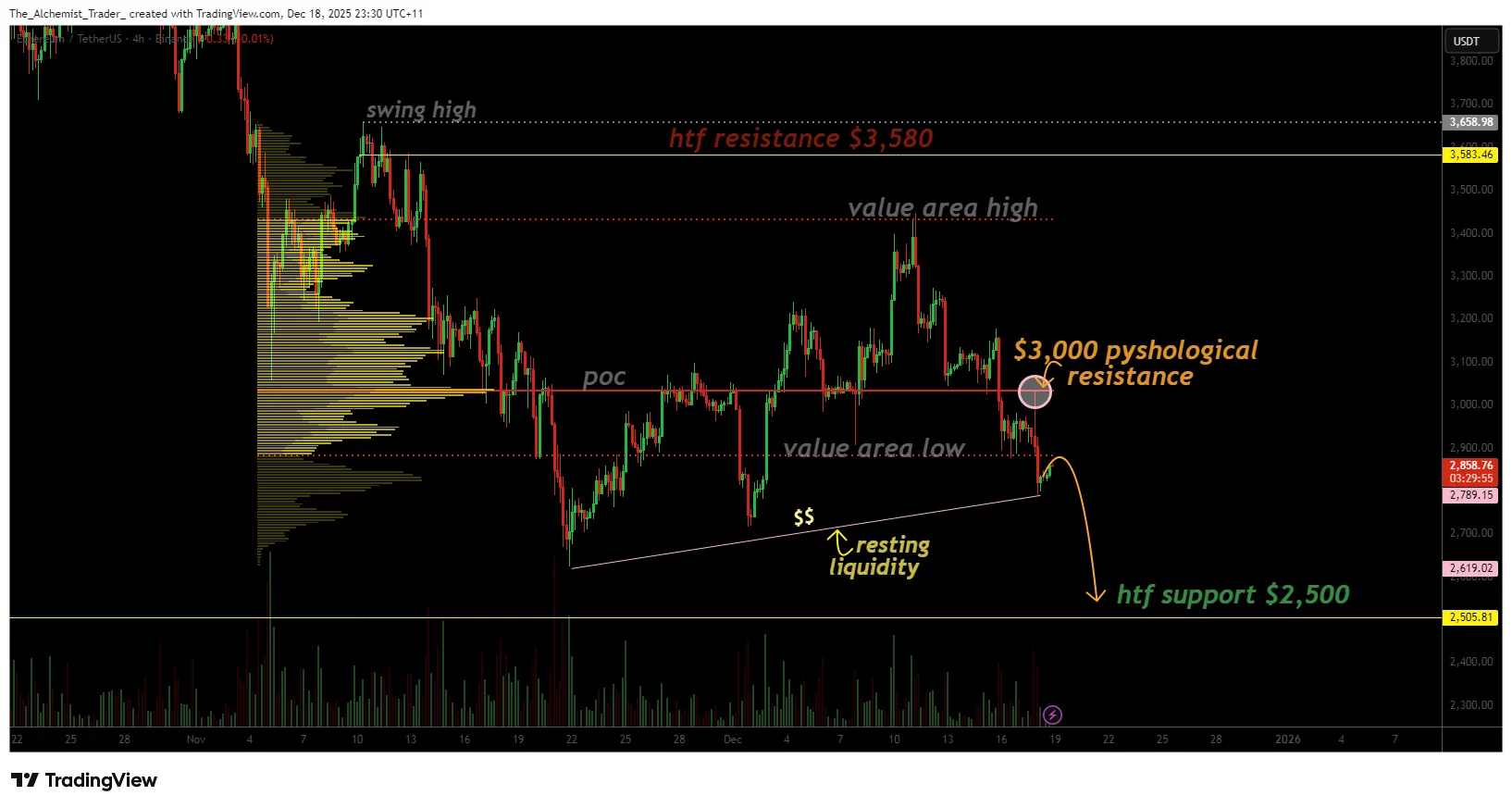
ETHUSDT (4H) chart, source: TradingView
A $3,000 loss means more than just a psychological setback for Ethereum. This level previously served as a major area of balance and had accumulated considerable trading volume. Failure on a closing price basis signals a clear shift away from equilibrium and toward a new downside search.
Since breaking below the point of control, Ethereum has attempted a small relief rally. However, these moves were almost rejected “against the dollar” and $3,000 was consolidated as a solid resistance zone. From a technical perspective, this behavior suggests that the buyer lacks the ability to take back control.
At the same time, sellers continue to aggressively defend low prices, a dynamic that increases downside risk for BMNR stock as Ethereum’s technical patterns become more concerning.
The broader market structure remains decidedly bearish. Ethereum continues to make new highs and lows, which is the classic definition of a sustained downtrend. In this context, the current lower time frame rally is best viewed as further rising lows rather than the beginning of a meaningful reversal. Such correctional bounces are common during downtrends and often precede further downsides than sustained recoveries.
One of the most important factors that increases the risk of capitulation is the presence of static liquidity below the current price level. Ever since Ethereum set lows around $2,600, liquidity has been steadily building below that area. Markets tend to seek out these liquidity pools, especially when bearish momentum is intact and structural support levels are broken.
You may also like: XRP bulls gain new momentum as DWP introduces algo trading for IRAs and retirement plans
The next major downside target is around $2,500, which is a high timeframe support area consistent with previous consolidation and structural demand. A move into this area is likely to wipe out any remaining downside liquidity, a process often associated with capitulation-style price action. Surrender typically includes an accelerated sale, forced liquidation, or emotional exit and represents the final stage of corrective action.
From a price action perspective, Ethereum’s action below $3,000 reflects acceptance rather than rejection. Rather than regaining the resistance level, the price is consolidating below the resistance level, and a continuation of the decline is statistically favored. Prolonged consolidation below break-key levels often increases the probability of a decisive decline, rather than decreasing it.
Volume dynamics further support this view. Recent downside moves have shown more participation than upside attempts, indicating that sell-side pressure remains dominant. Until Ethereum regains and surpasses $3,000 on significant volume, the bullish scenario will remain secondary.
That said, yield zones often create conditions for long-term stabilization once liquidity is completely resolved. While the immediate outlook remains bearish, traders should closely monitor how the price moves if Ethereum approaches the $2,500 area, as a strong reaction there could indicate an exhaustion of selling pressure.
What you can expect from future price changes
Downside risk remains high as long as Ethereum remains below the psychological level of $3,000 and the control point. A continued consolidation below this region increases the likelihood of a capitulation towards $2,500, where the next major support and liquidity zone is located.
read more: Bitcoin miners face new Chinese crackdown as Xinjiang shutdown cuts hashrate by 8%


