



Ethereum is trading above $2,200, pushing towards a major resistance level. Price is the deciding factor. And the supply of salable ETH continues to quietly and persistently disappear on four of the world’s largest exchanges simultaneously.
CryptoQuant analysis tracking Ethereum’s exchange reserve structure has identified developments that directly change the conditions under which current resistance tests are being conducted. ETH reserves are decreasing not on one or two platforms, but across Coinbase, Binance, Gemini, and OKX. These four major exchanges collectively represent the deepest and most liquid ETH trading infrastructure available.
This multi-venue confirmation is the analytical feature most clearly delineated in this report. Reserve declines on a single exchange may reflect a variety of platform-specific explanations, including transfers of custodial assets, institutional migration, and movement within the exchange. Platform-specific explanations lose credibility when the same direction of decline appears simultaneously in four different venues with different user bases and ownership structures. What remains is structural. ETH is moving away from the sell side of the market on a broad and calibrated basis.
The resistance of the Ethereum test above $2,200 in a market where the supply of salable ETH is shrinking across major venues is structurally different from the failed tests that preceded it. Overhead hasn’t disappeared. Overhead is thin, and thin overhead responds differently to buying pressure than deep overhead.
The numbers behind the drain are not small.
CryptoQuant data provides precise dimensions of multi-venue supply contraction. On Coinbase, between early August 2025 and April 9, 2026, Ethereum reserves decreased from 5.6 million to 3.2 million. This is a loss of 2.4 million ETH removed from America’s largest institutional trading venue in eight months. Binance saw its reserves decrease from 4.75 million ETH to 3.3 million ETH over the same period. 1.45 million ETH was withdrawn from the exchange, processing the largest share of global ETH derivatives trading volume.

These two numbers alone represent a sustained outflow of approximately 4 million ETH of supply across the market’s two most systemically important venues over an eight-month period. Other exchanges then add their own data.
Gemini recorded a reserve decline of approximately 74,000 ETH in one day on February 19th. This concentrated institution-wide withdrawals into a single session. OKX had the most dramatic results. Reserves decreased from approximately 990,000 ETH on March 20th to just 167,000 ETH by April 9th. This was an 83% collapse in less than three weeks.
When you take all four venues together, the scale of the withdrawal is clear. Millions of ETH have flown out of readily available sell-side pools over the past eight months, and the pace is not slowing down. The market resisting resistance above $2,200 is doing so with a fraction of the sell-side depth that existed when the current cycle began. It’s not a trivial structural detail. This is the situation in which all buyers and sellers are currently operating.
Ethereum holds key weekly levels as structure compresses
On the weekly time frame, Ethereum is holding near $2,200, and this zone is increasingly defining the structural key points of the market. This level has acted as both support and resistance for multiple cycles, and the current interaction suggests the market is in transition rather than a continuation of the trend.
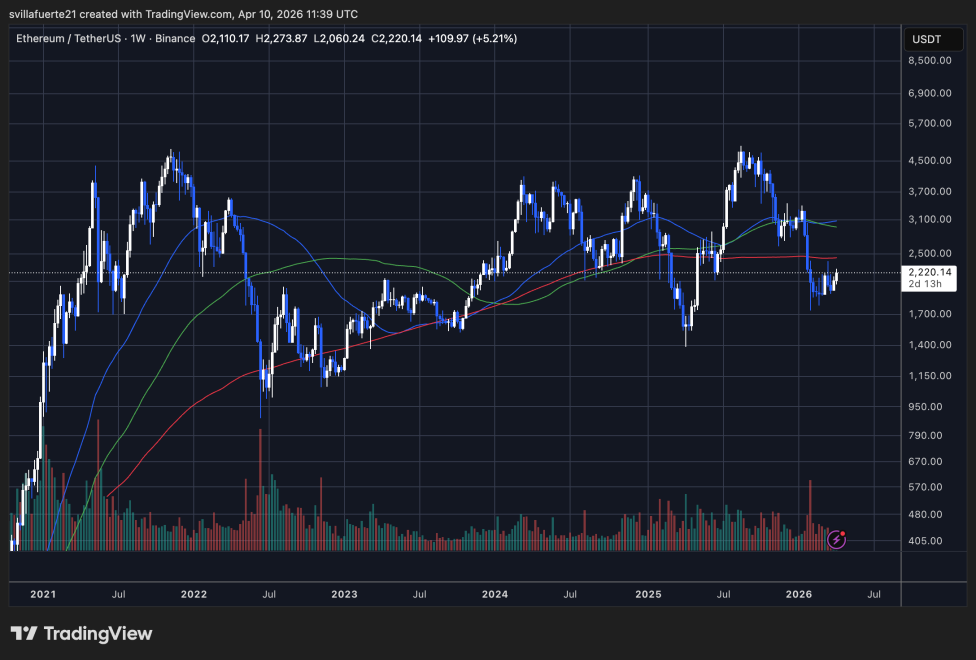
The broader structure indicates that Ethereum remains below previous cycle highs, with the recent rejection from the $4,000 to $4,500 area confirming lower highs. However, the subsequent decline provided support above the rising 200-week moving average (red), which continues to serve as the lower bound of the long-term structure. This is a very important point. Despite the volatility, macro trends have not completely broken.
The 50-week (blue) and 100-week (green) moving averages have converged around the current price level, reflecting compression. Prices are currently trading around these averages, indicating an equilibrium between buyers and sellers rather than directional control.
Volume patterns strengthen this interpretation. The sharp rally amidst the sell-off indicates a liquidation-driven move, but the recent normalization suggests less stress but limited confidence.
Structurally, Ethereum is swirling around a wide range. A sustained rally above $2,500-$2,800 would indicate new strength, while a drop below $2,000 would expose the 200-week support. For now, the market is in balance and waiting for a resolution.
Featured image from ChatGPT, chart from TradingView.com
editing process for is focused on providing thoroughly researched, accurate, and unbiased content. We adhere to strict sourcing standards, and each page is carefully reviewed by our team of top technology experts and experienced editors. This process ensures the integrity, relevance, and value of your content to your readers.


