



Ethereum is facing renewed volatility and uncertainty after weeks of consolidation, with price movements reflecting the market struggling to establish a clear direction. Although ETH has remained relatively range-bound in recent sessions, the underlying dynamics suggest that the current stage may be masking a deeper structural transition.
According to a report from CryptoQuant, while the Ethereum market may appear stagnant on the surface, on-chain data shows a tight supply environment coupled with a recovery in demand. One of the most notable trends is the continued decline in foreign exchange reserves, which have fallen to approximately 16.2 million ETH, the lowest level since 2016. This trend shows that fewer coins can be easily sold on centralized platforms.
At the same time, a large portion of the supply is being removed from circulation through staking. Approximately 37 million ETH is currently locked, and the liquid supply on the market is decreasing further. This dual dynamic – decreasing exchange balances and increasing stake supply – effectively compresses available liquidity.
In this context, even a modest increase in demand can have a disproportionate impact on prices. Although short-term volatility continues, the combination of contracting supply and stabilizing demand suggests that Ethereum’s current consolidation phase may precede a more meaningful directional move.
Demand recovery and structural reset support Ethereum thesis
The report further explains that Ethereum’s recovery is increasingly being supported by genuine network activity rather than speculative flows. We have seen a spike in active addresses in recent weeks, and that spike indicates a significant increase in usage across the network. This trend reflects real demand, particularly as lower gas prices following EIP-4844 accelerated Layer 2 adoption and increased transaction throughput. Unlike previous cycles where rising prices drove activity, the current situation suggests fundamentals are leading the recovery.

A similar normalization is occurring in derivatives markets. Open interest (OI), which had previously expanded to high levels, was flushed out during the correction and is now being gradually rebuilt. This reset indicates that excessive leverage has been removed. Importantly, current OI growth remains modest and is not accompanied by extreme funding rates, indicating a healthier position and return of new capital.
Institutional developments further strengthen this change. The introduction of staking-based ETH ETFs, coupled with increased regulatory clarity in the US, has lowered the barrier to entry for large investors.
Overall, Ethereum’s structure is evolving. Tight supply, rising intrinsic demand, and normalization of leverage appear to be moving the market into a more sustainable phase, which could signal the early stages of a broader uptrend.
Ethereum maintains important weekly support while macro structure remains opaque
On the weekly time frame, Ethereum is trading around the $2,100-$2,200 zone, and this level is emerging as a key support area following the recent sharp rejection from the $3,500-$4,000 range. This chart shows Ethereum moving from a bullish expansion phase to a correction structure, forming lower highs from late 2025 onwards.
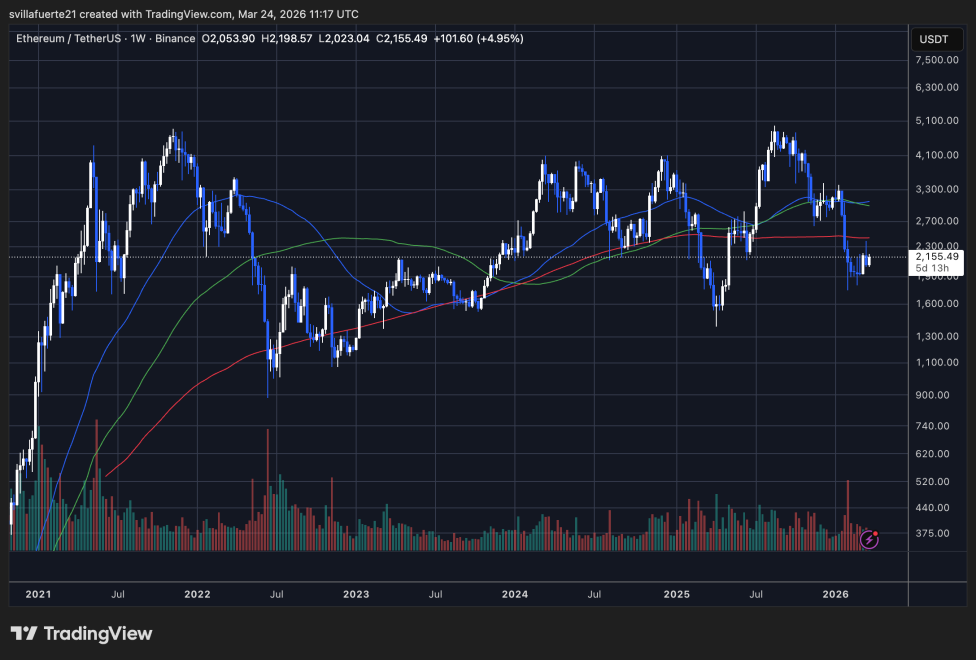
From a trend perspective, Ethereum is currently testing the 200-week moving average, a historically important level that often defines long-term market direction. Prices are currently hovering just above the area, suggesting buyers are looking to protect this area. A sustained break above this level would indicate structural resilience, but a break could expose a deeper downside towards the $1,800 area.
The 50-week and 100-week moving averages are starting to level out and converge near current price levels, reflecting a loss of momentum and increased compression. This usually precedes a movement in a larger direction, but that direction is still unclear.
Volume analysis shows increased activity during the recent pullback, suggesting a distribution or forced sell. However, the subsequent stabilization suggests that demand is absorbing supply at current levels.
Featured image from ChatGPT, chart from TradingView.com
editing process for is focused on providing thoroughly researched, accurate, and unbiased content. We adhere to strict sourcing standards, and each page is carefully reviewed by our team of top technology experts and experienced editors. This process ensures the integrity, relevance, and value of your content to your readers.


