

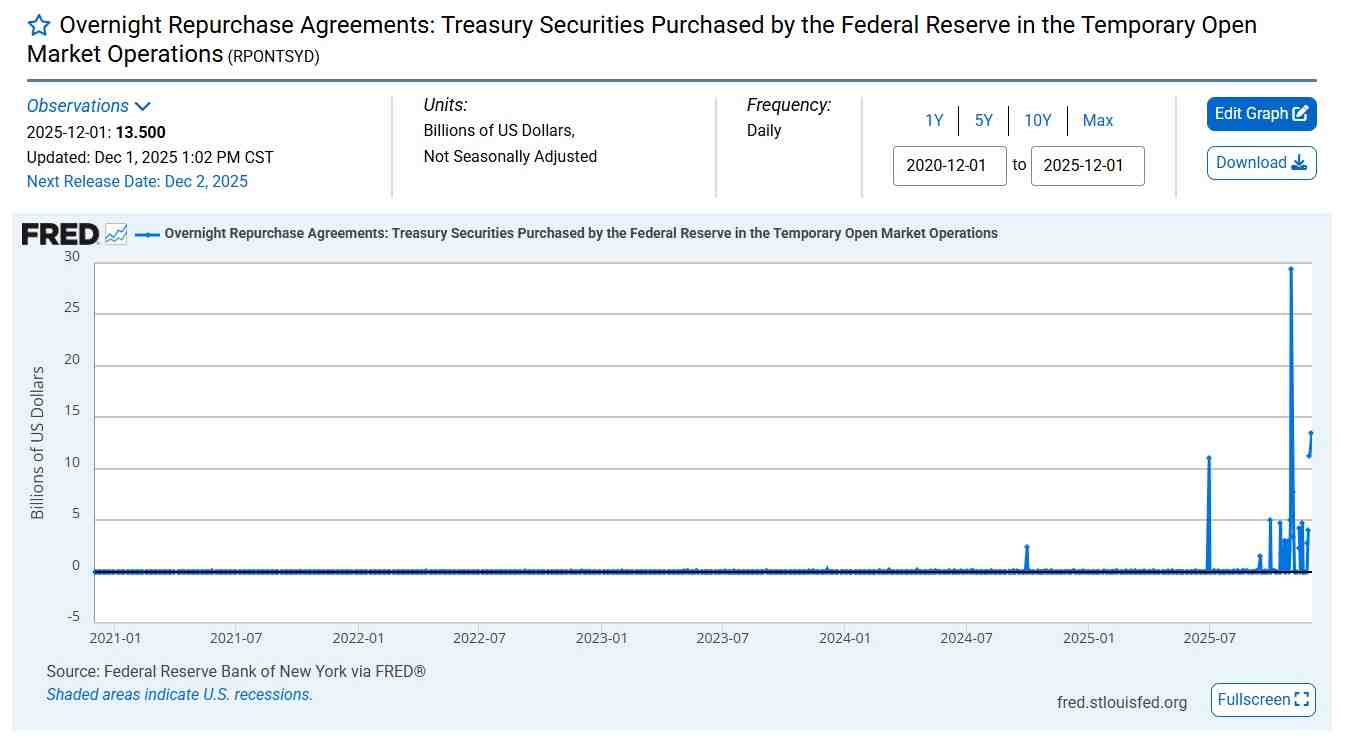
The US Federal Reserve ended its quantitative tightening (QT) program on Monday, December 1st, suspending it by injecting $13.5 billion into the US banking system through overnight repos.
According to Federal Reserve Economic Data (FRED), this is the second-largest liquidity injection since the COVID-19 era and even exceeds the peak of the dot-com bubble.
As a result, investors and analysts are wondering whether risky assets such as stocks and cryptocurrencies will be affected, especially as liquidity starts to loosen.
Analysts are bullish on cryptocurrencies and stocks
Tom Lee of Fundstrat said he remains optimistic about cryptocurrencies and stocks, CNBC In an interview, central banks said it would be the biggest tailwind in the coming weeks.
“I think the biggest tailwind that will emerge over the next few weeks will be around central banks. The Fed is planning to cut rates in December, but today is also the end of quantitative tightening. And as you know, the Fed has been shrinking its balance sheet since April 2022, which is a pretty big tailwind for market liquidity.” said Lee.
With liquidity no longer leaving the system, capital flows into risky assets could begin to accelerate.
“If you look back at the last time quantitative tightening ended in September 2012, the market responded really well.” He further pointed out:
Will Bitcoin hit an all-time high in January?
Lee seemed particularly convinced about Bitcoin (BTC), arguing that higher liquidity has historically correlated with better performance for risk-on assets.
Therefore, even though the effects of October’s recession are still noticeable and the Bank of Japan appears to be “hawkish”, he believes a new all-time high for “digital gold” is possible by late January. As for the S&P 500 index, he claimed it is likely to reach 7,200-7,300 in December.
Of course, all eyes will be on the Federal Open Market Committee (FOMC) meeting in December, with markets hoping for clarity on the Fed’s future rate-cutting path.
Featured image via Shutterstock


