

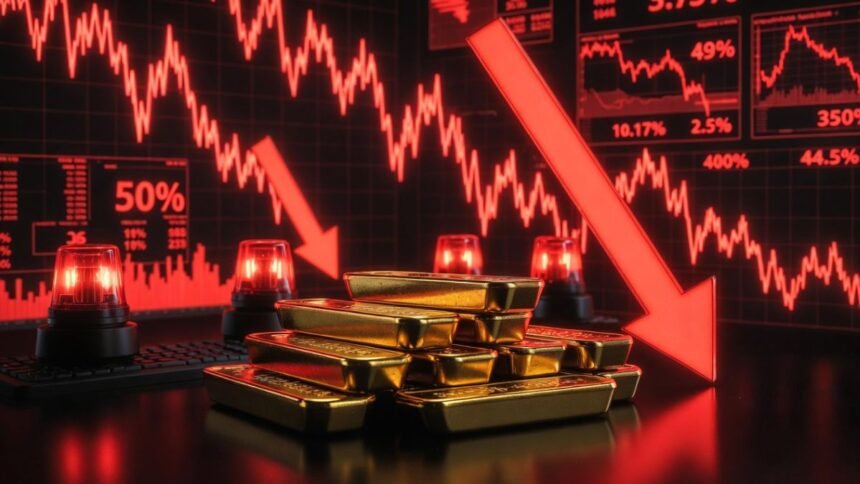
Gold prices fell 11% between March 16 and March 20, 2026, the worst weekly performance in over 40 years.
After reaching an all-time high of $5,596 per ounce on January 26th, the precious metal has significantly broken through the support at $5,000 and $4,500 to today, March 23rd, at $4,249.
This correction is similar to the one that occurred during the first week of March 1983. When geopolitical factors and central bank liquidity needs force large-scale sales.
The current scenario is similar to what happened in February 1983. At that time, prices fell to $408, and historical records show that on Monday, February 28, 1983 alone, gold fell 11.5%, making that week its worst level in history up to that point.
The cause of the 1983 decline was that, for the first time, the Organization of the Petroleum Exporting Countries (OPEC) had to accept significant price cuts and formalize a quota system in an effort to control the market in the midst of a global oversupply. To compensate for foreign exchange losses and obtain dollar liquidity, several countries such as Saudi Arabia and Kuwait sold large amounts of gold reserves on the international market.
The need for liquidity in the Gulf region
As reported by CriptoNoticias, history appears to be repeating itself amidst the Middle East conflict between the United States, Israel, and Iran that began on February 28th.
Critical oil infrastructure in Qatar, the United Arab Emirates, and Bahrain were attacked, and oil prices reached up to $119 per barrel on March 8 and March 19.
But today, Monday, March 23, 2026, Brent crude oil has fallen by 14%, falling from $114 per barrel to about $98 per barrel. The move came after US President Donald Trump reported “positive and productive” talks aimed at resolving hostilities. Within this framework, the President of the United States directed the Department of War to: Postpone all planned military attacks for 5 days Oppose Iranian power plants and energy infrastructure.
However, the Iranian government remains skeptical of the White House’s announcement, asserting that it has “no direct contact with President Trump, even through an intermediary,” raising uncertainty about the sustainability of the decline in energy prices.
For analyst Nick Pucklin, recent asset movements are unusual. He commented, “That’s crazy. This was supposed to be the golden moment.” In his view, “the $5,500 gold price was set for speculative purposes rather than a reflection of safety.” “It’s a very busy operation.”
The expert added: “After Russian assets were frozen in 2022, the central bank bought gold. They all accumulated. ETF flows soared. Gold ETFs set records.” However, the situation has changed significantly due to the financial exigencies of oil producers..
“Now, with the war, those same central banks are being forced to spend their foreign exchange reserves rather than increase them. Gulf oil states, which cannot export through the Strait of Hormuz, may turn from buyers to sellers. When the crowd that drove the rally needs liquidity, they sell what they own. Gold rose the most, so it was affected first,” Pucklin says.
The Strait of Hormuz is a maritime corridor connecting the Persian Gulf and the Gulf of Oman and constitutes one of the most important energy routes on Earth. 20% of the world’s oil production passes through it.
Purchase rate has decreased
Despite the liquidation, the World Gold Council The central bank purchased a net total of 5 tonnes of gold.. However, authorities revealed that the pace of gold purchases by central banks had declined at the start of the year, compared with an average of 27 tonnes over the previous 12 months.
This economic slowdown leaves gold vulnerable, along with the US Federal Reserve (FED) maintaining a restrictive stance due to energy inflation pressures. If the price fails to maintain above 4,200 for the next few days, Next tech goal could be in the $4,000 area.


