


Houdini Swap, a centralized instant exchange aggregator, has rolled out a private payments service that allows users to receive payments on their preferred assets without revealing their on-chain address.
According to an announcement shared with Cointelegraph, Houdini Pay allows users to generate shareable payment links that support over 4,000 digital assets across multiple blockchains. The asset is converted into the recipient’s preferred asset, and by routing the payment through the system, the on-chain link between the sender and recipient is severed, ensuring that neither party can snoop into the other’s wallet.
Fees for using the Service are for use of the Houdini Swap instant exchange aggregator on the backend and are borne by the sender. The recipient receives the full amount requested.
Payment links do not have an expiration date and can be used indefinitely. However, you cannot edit the submitted amount to set the requested payment amount rather than simply converting it.
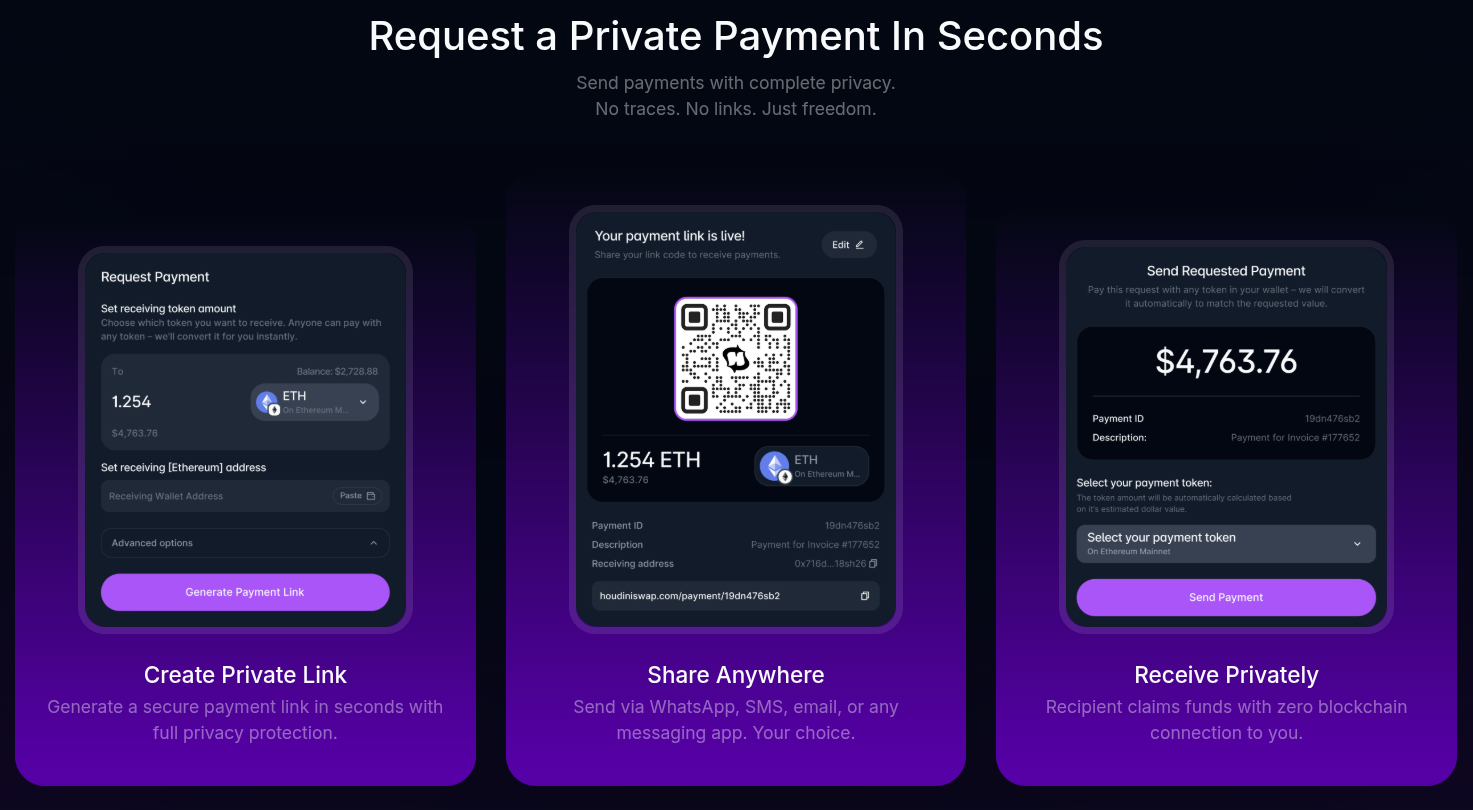
Houdini Pay UI explained. Source: HoudiniSwap
Related: Buterin donates to two projects promoting ‘next steps’ in digital privacy
Broken link, privacy not guaranteed
The service is centrally managed and complies with anti-money laundering (AML) regulations and geo-blocking features. Houdini and its partners also maintain transaction metadata, including associated wallets, assets, amounts, and IP addresses. The document also states that “if a transaction is flagged, the exchange may request additional information in accordance with its AML policies.”
This service cuts on-chain links to protect both paying parties’ wallets from the other party’s prying eyes. Still, it does not provide strong, trustless cryptographic privacy guarantees.
HoudiniSwap CEO Joshua Rogers explained that the service is not a mixer. Instead, “Houdini Pay is a compliant privacy infrastructure” and “does not hold, store, or access your encryption in any way.”
If privacy is a top priority, users may prefer a service like zkBob. It uses a zero-knowledge proof-based shielded pool to ensure that the sender, recipient, and amount are cryptographically hidden on-chain. The service offers cryptographic anonymity rather than a promise not to share your data, but it only supports Ether (ETH), USDt (USDT), and USDC (USDC).
Related: Blockchain struggles to maintain its original purpose: Aztec co-founder
The need for privacy in cryptocurrencies
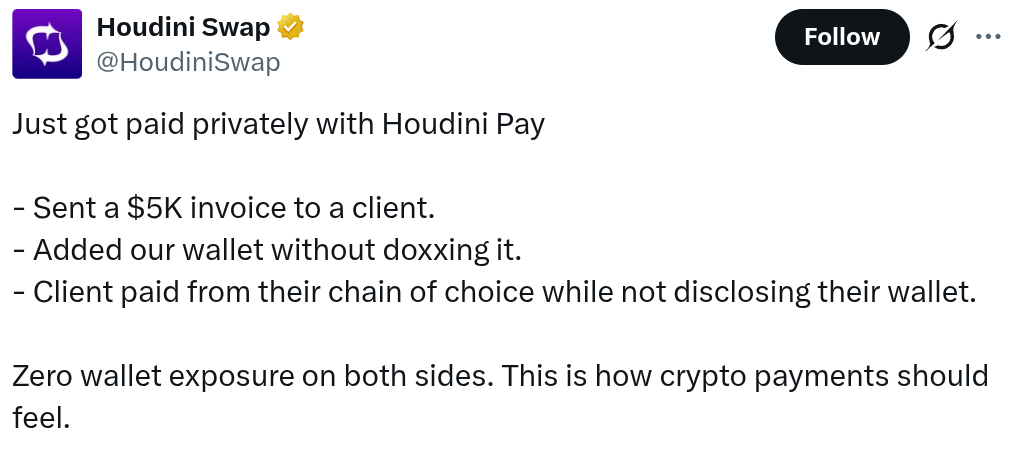
Houdini argues that privacy is essential to many real-world cryptocurrency applications for both business and security reasons. Using your public address, you can view your current balance, all transactions ever made, sources and destinations of funds, services exchanged, and assets held.
sauce: HoudiniSwap
Houdini points out that this is a problem in business applications, where clients can “lowball freelancers after checking their wallet balances” and competitors can track supplier payments and copy strategies. “I’ve seen freelancers get their fees cut in half after the client checks their wallet,” Rogers claims.
Houdini also creates safety implications by making it easier to visualize your assets. This year has seen an increase in so-called $5 wrench attacks. In this attack, the attacker uses a physical brute force approach to force users to part with their digital assets. Kidnappings and physical attacks against known cryptocurrency holders are becoming more frequent.
In May, it was reported that France’s interior minister was meeting with crypto experts following a violent kidnapping attempt on the family of a cryptocurrency exchange executive in Paris.
magazine: EU’s privacy-destroying chat control bill postponed, but the fight isn’t over


