

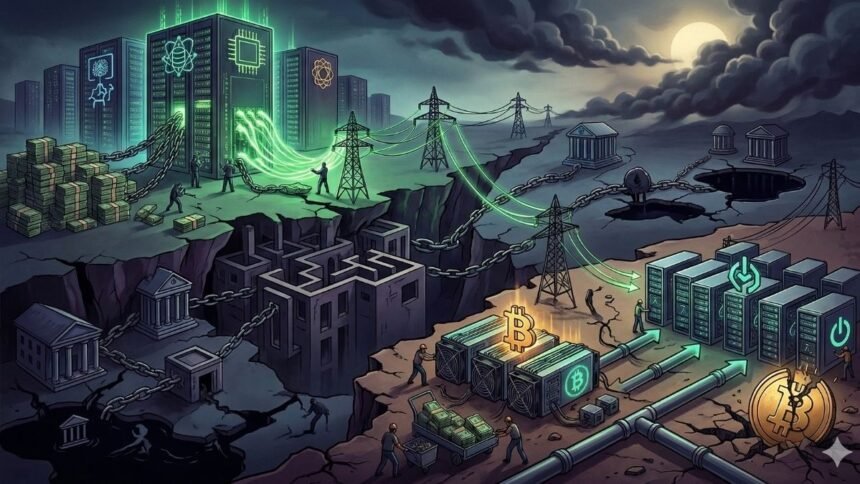
This week, the Bank for International Settlements (BIS) released a report revealing that tech giants such as Amazon, Google and Microsoft are taking on unprecedented levels of debt to fund the artificial intelligence (AI) race. This data reveals an increase in debt while more Bitcoin mining companies are moving their operations to AI data centers to diversify their revenue in the current bear market.
According to the document, these companies are known as hyperscalerwill issue more than USD 100,000 million in bonds in 2025 This is to build a data center.
This phenomenon occurs because the cost of developing AI is increasing faster than the cash these companies generate. To avoid scaring investors, Technology companies are using ‘shadow finance’ techniques.
Instead of putting all the debt on the books, we partner with private investment funds to buy the equipment and build the facility. This way, the obligation to pay still exists, but the liability does not appear directly on the balance sheet.
This situation coincides with a difficult period for Bitcoin, whose price has fallen 50% from its 2025 high. Faced with declining revenues and rising costs, many Bitcoin miners have decided that it is more profitable to use powerful electrical equipment. Process AI data rather than generating hashes. This relationship is clear. AI has money and needs energy, but miners have energy and need steady income.
Hidden debt and market risks
This off-balance sheet financing system creates risks that BIS documents. Connecting big technology companies with private credit funds and insurance companies creates a channel through which AI issues can impact other financial sectors.
Additionally, the price of insurance against default (called CDS) has also increased. This shows that the market is becoming more distrustful. the ability of these companies to refund money if their AI projects do not yield the expected benefits;
For the crypto sector, this has caused a turnover of capital. Investors are moving money out of risky assets like Bitcoin to hedge their positions in the technology sector or take refuge in more traditional sectors. This financial pressure is forcing mining companies to look for new ways to make money.
Miners sell Bitcoin to buy GPUs
Current demand has made data centers an attractive investment opportunity, offering relatively stable returns over the specific models used by these companies. Search for this return Encouraging multiple companies to develop infrastructure It is up to you to obtain that value.
However, the operational difficulties associated with building electrical equipment from scratch created a favorable situation for Bitcoin mining companies. These already have electrical capacity installed; Enabling business diversification towards data center business With limited additional investment, you can address segments where there is still less competition in a specific niche.
The company Cango Inc. is one of the clearest examples of this transition. In February 2026, the company sold 55% of its Bitcoin reserves (approximately 4,451 BTC). Raise $305 million. With that money, he paid off his loan and began purchasing graphics processing units (GPUs), the “brains” needed to train his AI models. Their plan is to stop relying solely on Bitcoin’s volatility and become a computing provider, a business they think is more predictable.
Other companies, simple mining, Decided to provide 234MW of power Directly to AI companies. Its competitive advantage is speed. It may take up to five years for a new AI data center to connect to the power grid, but Simple Mining is already ready for permitting and connection. Like other miners such as Riot Platforms and MARA, they are leveraging energy infrastructure to capture AI demand rather than abandoning Bitcoin completely.
The miner’s dilemma: From volatility to debt bubble?
For Bitcoin mining companies, this financial structure represents a risk that is often ignored when transitioning sectors. companies like Kango Co., Ltd. y simple mining They want “stability” but are entering an ecosystem that is completely dependent on big tech companies to stay solvent.
The risks for miners are twofold.
- Reliance on private credit: Technology companies are tied to banks and insurance companies through these debt structures. If the AI sector slows down, banks could immediately cut off loans, impacting the entire data center infrastructure that miners currently operate.
- Liquidation of real estate assets with debt commitments: By selling Bitcoin reserves to buy video cards (GPUs) or AI servers, miners trade valuable assets (BTC) for equipment that depends on the financial health of their customers.
Miners are driving technological advances that could even lead to quantum computing and something horrifying. “Q-day” (The moment current cryptocurrencies fail) they will also expose themselves to the collapse of AI debt and lose the Bitcoin capital that has protected them thus far.
(Tag translation) Bitcoin (BTC)


