


Bitcoin has been bouncing between $85,000 and $90,000 with no clear breakout in sight for some time, frustrating both bulls and bears. The culprit lies in the options market, not a lack of buying interest or macroeconomic headwinds.
Derivatives data reveals that dealer gamma exposure currently dampens spot price volatility through mechanical hedging flows. This structure has kept Bitcoin locked within a narrow range, but its price-holding power expires on December 26th.
gamma flip level
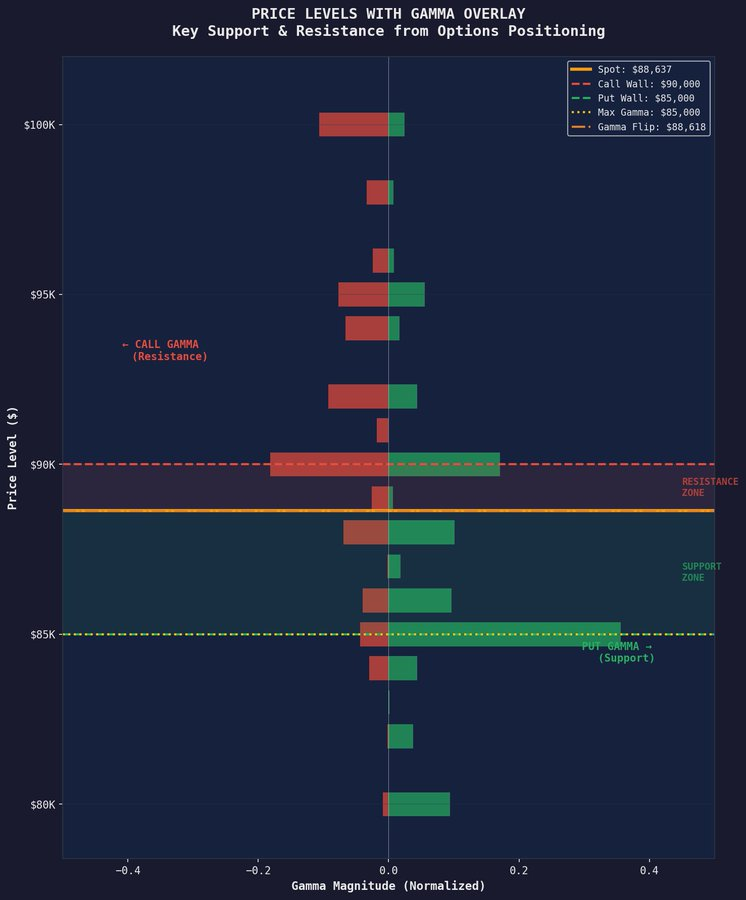
At the heart of this move is a level traders call the “gamma flip,” currently located at around $88,000.
Once this threshold is crossed, market makers holding short positions in Gamma will be forced to sell on the upswing and buy on the dip in order to maintain delta neutrality. This action dampens volatility and pulls the price back towards the middle of the range.
Below the reversal level, the mechanism reverses. As dealers hedge in the same direction as price movements, selling pressure amplifies itself, amplifying volatility rather than suppressing it.
$90,000 continues to be rejected while $85,000 continues to be held.
The $90,000 level has repeatedly acted as a ceiling, and the reason for this is the concentration of call option positioning.
The dealer is shorting a significant amount of call options with a $90,000 strike. When the spot price approaches this level, you will need to sell your Bitcoin to hedge your risk. This gives the appearance of organic selling pressure, but actually creates forced supply through derivative hedging.
This hedge flow is triggered every time it rises towards $90,000, explaining why breakout attempts repeatedly fail.
Source: NoLimitGains via X
On the downside, $85,000 acted as reliable support through the exact mechanism of the opposite.
A heavy put option position at this strike means dealers will have to buy spot Bitcoin as the price falls towards that level. This forced demand absorbs selling pressure and prevents sustained failures.
As a result, markets appear to be stable on the surface, but in reality they are artificially balanced by opposing hedging flows.
Future clearances will enhance range
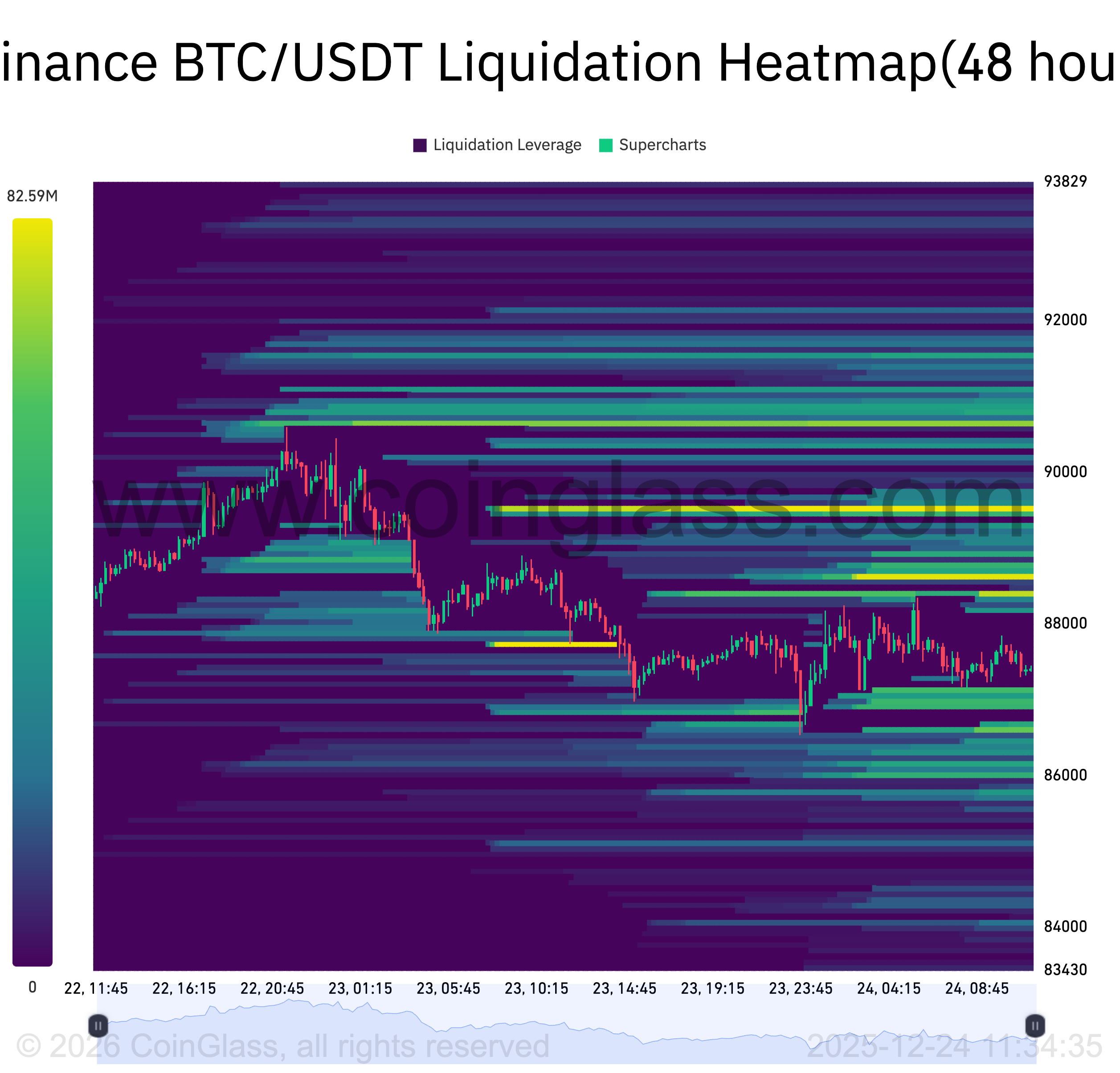
Option-driven ranges do not work alone. Coinglass’ liquidation heatmap data shows that leveraged futures positions are clustered around the same price level, creating additional magnetism that strengthens the $85,000 to $90,000 corridor.
Above $90,000, significant short-term liquidation levels have accumulated. If the price breaks through this ceiling, forced short covering could trigger a series of buy orders. Conversely, long liquidation levels are concentrated below $86,000, meaning the collapse will accelerate as leveraged longs stop. Both options dealer hedging and futures clearing mechanisms have worked together to compound the structural pressures that keep Bitcoin within its current range.
Source: Coin Glass
Optional traps await
The Dec. 26 options expiration is shaping up to be the largest in Bitcoin history, with an expected loss of about $23.8 billion in notional value.
For comparison, the annual expiry reached approximately $6.1 billion in 2021, $11 billion in 2023, and $19.8 billion in 2024. This rapid growth reflects the increasing participation of institutional investors in the Bitcoin derivatives market.
According to analyst NoLimitGains, approximately 75% of the current gamma profile will be lost once this expires. The mechanical forces that kept prices in the $85,000 to $90,000 range will essentially disappear.
Dealer Gamma dominates ETF flows
Currently, the scale of dealer hedging activity dwarfs spot market demand. Dealer gamma exposure is about $507 million, compared to just $38 million in daily ETF activity, a ratio of about 13 to 1, according to data cited by analysts.
This imbalance explains why Bitcoin has defied seemingly bullish catalysts. Until the derivatives overhang is resolved, dealer hedging calculations are more important than the institutional adoption story.
what happens next
After the December 26 expiry date, the suppression mechanism will end. This does not guarantee a specific direction, it simply means that Bitcoin is free to move.
If the bulls are successful in defending the $85,000 support until expiry, a breakout towards the $100,000 level is structurally possible. Conversely, a break below $85,000 in a low gamma environment could accelerate the decline.
Traders should expect volatility to increase into early 2026 as new positioning is established. The range-bound movements of the past few weeks are likely a temporary phenomenon caused by the way derivatives work, rather than a reflection of underlying market conviction.
The post Bitcoin Stuck Between $85,000 and $90,000? A $24 Billion Option Trap Expires in 2 Days appeared first on BeInCrypto.


