

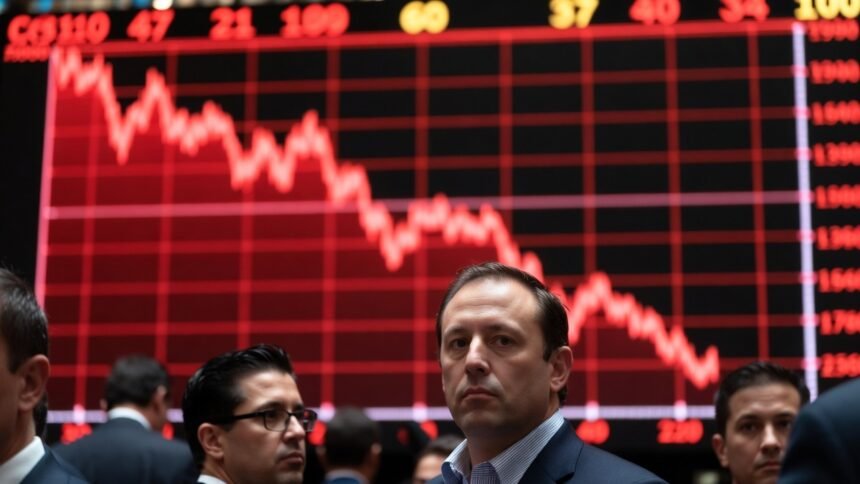
Fund managers’ stance on the US dollar is currently the most bearish in 14 years. This was revealed in a Bank of America (BofA) study released on Friday, February 13th, which suggests that other financial assets are becoming more liquid.
This U.S. Bank study shows: Fund managers’ dollar exposure falls to 2012 levelsthe first year with comparable survey data. It thus revised down the previous low set in April 2025, when President Donald Trump triggered global volatility with his announcement of wide-ranging tariffs.
The change comes at a time of growing concern for the economic and political stability of the United States. President Trump’s geopolitical threats and pressure on institutions like the Federal Reserve to lower interest rates are contributing to this scenario.
Analysts at Bank of America said Kevin Warsh’s appointment as Fed chairman “did not lead to increased dollar demand or renewed optimism for U.S. assets.”
“The majority now want to increase their currency hedging ratios or reduce their exposure to U.S. assets,” BofA added. “There is a growing belief among reserve managers that it is better to continue to reduce dollar holdings,” he said.
In any case, banks believe that the majority of responses are They got them before the positive jobs report was released. In the US. Therefore, it seems prudent to consider that this report may soften some of the bearish stance on the dollar.
Seeking refuge against the dollar
If caution and a bearish outlook for the dollar persists, this will reflect bullish tailwinds for other assets. This means that investors will increasingly park their money in non-US currencies in search of returns.
assets like Bitcoin (BTC) and cryptocurrencies may benefit of this movement. In fact, they tend to rise during periods of DXY declines or flattens, similar to the US stock market. It is an index that measures the value of the U.S. currency against six currencies weighted according to their importance in international trade: the euro (57.6%), the Japanese yen (13.6%), the British pound (11.9%), the Canadian dollar (9.1%), the Swedish crown (4.2%), and the Swiss franc (3.6%).
However, as seen in the current performance, this dynamic does not always occur. Despite the dollar’s decline, Bitcoin’s price is still down 45% from its all-time high set in October 2025. Bitcoin is trading around $68,000 amid macroeconomic uncertainty, CriptoNoticias reports.
By contrast, the S&P 500 (SPX), which tracks the stock prices of 500 major U.S.-listed companies, remains close to its all-time high of 7,000 points reached at the end of January. It currently sits at 6,800 points, just 2% below.
In addition, The dollar’s decline has historically coincided with moments of gold’s rise.as seen last year. Metal prices have fallen 12% since the end of January, when they hit a historic high of 5,600 points, but are still up 69% for the year.
For Kyle Chassé, founder of Master Ventures, trading in the market is currently “saturated.” But he expects a reversal given the bearish outlook for the dollar and expectations for interest rate cuts this year. « If we shrink, the danger looms. If it falls, cryptocurrencies will fly,” he says.
However, it is worth mentioning that A weak dollar is not always the driving force behind Bitcoin prices.. Other factors such as global liquidity, US monetary policy, risk appetite, industry regulation, and institutional implementation also have a significant impact on the market. In this sense, while there is a possibility that a weaker dollar will contribute to an appreciation, it is not a special condition for a weaker dollar to occur.
The value of the dollar has fallen 10% in one year.
DXY is down 1.3% year to date in 2026, and is down more than 10% in one year. The index reached 95.5 points at the end of January, the lowest level in four years since 2022, but now stands at 97.2 points.
In the midst of this scenario, according to CME Group Options Market, Bets against the dollar have outpaced bullish bets so far in 2026reversing the situation in the fourth quarter of 2025.
Meanwhile, bets on further weakness in the dollar against the euro have reached levels seen in the face of the coronavirus pandemic and President Trump’s tariff announcements last April.
Ian Steely, Director of Global Fixed Income, Currencies and International Investments, JPMorgan Asset Management merchandise. “The environment in which the dollar is likely to decline will continue,” he said.
“Some of the volatility last year has led investors to question the historically low hedge ratios (denominated in dollars) for U.S. assets,” said Roger Hallam, global head of rates at asset management giant Vanguard. The revaluation was a “significant factor” in the recent dollar decline.accurate.
(Tag Translation) Central Banks


