

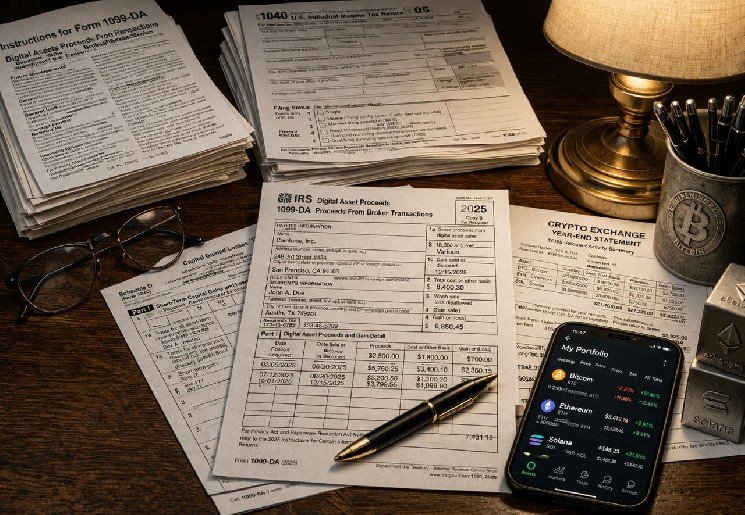
The first Form 1099-DA season is here for U.S. crypto investors with fundamental concerns. That means a lot of people are getting their new IRS forms before they understand what they’re actually telling you.
A survey of 3,000 US crypto users conducted by Coinbase and CoinTracker found that 61% were unaware of the new reporting rules in 2025, although 74% said they knew their crypto activity could be taxable and 56% rated their knowledge of crypto tax rules as good or excellent.
This gap arises as the IRS begins to receive more standardized data on digital asset sales handled by brokers. The Treasury Department and IRS require brokers to report gross proceeds from digital asset sales conducted in 2025 on Form 1099-DA, with underlying reporting of covered securities beginning in 2026.
The IRS is also telling taxpayers that most 2025 returns do not include a basis, meaning the form could show that sales occurred without doing the work necessary to determine the actual gain or loss.
For many investors, it gives the return of new information a false sense of completeness. According to the IRS, Form 1099-DA is used by intermediaries to report to both taxpayers and the government the income they receive from the disposal of digital assets, and in some cases the basis thereof.
It also states that taxpayers must report all income, gains and losses from digital asset transactions, regardless of whether they receive the form, and calculate the basis before filing.
New form, but not a completed tax answer
The structure of the transition year makes the first filing season unusually easy to misunderstand. Taxpayers who purchase Bitcoin on one exchange, transfer it to self-custody, and then transfer some of it to another platform where they sell it may receive a Form 1099-DA showing the proceeds of disposal.
However, if the assets were transferred from another broker or wallet, the form may not contain the underlying information needed to calculate the actual tax consequences.
Tax accountant writing tax accountant Taxpayers said they may receive an unwarranted Form 1099-DA for assets transferred from another broker or self-custodial wallet, sales on some non-custodial platforms, and assets purchased before 2026 that are not treated as covered securities.
For this reason, tax experts caution taxpayers not to treat this document like a completed brokerage statement. Jonathan Cutler, a senior manager at Deloitte, said the 2025 form primarily shows taxpayers have made transactions in cryptocurrencies, but added that taxpayers “need to keep their records tough.”
The IRS makes a similar point in clearer language. The guidance states that taxpayers should use Form 1099-DA in conjunction with other records and calculate basis before filing. It also notes that taxpayers who trade through foreign brokers may not receive a Form 1099-DA from those brokers, even if the trades remain taxable in the United States.
Where investors are stuck
Meanwhile, Coinbase and CoinTracker survey data found that only 49% of respondents correctly answered that a tax event is triggered when selling a virtual currency, suggesting confusion is not limited to the rationale.
Additionally, 41% believe that taxes are payable when cryptocurrencies are transferred to a bank, 36% believe that taxes only apply if profits exceed a threshold, and 22% believe that transferring money from another account itself is a trigger.
At the same time, users reported an average of 2.5 platforms or wallets, 83% said they used a self-custodial wallet, and 71% said they had transferred assets between wallets or platforms.
The new IRS guidance goes against the cash-out logic that remains common among retail traders.
The agency treats digital assets as federal income tax assets, and its Form 1099-DA guidance states that taxpayers may receive this form when they exchange a digital asset for dollars, exchange it for another digital asset, use it to pay for any amount of goods or services, or use the digital asset to pay a broker’s transaction costs.
The IRS FAQ on virtual currencies also states that taxpayers generally recognize a gain or loss when virtual currency is sold as real currency.
As a result, the market is filled with investors who are widely aware that cryptocurrencies can be taxable, yet still misunderstand when taxable events occur and what records the IRS expects them to keep.
According to a Coinbase survey, 76% of respondents knew they might need to make a cost base adjustment, but only 35% said they had actually made one in the past.
Shehan Chandrasekera, Head of Tax Strategy at CoinTracker, said:
“While virtual currency intermediaries will be offering 1099-DA forms this tax year, users are responsible for correctly calculating cost basis, holding period, and actual profit or loss. This cost basis issue is extremely difficult to resolve.”
Awareness grows before compliance catches up
This press push reflects the widespread belief that the old system captured only a fraction of the market. 2026 paper Accounting review Using IRS data, we found that the IRS appears to only monitor between 32% and 56% of crypto holders in the United States.
Another NBER paper using data from Norway found that 88% of crypto holders fail to declare their holdings and profits, and 80% still do so among investors using domestic exchanges that share personally identifiable data with tax authorities.
On the other hand, the current heightened scrutiny could change the behavior of crypto investors before the tax gap is completely eliminated. An NBER study on crypto tax loss recovery found that increased tax audits are driving investors toward more legitimate tax planning and influencing their preferences for U.S.-based exchanges.
This is consistent with what practitioners saw in the first season of the 1099-DA. There, missing or incomplete evidence forces accountants to make what Accounting Today described as forensic adjustments to client-controlled records rather than simple form checks.
For U.S. investors filing this year, the immediate lessons are narrower and more pragmatic. Form 1099-DA will give the IRS a clearer picture of many virtual currency sales in 2025. However, that alone does not mean that the tax payment is complete.
Taxpayers still need to prove what they paid, where the asset went, how long they held it, and whether the disposal resulted in a gain, a loss, or an amount significantly less than the amount of income listed on the form.
Until those records are reconciled, the government may have a clearer picture of the sale price than investors can account for their profits.


