

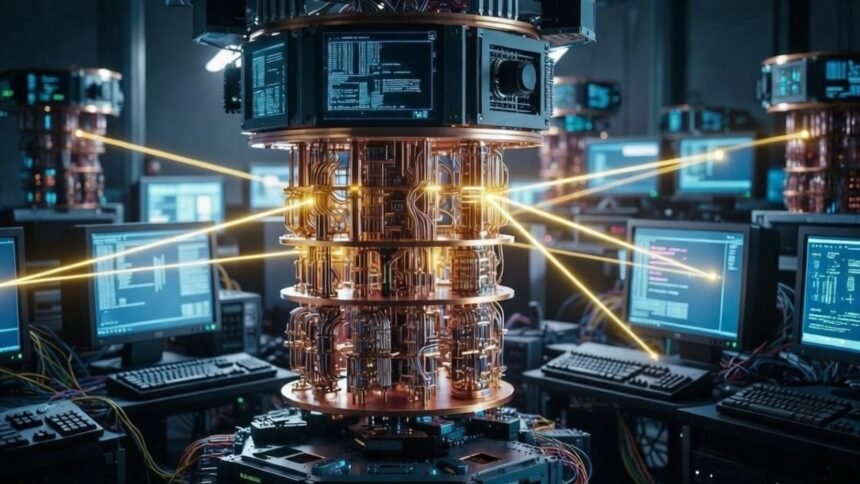
Quantum computing has overcome the biggest technological bottleneck. A new experiment using Quantinuum’s Helios processor, published on February 25, makes error correction efficient for the first time. The system can now resolve more errors than it generates.
The validity of this report lies in the fact that these correction techniques (which have been used for decades) were so complex that they ultimately caused more failures than they solved. According to research, they managed to cross that threshold.
The researchers implemented an error correction code called “iceberg.” create some groups cubit Use physics to form protected logical qubits.
A physical qubit is like a piece of ink that is blown away by the wind. Conditions may change due to vibration or interference. A logical qubit, on the other hand, is like reconstructing a message using some copies and mathematical rules. If the text is distorted, you can detect and correct the error.. Although it does not eliminate risk, it greatly reduces the chance that the final message will be corrupted.
According to the report, the modified logical qubits showed higher fidelity (i.e., fewer errors) than unprotected physical qubits. This critical point is known as: ‘break even’: The moment protection ceases to be a net cost and begins to improve outcomes.
The authors evaluated this performance with specific tests.
- Condition preparation and measurement– They verified that the system can correctly create and read quantum states without significant degradation.
- Executing logic gates: They verified that the basic operations of quantum computation work with lower error rates.
- quantum simulation: They ran complex physical models to measure whether the results remained consistent and accurate under error correction.
The study also showed that increasing the level of mathematical protection can reduce the need to discard erroneous results, a process called post-selection. This suggests that the method can be extended with additional engineering improvements.
Are threats to Bitcoin and digital systems accelerating?
The advances demonstrated in this new study add to other reports, including a new architecture that optimizes the use of qubits and estimates it can break the RSA-2048 cipher with 10 times less hardware than predicted.
Added to this, as reported by CriptoNoticias, is another recent study proposing an architecture that can reduce the number of logical qubits needed to compromise a Bitcoin key by 48%, significantly optimizing previously estimated resources.
Together, these developments encourage discussions such as: Possibility of so-called “Q-day” comingThis is the moment quantum computing could potentially compromise the cryptographic systems that currently secure networks such as Bitcoin and much of the world’s digital infrastructure.
This result does not mean that quantum machines already exist that can significantly outperform classical supercomputers. But this removes the fundamental question that error correction can work without making the system unworkable. And this has been one of the biggest technical hurdles in this field to date.
(Tag Translation) Bitcoin (BTC)


