

If you log into Coinbase next tax season, you may not receive your tax documents in the mail.
A new IRS proposal could require virtual currency exchanges to file Form 1099-DA electronically. This form reports digital asset transactions, and we may refuse to do business with customers who refuse to do so.
The comment period ends on May 5th, and once the rules are finalized, crypto tax reporting will be moved from the mailbox to the platform.
This is not a reduction in taxes or a repeal of reporting requirements. Brokers send the same information to the IRS regardless of how they pass the form to their customers. The proposal would allow exchanges to mandate app-based distribution.
As a result, millions of cryptocurrency users will only receive their tax forms via email and in-app documentation center, with no paper backup or reversal rights.
Twist: Cryptocurrency taxes are not getting lighter. They are getting quieter.
What actually changes?
The IRS proposal creates an alternative electronic delivery process for Form 1099-DA.
Current regulations require brokers to provide paper forms to their customers. The proposal would allow exchanges to use streamlined consent, allowing customers to consent to electronic delivery during account setup and allowing exchanges to terminate relationships with those who decline.
The consent will likely appear as a pop-up with an “accept” button and include language indicating that the broker may not continue to provide services to customers who decline.
Once the customer consents, the exchange remains the customer and does not have to withdraw that consent. The only guaranteed alternative to paper is email notification of failed delivery rather than a complete tax document.
Delivery is done by posting the form to an online documentation center with email notification or by attaching it directly to an email.
Exchanges must maintain access until October 15 of the following year and store previous statements for seven years. Undeliverable emails will trigger a physical notification within 30 days, but this is a procedural matter and does not replace the email notifications that many users expect.
Greater enforcement changes
The proposal comes within a larger compliance push.
Starting with transactions on or after January 1, 2025, virtual currency brokers will be required to file Form 1099-DA reporting gross revenue.
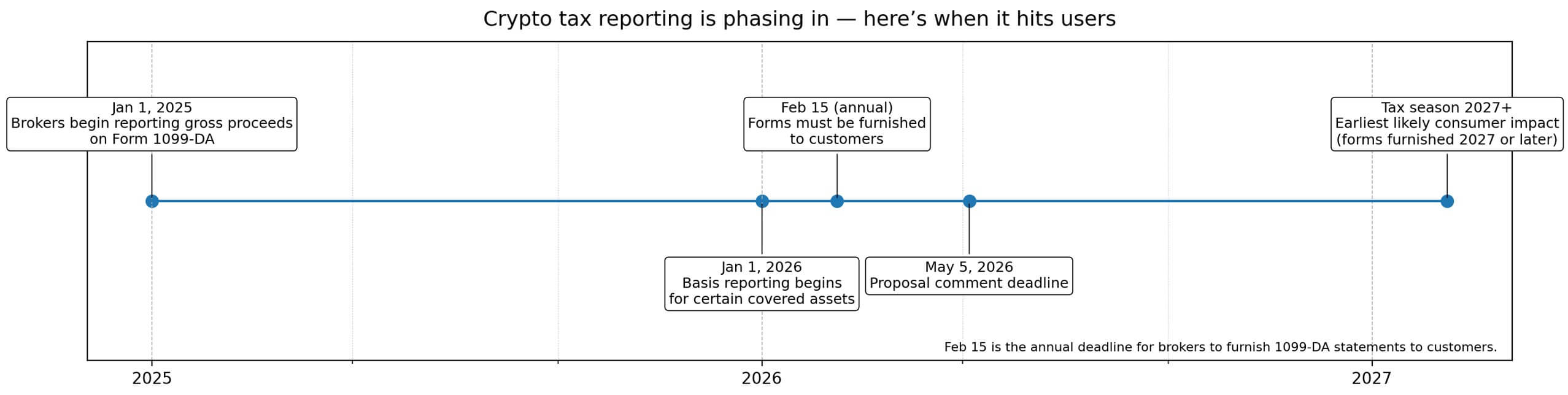
Basis reporting, the cost information required to calculate profit and loss, will be phased in for certain trades from January 1, 2026, only for eligible assets acquired and held from the same broker.
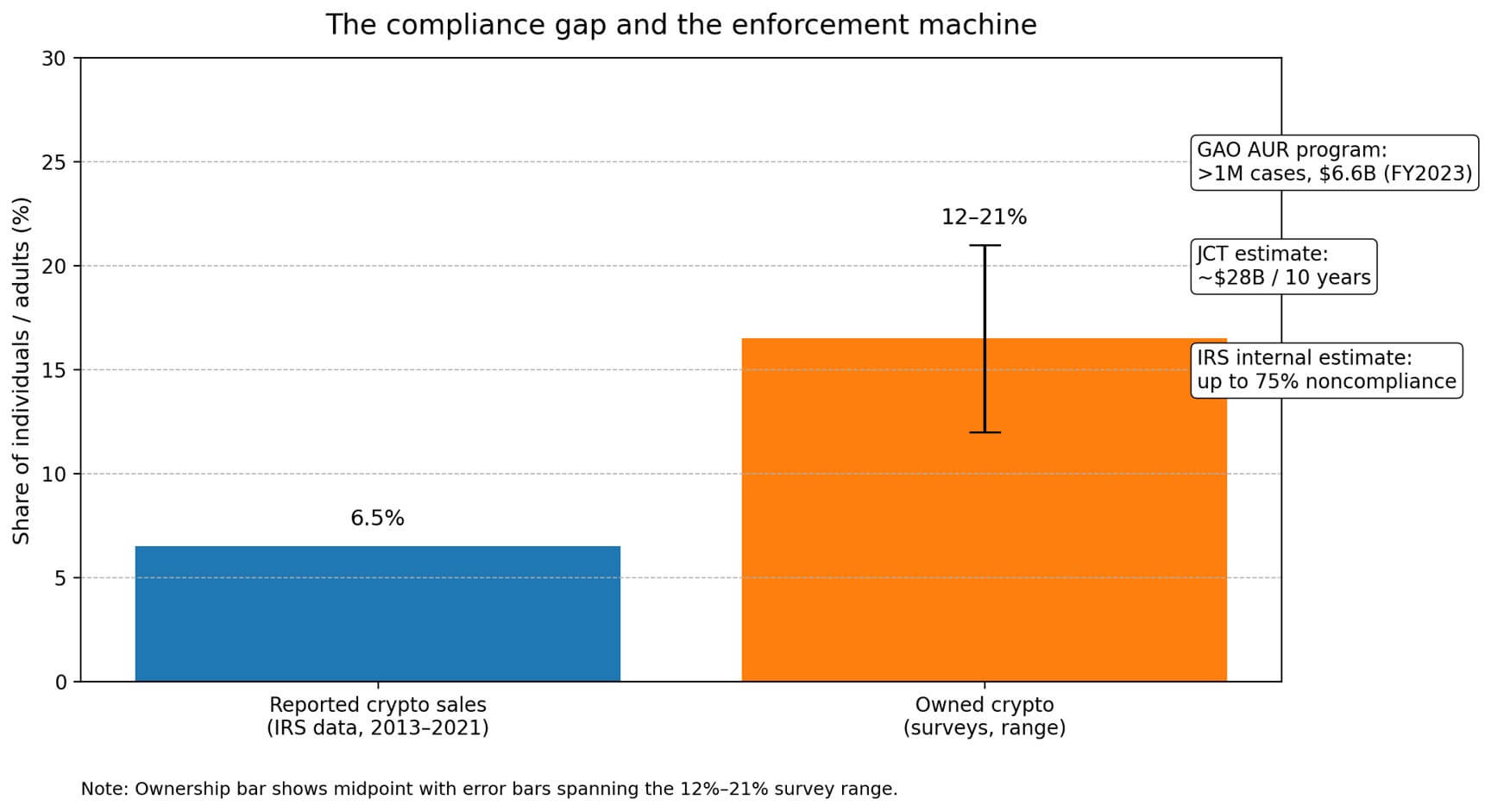
Enforcement calculations are important. The IRS’ automatic underreporting program identified more than 1 million potential underreported income cases totaling $6.6 billion in fiscal year 2023, the Comptroller’s Office report found.
Form 1099-DA feed matched by matching engine. According to an IRS research paper, 6.5% of individuals, or 17.4 million people, reported selling cryptocurrencies from 2013 to 2021, while external research suggests that between 12% and 21% of U.S. adults own cryptocurrencies.
This gap means that many holders do not appear on sales reports.
The Joint Committee on Taxation estimates that digital asset reporting provisions will raise approximately $28 billion over 10 years. The IRS cites internal research showing that up to 75% of taxpayers with digital assets are not compliant.
The electronic delivery proposal is not intended to reduce the burden. It’s about standardizing the infrastructure for automated compliance.
What retail users notice
The user experience moves from annual paper envelopes to permanent digital workflows. Tax season will be a notification in your document center instead of a mailbox event.
For users accustomed to physical forms of submission reminders, this change creates new ways to meet deadlines.
Exchange integrates consent into onboarding or account settings and presents it as a day-to-day platform agreement. Email delivery relies on users maintaining current contact information and checking spam filters.
An in-app documentation center integrates tax forms into a notification stream that handles transaction confirmations, security alerts, and promotions. The seven-year retention requirement means that past forms can still be accessed if users know how to retrieve them.
Coinbase’s 2025 10-K reported 9.2 million monthly trading users on the platform and $376 billion in total assets. Other major exchanges have similar scale.
If electronic consent is required for any portion of tax documents, the amount of tax documents that will be moved exclusively through digital channels will be significant.
There is a signal every day and no noise.
Get the market-moving headlines and context all at once, every morning.
5 minute digest 100,000+ readers
free. No spam. Unsubscribe at any time.
Oops, looks like there’s a problem. Please try again.
Subscribed. welcome.
Enforcement becomes less visible
Key difference: This proposal would change how customers receive their forms, not whether the IRS receives them.
Broker reporting to the government continues. Exchanges that transition to app-only distribution still submit the same information to the IRS.
The IRS has specifically stated that digital asset transactions must be reported regardless of whether a taxpayer receives a Form 1099-DA. The agency places great emphasis on record management. Taxpayers will need to maintain their own basis records to calculate profits and losses, especially during phase-in when many documents do not contain the basis.
For transactions in 2025, brokers typically report only total revenue. Basis reporting will begin in 2026 for certain assets held with the same broker from the time of acquisition.
This creates a compliance gap where users must export their own transaction history even if they receive the form. With electronic delivery proposals, access to historical data will rely on platform tools such as document centers, CSV exports, and API access, rather than mailed statements.
From an enforcement perspective, this transition is efficient. Information returns are sent digitally to the IRS regardless of the customer’s shipping method. Automatic matching compares your application to your broker’s report without manual intervention.
Users who miss app-based notifications may still face potential underreporter notifications, penalties, and interest. This system remains completely visible to the IRS, yet less visible to unwary users.
what happens next
The proposal is open for public comment until May 5, 2026. If finalized, it would apply to forms filed after January 1 of the calendar year following its announcement, with the earliest possible application being after the 2027 tax season.
Whether an exchange adopts mandatory electronic delivery is a business decision. This proposal confers an authority, not an obligation. Some brokers maintain paper options as a customer service, while others find digital-only easier to operate.
Adoption rates determine how many users are faced with the choice to “accept or lose access.”
Users should assume that once electronic distribution is allowed, it will become the norm across major platforms.
Treat your Exchange email settings as critical tax infrastructure. Please make sure your contact information is up to date. Enable document notifications. Please check your spam filters before the February 15th form submission deadline. Back up your trading history by regularly downloading it, especially when trading across multiple platforms where no single broker has complete underlying information.
The broader picture is the global convergence towards standardized cryptocurrency tax reporting.
The OECD Cryptoassets Reporting Framework has been adopted across jurisdictions. The EU’s DAC8 directive extends reporting to crypto assets. The US e-delivery proposal falls within a multi-year build-up in which the informality premium of cryptocurrencies narrows towards the information returns of traditional securities.
Cryptocurrency tax reporting is not built into the app to reduce compliance. Enforcement is moving inside the digital rails to become more automated and less likely to be ignored.
The IRS does not track documents. This moves the trail from the mailbox to the platform, where the broker’s copy continues to go to the government, while the customer’s copy becomes just one notification in a crowded interface.


