

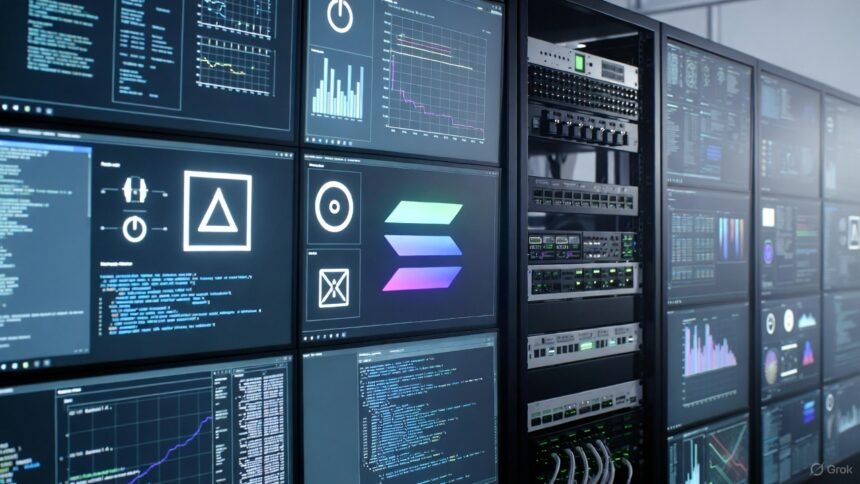
Developer Kevin Bowers, part of the Jump Crypto team, confirmed the activation of Firedancer, a new verification client, on the Solana mainnet on December 12th.
Client is the software that enables validators Execute network rules and participate in consensus. Firedancer supports two clients in this ecosystem, Agave and Jito-Labs, the latter of which is fork agave).
Along with the integration of Firedancer into Solana, Native SOL currency recorded volatility moves: rose from $136 to $140, then fell to $132, where the note was trading at close of trading.
In January 2025, CriptoNoticias predicted that Firedancer could be introduced to Solana.
According to its developers, Firedancer aims to improve three core aspects of network operations. Performance, scalability, and stability.
What does Fire Dancer bring to Solana’s operation?
First, having more customers reduces risks such as: A failure in one implementation affects the entire network. It also reduces the risk of centralization.
At the time of this memo, Agave accounts for over 81% of Solana validatorsafter recent releases, Jito was at 18.38% and Firedancer at 0.13% (around 800 overall).
Fire Dancer’s next goal is to Optimize how validators process data.
To achieve this, we use a modular approach. Separate different validator tasks (packet processing, signature verification, block processing, etc.) into separate components.
This department aims to Improve efficiency and reduce bottlenecks Solana’s information flow is a problem the network has experienced in the past.
During testing in the beta stage of Firedancer, it was shown that this client can handle up to. “1 million transactions”.
The new client also works for node-to-node communication using Solana’s block propagation protocol, Turbine. Optimizing that flow allows blocks to be distributed more evenly and quickly among validators.
Firedancer can provide the following benefits:
- Faster transaction executionbecause the signature and package handling is now more efficient.
- Improved fault toleranceThe second client is to avoid relying on a single development.
- Ability to absorb peaks of activityThis is important during times of high demand for high-traffic applications.
In the following image taken from the documentation for this new software, you can see the technical requirements for running this software.
On the other hand, unlike other clients Agave and Jito written in the Rust programming language, Firedancer is a developer using C and C++.
The first few minutes of Fire Dancer
You can check the status of the Firedancer client from the image below.
Screenshots from the gui.firedancer.io site correspond to monitoring panels for validators using Firedancer.
A screenshot of the Firedancer dashboard shows that the validator is processing 2,858 transactions per second (TPS), which is similar to the average exposed by Solana Explorer.
The match between the TPS reported by Firedancer and the TPS reported by the browser indicates that the client is providing a tailored and realistic view of the network’s global activity.
Also, the bottom section of the image above is titled “”.shred” (data category), validators using Firedancer observe how Solana manages fragments that split blocks during propagation.
There are categories like “Repair Request, Turbine Receipt, Turbine Regeneration, Skip & Publish”representing different states of their circulation. Shredded.
Some of these stages are directly associated with the Turbine protocol (such as packets being received and forwarded), while others are part of the validator’s general maintenance.
The presence and updating of these metrics allows Firedancer to Processing, transferring and repairing data Demonstrate operational integration according to the actual flow of the network.
Finally, Firedancer comes at a complicated time for Solana. This is because the network is currently operating without nearly 70% of the validators it had three years ago.
The latest Soulana


