

Tether’s growing influence in the global gold market is making headlines thanks to a new analysis by Jefferies that positions the stablecoin giant as akin to a private central bank.
Why Jeffries thinks Tether is the most important gold buyer you’re not paying attention to
Tether is already known for operating the world’s largest stablecoin, but it now appears to be leading the way in something else: bullion flows. A report by Jefferies equity analysts Fahad Tariq and Andrew Moss, amplified by reporting by Mike Dolan of Reuters and Niels Christensen of Kitco News, argues that Tether has quietly evolved into one of the most influential buyers in the gold market, competing with mid-tier central banks and subtly shaping global prices.
For those outside of the investment banking bubble, Jefferies is a New York-based financial giant specializing in capital markets, research, advisory services, and general high finance. The firm’s analysts are known for tracking structural trends, not just headlines, which is why the latest deep dive into Tether’s bullion binge carries so much weight.
According to a report written by Jefferies analysts, Tether will hold 116 tons of gold by the end of Q3 2025, split between reserves backing its gold token XAUT and a much larger chunk that will shore up USDT’s balance sheet. This cache puts stablecoin issuers well beyond many institutional investors and on par with sovereign holders such as South Korea and Greece.
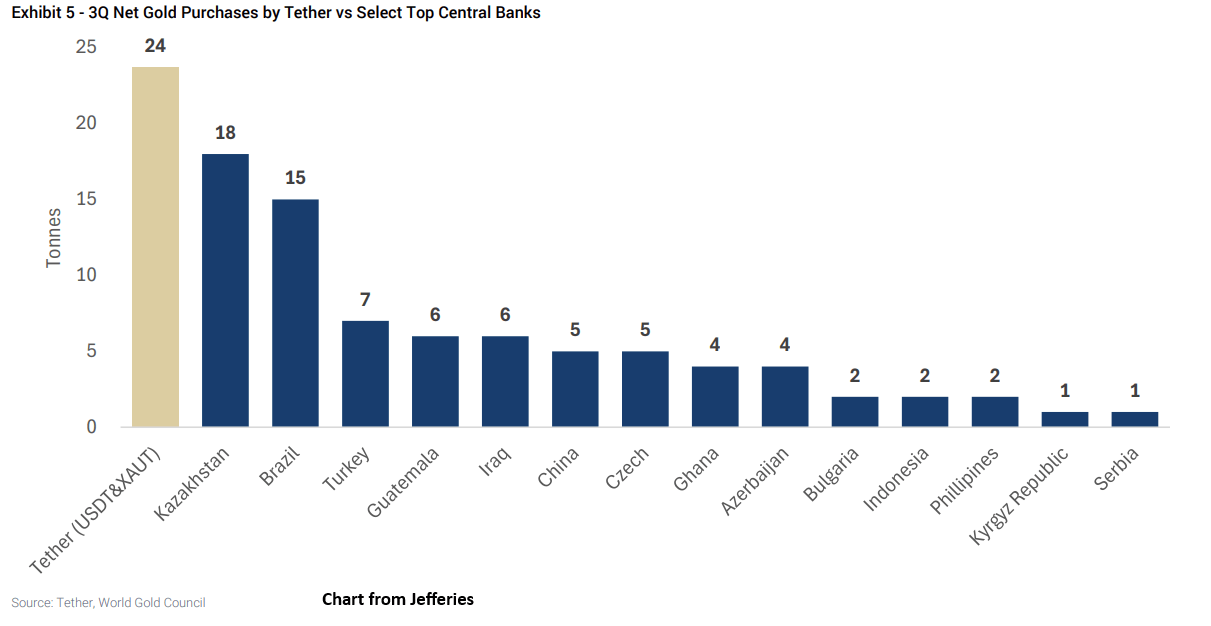
Source: Reuters summary by Jefferies report.
Market strategists say Tether’s holdings are not for show. These are strategic and are expanding at a pace that is significantly tightening supply. Jefferies estimates that Tether added 26 tonnes of gold in the third quarter alone, accounting for about 2% of global demand and more than 12% of all central bank purchases over the same period.
read more: Tether enters Bitcoin-backed lending with strategic Ledn stake
Coincidentally, gold prices have climbed more than 50% this year to more than $4,000 an ounce due to a combination of investor anxiety, geopolitical tensions, and central bank accumulation. According to the report, Tether’s purchase wasn’t just riding the wave. That helped lift it up. Analysts predict that Tether could add up to 60 tonnes of gold per year if it allocates half of its expected profits to bullion in 2025.
With USDT issuance still expanding globally, Jeffries argues that demand for gold from the stablecoin ecosystem could become a structural force rather than a seasonal one. In other words, this trend may only be warming up. Beyond its gold reserves, Tether has reportedly funneled more than $300 million into mining royalties and streaming companies and hired a former HSBC metals trader, suggesting deeper ambitions than passive reserves management.
The report describes these moves as early steps toward a vertically integrated metals strategy, which may sound dramatic until you remember that Tether already has a balance sheet larger than some Treasurys. Still, Jeffries tempered the bull’s claims with a warning.
Tether’s upcoming GENIUS-compliant stablecoin USAT does not require gold backing, which could reduce long-term demand for bullion. Regulatory changes can disrupt reserve strategies. And Tether’s history of scrutiny means any failure can have repercussions far beyond crypto-native circles.
Still, Jeffries’s point is clear. Tether is important to the gold market right now – perhaps much more so than global traders realize. And if USDT continues to grow, Tether’s appetite for gold is likely to grow as well.
Frequently asked questions ❓
- What did Jeffries emphasize about Tether’s gold strategy?Analysts noted that Tether’s rapid gold accumulation is impacting global supply and supporting high prices.
- How much gold does Tether hold?Tether controls approximately 116 tonnes of bullion across USDT and XAUT reserves.
- Why is this important for global markets?Jeffries argues that demand for Tether could shape its price over the long term as stablecoins become more popular.
- What is Jeffries’ role in this analysis?Jefferies provides institutional research that explains how the purchase of Tether will impact global commodity markets.


