

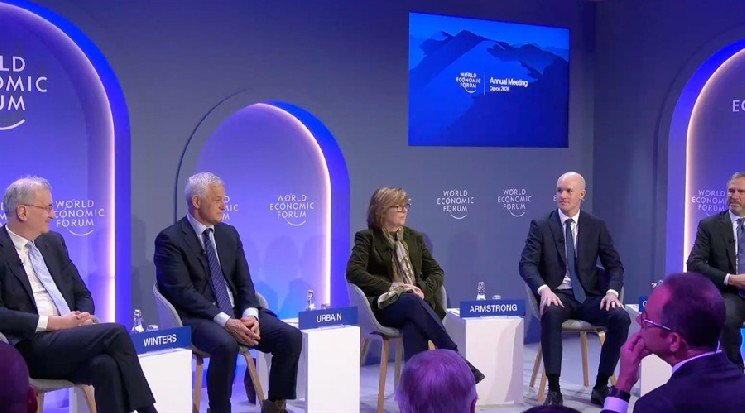
The discussion on digital assets at the World Economic Forum has moved from speculative discussions to practical implementation.
Global financial leaders have framed tokenization and stablecoins as the “name of the game” for 2026. But the clear consensus emerging from Davos is that, at least for now, the revolution is institutional, not retail.
wholesale consensus
Last year, the future of cryptocurrencies was discussed at Davos. However, this year’s discussion focused squarely on how to deploy blockchain-based infrastructure at scale. The important takeaway for brokers and financial institutions is that, far from the consumer hype, the most immediate and visible progress is occurring in the wholesale market.
François Villeroy de Galhau, Governor of the Banque de France and member of the ECB Executive Board, captured the atmosphere perfectly. He acknowledged that while stablecoins are “very trendy,” the jury is still out on use cases beyond the native crypto ecosystem.
Is tokenization the future? @cnbcKaren (@CNBC), @brian_armstrong (@coinbase), @bgarlinghouse (@ripple), Valérie Urbain (@EuroclearGroup), François Villeroy de Galhau (@banquedefrance), Bill Winters (@StanChart) #WEF26 https://t.co/Ob8n7PCh1T
— World Economic Forum (@wef) January 21, 2026
He pointed out that the ECB’s wholesale central bank digital currency (CBDC) efforts are the real focus, allowing tokenization to be tested in controlled, high-value environments such as payments and collateral management. This “wholesale first” approach seemed to be a recurring theme.
Valérie Urbenu, CEO of payments giant Euroclear, highlighted ongoing efforts to tokenize the €300 billion French commercial paper market. The goal, she explains, is not just to test new products, but to put the entire ecosystem on new rails to understand how issuance, payments, and investor participation work together at scale.
Bill Winters, chief executive of Standard Chartered, said the industry was at a “tipping point”, but noted there were key constraints for global banks and brokerages. The path from experiment to full-scale operation will be determined not only by technology but also by regulatory coordination across dozens of jurisdictions.
(#Highlighted link#)
retail discussion
Although an institutional focus dominated the discussion, the possibility of broader retail access was not completely ruled out. Coinbase CEO Brian Armstrong has hinted at long-term ambitions, arguing that tokenization has the potential to bring high-quality assets to billions of the world’s population in an “unintermediated” manner.
However, this vision of mass access received a harsh reality check from regulators. Villeroy de Galhault warned that the widespread adoption of privately issued tokenized currencies, particularly by foreign issuers, could raise “sovereignty concerns” for national economies. His central message was clear. Regulation is not the enemy of innovation, but a “guarantee of trust” necessary for innovation to succeed.
For brokers and multi-asset platforms, the message from Davos is clear. The short-term focus is on market infrastructure, not retail traded products. Strategic discussions turned to trust, governance, and how to position your company as a regulated gateway between the old financial world and the new tokenized rails. The era of asking “what if” is over. The era of building “how” has begun.


