

Needham Wall Street analyst Alex Henderson provided the latest example of institutional investors’ bullishness on artificial intelligence (AI) when he raised his 12-month price target for Lumentum Holdings (NASDAQ:LITE) on March 4.
Specifically, Mr. Henderson revised his previous LITE stock price forecast from $550 to $850. This change means Needham no longer expects Lumentum Holdings shares to fall 23.77% by early 2027, but instead expects them to rise 17.81%.
This change is directly related to the company’s $2 billion investment deal with semiconductor giant Nvidia (NASDAQ: NVDA) announced in early March. Alex Henderson also supported the upgrade, citing both the scope and relatively long-term nature of the deal.
In fact, the blue-chip chipmaker is expected to begin supplying Lumentum’s high-power lasers in the second half of 2027, and the deal runs through at least 2029.
Given Nvidia’s position in the semiconductor industry, the deal could serve as a harbinger of more laser maker customers coming on board in the coming years, further reinforcing its bullish stance.
Wall Street is at odds with the broader market over the AI boom and AI bubble
Elsewhere, Needham’s amendments signal a growing disconnect between Wall Street’s convictions and broader market doubts. LITE stock rose significantly when this deal was announced, but saw a significant pullback in trading on March 3rd, before partially reversing again in the pre-market rally on March 4th.
Specifically, the company’s stock price first rose from Friday’s closing price of $700 to Monday’s closing price of $784, then reversed to $694 on Tuesday, and finally reached its price of $721 at press time on Wednesday.
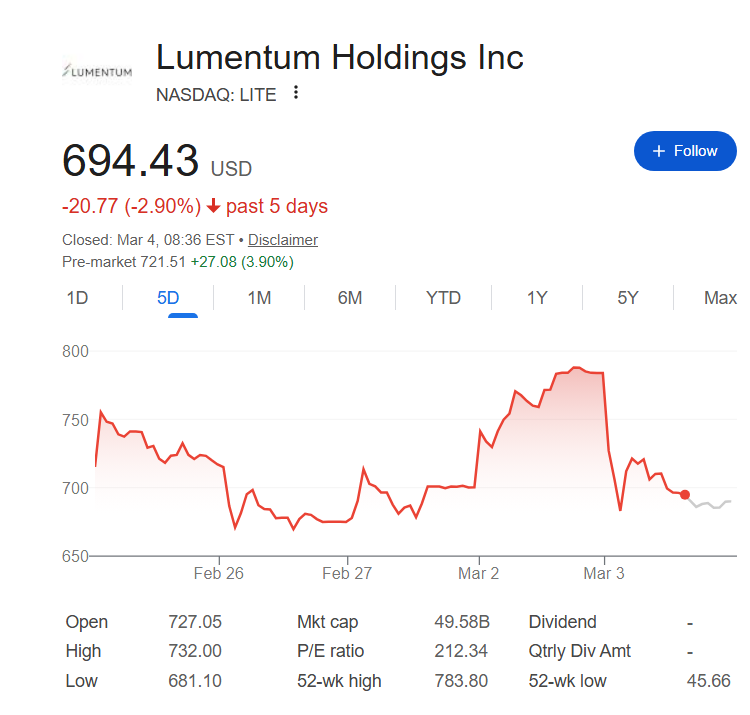
This intense volatility is consistent with widespread unease over lofty valuations and high expectations for AI that have been evident since the start of 2026, but perhaps also since Nvidia briefly surpassed the $5 trillion market cap.
As of press time on March 4, the most dramatic example of investor anxiety came in the wake of the latest earnings reports from Microsoft (NASDAQ: MSFT) and Nvidia. That’s because both filings showed very strong performance, yet led to hundreds of billions of dollars worth of single-session wipes.
Featured image via Shutterstock


