

A wave of criticism and warnings about Tether’s current reserves have called into question the stability of USDT, the main stablecoin pegged to the US dollar.
These criticisms have been exacerbated by S&P Global’s recent downgrade of the company’s credit rating. The rating agency pointed out the risk of USDT price decline. but, Financial data from companies behind stablecoins suggests solid ability to face adverse scenarioseven as the cryptocurrency winter drags on.
S&P Global’s recent rating changes from 4 (Limited) to 5 (Weak) indicate an increased perceived risk to the ability to maintain a dollar peg for digital assets.
The analysis justified the negative revision, citing increased exposure to “high-risk assets” such as Bitcoin (BTC) in USDT reserves over the past year, as well as persistent gaps in disclosure.
Composition of USDT reserves
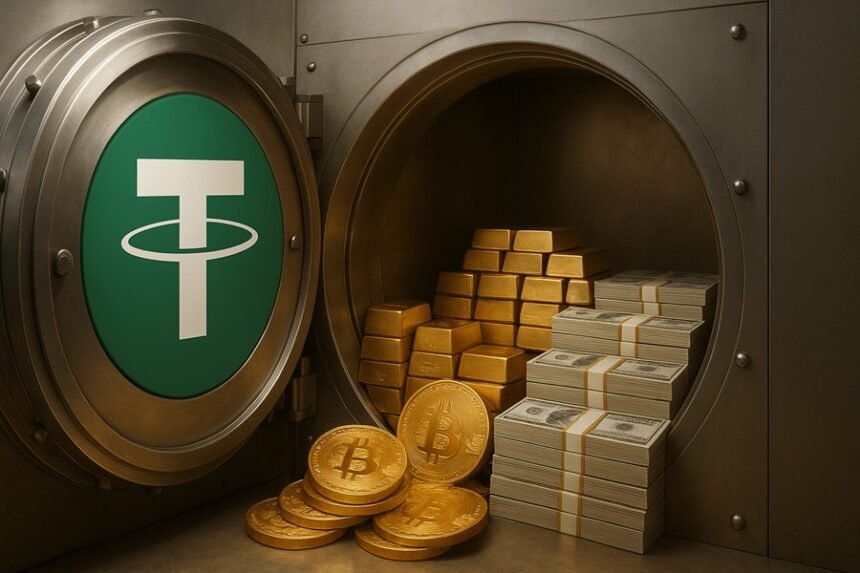
The audit at the end of Q3 2025 will provide insight into the current composition of USDT reserves. the data shows that Tether holds 80.3% of its reserves in US Treasuries, 7.1% in gold, and 5.4% in Bitcoin..
By October 31st, a total of $181.223 billion will be spread across various assets within its reserves. Reserves represent the assets backing the tokens in circulation, slightly exceeding the value of the issued tokens to maintain stability and cover risks. However, currently, the circulating supply of USDT has already exceeded 184.58 billion USDT, and the total supply is approximately 186.956 million USDT.
The company has established itself as one of them. It is now the world’s largest holder of U.S. debt, surpassing countries such as Germany. It holds a total of $141 billion in Treasury-related assets. This figure includes $112.417 billion placed directly in bonds and $27.457 billion placed in repurchase contracts and money market funds. These products are almost entirely backed by government bonds.
Most U.S. bond collateral is considered low risk and highly liquid.
Equally noteworthy is the growing diversification into assets such as gold. Tether holds $12.921 billion in precious metals (mainly physical gold) and $9.856 billion in Bitcoin, which together account for more than 12% of the total stablecoin backing. For critics, this part is excessive in a product that is touted as “stable” and whose value must be fixed in dollars under all circumstances.
In fact, the country’s gold reserves, with 116 tonnes of the precious metal, rival those held by countries such as South Korea, Hungary and Greece, making it the world’s largest investor in gold outside of central banks, as reported by CriptoNoticias.
USDT Additional Capital and Arthur Hayes Criticism
Arthur Hayes, co-founder of BitMEX exchange, questions Tether’s financial health, Argues that diversification into gold and Bitcoin is a hedging strategy that exposes you to falling prices.
Hayes warned that a hypothetical scenario could wipe out Tether’s capital and render USDT insolvent if the combined value of gold and BTC falls by around 30%.
However, Tether CEO Paolo Ardoino flatly rejected that analysis, explaining that both Hayes and recent criticisms (including the S&P Global downgrade) ignored important parts of the company’s balance sheet.
In Ardoino’s own words, as of the end of the third quarter of 2025, the company had $7 billion in excess capital over its stablecoin reserves, and an additional $23 billion in retained earnings, which is part of Tether Group’s capital.
This cushion is not reflected in the audit, but The total amount of $30 billion belongs entirely to the company. It is also uncommitted as a 1:1 backup of the tokens in circulation, thus serving as an additional layer of protection not considered in adverse scenarios raised by critics.
However, the very fact that they do not appear in the audit raises legitimate doubts as to whether these funds really exist in the declared size or may have already been pumped into other operations of the group. This opacity is one of the most recurring points of skepticism about Tether.
Former Citi analyst Joseph Ayoub also defended Tether, but his argument strayed from the central issue. Instead of talking about USDT support, he focused on the profitability of the business. “Tether holds approximately $120 billion in interest-bearing government bonds (…), which equates to approximately $10 billion in net income at almost all costs (150 employees), making it one of the most efficient cash generators in the world.”
While it is true that Tether is profitable, this point does not address the main criticism of whether USDT reserves can be fully backed 1:1 in extreme stress scenarios. Parent company profitability alone does not guarantee immediate redemption of tokens in the event of a large run.
USDT resilience
From the data presented so far, it can be inferred that the robustness and diversification of today’s USDT reserves, as well as its huge surplus capital, makes it possible to face a prolonged crypto winter.
Analysts like Ted Pillows remember that “Tether has been on the market for 10 years and USDT is still $1.00.” He added that it operates on a fractional reserve model similar to traditional banks, but that stability will be maintained “as long as repayments are normal.”
Tether’s history includes moments of extreme market panic, such as the Luna/Terra crash in May 2022. Slight loss of parity with the US dollar in a few hours, almost 2%reaching a low point around 0.98 per dollar. Nevertheless, digital assets recovered in a short period of time.
It’s this resilience, Ayoub added, that has led analysts like him to point out that “Tether is not bankrupt; quite the opposite. They own the money printing presses.”
While there are legitimate reasons for concern, including S&P Global’s downgrade, increased exposure to volatile assets such as Bitcoin and gold, and continued opacity in the disclosure and actual existence of declared excess capital, the risk of USDT collapse remains low.
Therefore, until there is a massive and simultaneous loss of confidence coupled with extreme declines in the prices of Bitcoin and gold, there is no hard evidence that USDT will irreversibly depeg from the dollar in the short or medium term. We encourage continued vigilance, but current data does not warrant panic.
(Tag translation) Altcoin


