

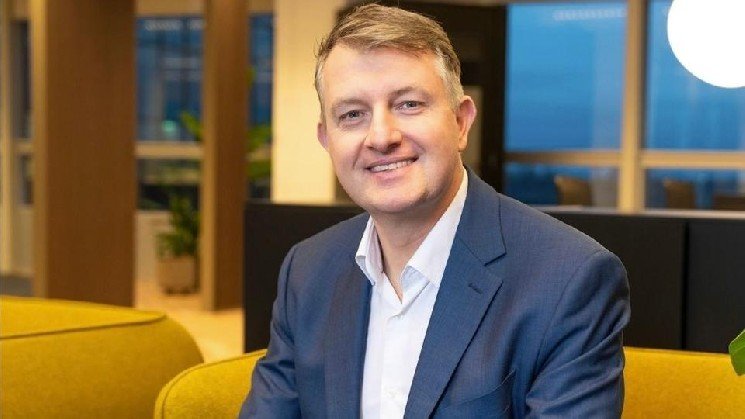
Unless Europe puts the euro on blockchain rails, it risks losing control of its financial future to the dollar, said Jean-Oliver Sell, CEO of bank-backed stablecoin project Kyvaris.
The warning reflects growing concern among European banks and policymakers that the next phase of global finance is increasingly built on blockchain infrastructure, becoming overwhelmingly dominated by dollar-pegged stablecoins such as Tether’s USDT and Circle’s USDC.
“In the absence of a liquid on-chain euro, the only alternative is the US dollar,” Sell told CoinDesk. “This is a real risk to Europe’s financial and digital sovereignty.”
Stablecoins are no longer just cryptocurrencies. They are now at the core of the global financial system, and their market capitalization, currently around $314 billion, could rise to between $800 billion and $1.15 trillion over the next five years, according to recent calculations by Jefferies.
In traditional finance, the euro accounts for about 20-25% of global activity, making it the world’s second-largest reserve currency, Sell said. However, its presence on-chain is almost non-existent.
“In the blockchain space, the euro accounts for about 0.2% of transactions,” Sell said. “It’s a huge disconnect.”
Top 12 EU banks vie for stablecoin supremacy
Qivalis, backed by a consortium of 12 major European banks including ING, UniCredit and BBVA, aims to fill that gap by issuing a MiCA-compliant Euro stablecoin.
The project aims to begin as soon as regulatory approval is received, with Sell targeting the second half of this year, depending on the licensing timeline with the Dutch central bank.
Sell said the consortium aims to build a “default” euro-denominated token for the global crypto market, effectively creating a European alternative to the dominant dollar stablecoin.
“We want to be the leading issuer of euro stablecoins globally,” he said. Fundamentally, Qivalis positions itself as an infrastructure rather than just a token. “We are building an interface between blockchain and the euro,” Sell said. “It needs to be available no matter where the use case is.”
Qivalis is designed to address a key issue that has hampered euro stablecoins to date: fragmentation.
“Some banks are trying to issue their own coins, but that space will only become more fragmented,” Sell said. “Bringing the institutions together creates the diversification and liquidity needed to make it available.”
Not the ECB’s digital euro
The project comes as the European Central Bank (ECB) continues its work to develop a digital euro, which it aims to issue by 2029, but Sell said the two efforts are fundamentally different.
ECB President Christine Lagarde recently said that the ECB had finalized parts of the central bank’s digital euro and that the future would depend on the actions of political institutions. The project aims to create a public digital payment instrument and is under review by the European Council and the European Parliament.
Kyvaris will issue a private stablecoin regulated by MiCA, but the ECB’s plan relies on centralized infrastructure.
“We don’t think of this as a competition,” Sell said. “This is an enhancement of the same financial stack.”
He described a “currency stack” where central bank funds reside on a centralized system, while blockchain-based use cases such as cross-border payments and on-chain payments require euro-native assets on public networks.
“Right now, if you want to operate on-chain, you’re effectively forced into dollars,” he said.
Competition with dollar dominance
The urgency behind this project relates to how rapidly financial activities are moving to blockchain-based systems, from crypto trading to global payments and decentralized finance.
Kyvaris is betting that its bank-backed, regulated approach can compete with existing dollar-denominated stablecoins by building liquidity and integrating exchanges, custodians, and DeFi platforms.
“We aim to build an entire ecosystem around Euroonchain,” Sell said.
Part of the challenge is not just issuing tokens, but creating demand in a market where dollar stablecoins are already deeply entrenched.
Sell cited currency risk as one of the reasons why euro-denominated alternative currencies are gaining momentum.
“If you’re a European user who earns yield in dollars, you’re also exposed to currency risk,” he said, noting that exchange rate fluctuations could offset returns.
Financial sovereignty issues
As more financial activities move to blockchain rails, the absence of widely adopted euro stablecoins could leave Europe structurally reliant on dollar-based infrastructure.
“One of the risks is that as more activity moves on-chain, without euros available, everything will just be done in dollars,” he said.
“We are laying the foundations for European digital autonomy, without which we will face dollarization.”
He added that the goal is not to fully replace the dollar, but to keep the euro competitive in a rapidly evolving financial system.
“In this area as well, we want to restore the euro to its status as the second world reserve currency,” Sell said. “It’s about taking the future of finance back into our hands as Europeans.”


