

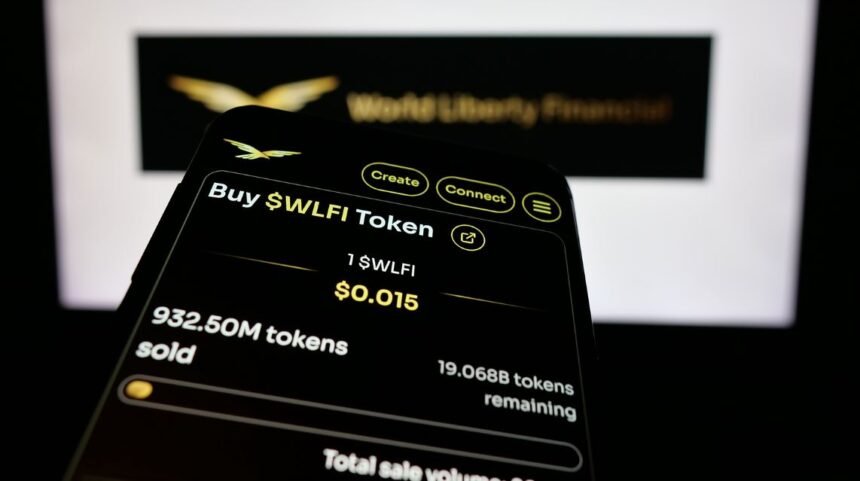
World Liberty Financial Token (WLFI) has fallen nearly 10% in the past 24 hours, hitting a new all-time low amid growing concerns over a series of on-chain moves related to debt acquisitions.
At the time of publication of this memo, April 10, 2026, the platform’s governance tokens were tied to Donald Trump’s family. Trading around $0.083This is 82% below the all-time high of $0.46 recorded on September 1, 2025.
The series of events that set off the alarm began on February 8, 2026. According to data revealed by the Arkham Explorers, on that day, World Liberty Financial’s Treasury Department Deposit 14 million USD1a proprietary stablecoin used as collateral in the Dolomite decentralized finance (DeFi) protocol. At the same time, it borrowed 11.4 million USDC.
After a few minutes, these funds were sent to a Coinbase Prime address, a platform commonly used for fiat conversion and institutional work.
2 days later, World Liberty Financial I sent another 12.5 million USD1 directly to another Coinbase Prime address. Then, on February 20, the Ministry of Finance deposited WLFI 890 million as collateral and borrowed USD 20 million1. On March 24, another 1.1 billion WLFI was issued; Total tokens used as collateral within Dolomite reached 1.99 billion.
Together, these operations allowed the platform to acquire approximately $31.4 million in stablecoins. In other words, it is not the entry of new capital; Liquidity extraction backed by assets issued by the structure itself.
This is a move that suggests World Liberty Financial is using its own stablecoin and its own token to support its fundraising strategy within the protocol, and that it also has a dominant position there.
According to available data, WLFI accounts for nearly 55% of the total liquidity supplied in the Dolomites.. The USD1 pool, on the other hand, has a utilization rate close to 93%, which suggests very concentrated usage and little room for large-scale withdrawals.
The problem is that the collateral doesn’t seem to be very strong relative to the size of the position. WLFI has limited market depth compared to the number of pledged tokens. This means that if the price drops sharply and auto-liquidation is enabled, a forced sale of those tokens could cause the price to fall further before the protocol unwinds the position.
In that scenario, the risk no longer rests solely on the token; as well as depositors who have lent funds within the system.
In the face of criticism, the project has come out to defend its position on X. According to their official account, the “FUD” regarding the loan was wrong, they said. FUD in the financial ecosystem fear, anxiety, doubt (fear, uncertainty, doubt) and is typically used to refer to information intended to create distrust in an asset or project.
“Yes, we are offering WLFI as collateral and borrowing stablecoins. No, we are a long way from liquidation,” they wrote. They also assured that their role as large borrowers has helped maintain the protocol’s attractiveness, stating, “By being an anchor borrower, we are generating performance that makes the WLFI market attractive to everyone else.”
The company added that it has repurchased 435,301,344 WLFI tokens in the past six months. Total price: $65.58 million, average price: $0.1507. “We didn’t have to do it because we believe in what’s going to happen,” they argued.
As reported by CriptoNoticias, this strategy is supported by World Liberty Financial’s proprietary automatic token repurchase and write mechanism.
Still, the market seems to think differently. Rather than seeing signs of strength, many traders observe circular structures Liquidity is based on assets issued by the platform itself, with concentrated risk and little margin in case prices fall further.
(Tag Translation) Altcoin


