


Stablecoins currently account for up to 90% of the $28 billion traded annually in Peru’s crypto market, said Daniel Acosta, general manager for Latin America and North at Binance. Acosta emphasized that the main use case for stablecoins in Peru is cross-border payments and remittances.
Important points:
- Binance’s Daniel Acosta points out that 90% of Peru’s $28 billion annual crypto trading volume now involves stablecoins pegged to the dollar.
- According to Lemon’s report, Peru will hit the top six crypto economies in 2025, with stablecoins significantly reducing remittance costs.
- Next, Acosta predicts that financial institutions will seamlessly adopt cryptocurrencies, providing a new alternative to traditional banks.
Stablecoins control 90% of Peru’s crypto market
Stablecoins have become one of the primary use cases for cryptocurrencies, more prominently in regions facing economic hardship due to difficulty accessing regular dollars.
Daniel Acosta, general manager for Latin America North at Binance, recently commented on the relevance of these digital assets in the country, highlighting that these digital assets are responsible for the majority of crypto transactions originating from Peru.
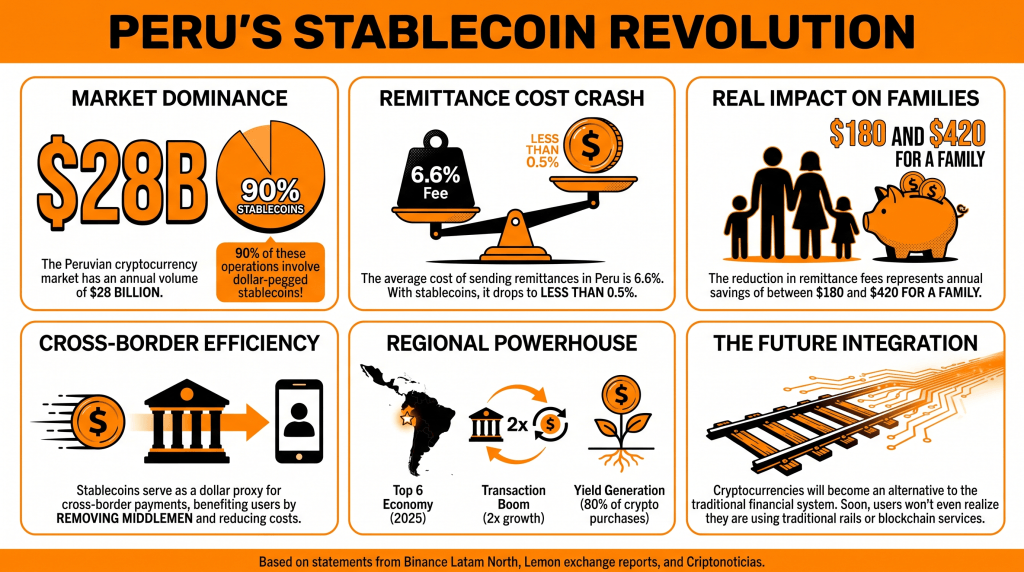
According to Criptonoticias, Acosta said Peru’s cryptocurrency market has an annual trading volume of $28 billion, and 90% of its operations involve stablecoins pegged to the dollar.
For Acosta, one of the drivers of this high level of adoption is the use of these as dollar agents for remittances and cross-border payments, as they can eliminate intermediaries, reduce costs and increase the efficiency of these processes.
“The average cost of remittances in Peru is 6.6%. Using stablecoins, that drops to less than 0.5%. This equates to savings of $180 to $420 per year for families. We are not talking about speculation, we are talking about real impact on people’s lives.” He evaluated and reiterated the benefits of using stablecoins compared to leveraging traditional alternatives.
Peru’s cryptocurrency market has experienced a boom in recent years. Argentina-based crypto exchange Lemon has found that the country will be among the top six crypto economies in the region by 2025, with interbank transactions more than doubling. 80% of crypto purchases in Peru last year included stablecoins, which were used to generate yield.
Acosta believes that cryptocurrencies will begin to be considered as an alternative to the traditional financial system, with institutions implementing them as part of their processes. This way, users will not be able to detect whether they are using traditional rails or a crypto or blockchain-based service.


