



Ethereum Foundation Chairman Aya Miyaguchi offered his thoughts on the organization’s new mission, framing the transition as a necessary reset as internal discussions became increasingly tense and the foundation faced pressure to do more things at once.
Her comments, posted on X after Vitalik Buterin shared his views on the foundation’s direction, come at a sensitive time for Ethereum’s core nonprofit organization. The EF is moving to a smaller, more focused structure, while the broader ecosystem debates its governance role, technological priorities, and a wave of high-profile departures.
Ethereum Foundation enters a new power era
Miyaguchi said the authority comes from the board of directors, but she proposed it late last year. The trigger, she says, was not a single controversy, but a structural problem. In other words, EF was the focus of competing expectations.
“First, discussions that were supposed to be technical began to become political and personal, sometimes shaped by quiet motives,” she wrote. “Second, as EF grew, different versions of ‘what EF should be’ began to pull at the core of the organization from all directions simultaneously. We became convinced that trying to satisfy them all would accomplish nothing.”
This line goes to the heart of the Foundation’s dilemma. Ethereum has long relied on EF for research funding, coordination, and management, but its culture has also resisted the idea that a single organization should become Ethereum’s command center. Miyaguchi leans heavily into that tension, arguing that the decline in EF centrality is not an escape from responsibility, but evidence that Ethereum has matured beyond its initial system.
“As I have said many times, EF is one of many nodes on Ethereum,” she wrote. “I know that’s hard for some people to hear because EF was the first group and was essential to making things happen in the early days. But it was never meant to stay this way.”
Miyaguchi connected that philosophy to his history with cryptocurrencies, saying he has been in the field since 2012 and joined Kraken in 2013, just before the collapse of Mt. Gox, and helped clean up its aftermath. That experience, she claimed, shaped her understanding of both the risks of growth and centralization. When she became executive director in 2018, her goal was to help Ethereum grow beyond EF.
She said the Foundation made a deliberate choice to decentralize power rather than maintain control. Miyaguchi pointed to EF’s role in nurturing and releasing projects like Uniswap and ENS, supporting ETHGlobal and hackathons, and “providing funding to funders” through groups like Gitcoin and Moloch. The guiding question, she says, has always been, “How is this going to stand on its own without us?”
According to Miyaguchi, this strategy resulted in EF holding less than 0.2% of the total ETH, making its role even narrower by design. Her mission, she said, is to preserve and accelerate the characteristics and goals that make Ethereum “uniquely valuable, competitive, and worth building on,” centered around what she calls CROPS and “the alignment of unalienable user self-sovereignty and self-sovereignty.”
“We cannot and will not do it alone,” she wrote. “But defining this as the North Pole of the mission and coordinating with allies who share it is a responsibility we uphold.”
Miyaguchi also pushed back against the idea that if EF were sharp, there would be fewer concerns about its adoption. She said the opposite is true, arguing that everyday users and institutions both rely on Ethereum’s fundamental value proposition. Adoptions, including institutional adoptions, are part of EF’s work, but only in a way that fits the mission, she said.
EF’s comments come amid a notable exodus of senior and prominent contributors in 2026, including researchers and ecosystem players such as Karl Beekhuizen, Julian Marr, Barnabe Monot, Tim Beiko, Trent van Epps, Josh Stark, and former co-executive director Tomasz Stanczak. The personnel changes have led to increased scrutiny over whether the foundation’s reorganization is a sign of healthy decentralization, internal tensions, or both.
Mr. Miyaguchi directly acknowledged the impact on personnel. “As EF becomes more focused and assertive, the team will naturally become smaller and more focused. That’s part of the choice,” she wrote, adding that a new leader has already stepped into the mission and that management will provide more details about the new structure and strategy in the coming weeks.
Buterin’s post on May 24 triggered Miyaguchi’s remarks. He said EF is still in a period of transition, stressing that he has no special authority over the board, and that other leaders are carrying out most of the current transition. He also envisioned the future of the foundation as leaner and more focused, less focused on being central to Ethereum and more focused on preserving the network’s long-term assets.
At the time of writing, ETH was trading at $1,986.
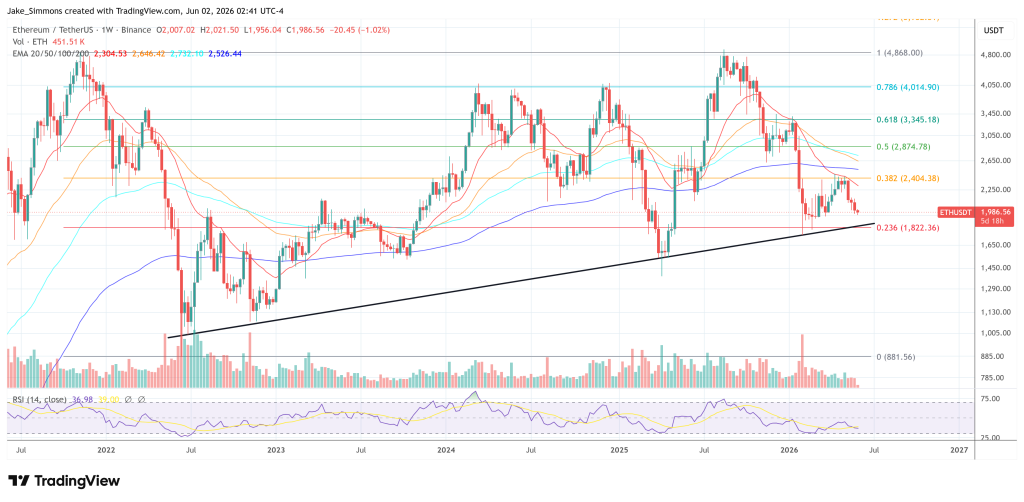
Featured image created with DALL.E, chart on TradingView.com
editing process for is focused on providing thoroughly researched, accurate, and unbiased content. We adhere to strict sourcing standards, and each page is carefully reviewed by our team of top technology experts and experienced editors. This process ensures the integrity, relevance, and value of your content to your readers.


