

Aztec Labs, the team building Ethereum’s programmable privacy layer 2, has acquired Obsidion and is committed to maintaining the ZKPassport protocol and its iOS application as open source software.
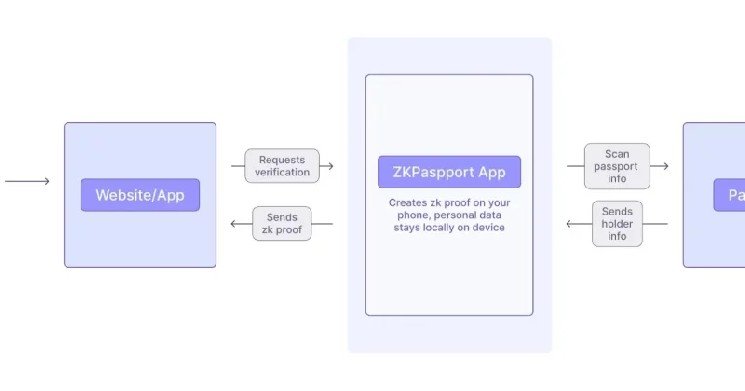
ZKPassport allows users to use government-issued IDs to verify their identity without actually exposing sensitive data on their documents. The protocol accomplishes this through zero-knowledge proof, a cryptographic technique that allows one party to prove that a statement is true without revealing the underlying information.
What ZKPassport actually does and why Aztec wants it
In the world of blockchain, one of the most persistent headaches is Sybil attacks. In a Sybil attack, one person creates thousands of fake accounts for the purpose of airdropping, governance voting, or token sales. ZKPassport provides a privacy-preserving solution to this problem. Verify that your users are real, unique people without collecting or storing personal data.
ZKPassport was integrated into the Aztec ecosystem starting around June 2025 and served as a human verification layer on the project’s testnet. The goal was simple: to ensure that each participant was a real human, not a bot farm operator running scripts from a data center.
The protocol also played a role in Aztec’s token sale in November 2025, raising approximately $59 million to $61 million at an initial fully diluted valuation of approximately $350 million.
Obsidion itself is described as a wallet designed for private payment operations on the Aztec network. Aztec Labs is bringing its identity and payments layers in-house by acquiring the team and technology behind both the wallet and ZKPassport.
Open source efforts are more important than you think
Open source is more than just a good philosophical position for protocols that handle identity verification. It’s a trust requirement. Users are asked to prove their identity using government documents. If the code that does that validation cannot be audited by anyone, the entire value proposition falls apart.
It’s also worth noting that we keep our iOS apps open source. Mobile applications are often a layer where open source projects quietly introduce proprietary components. Aztec’s decision to keep both the protocol and the app transparent suggests that this is not a token gesture.
The broader Aztec Network runs on Noir, a domain-specific programming language designed for creating zero-knowledge circuits.
What this means for investors and the privacy market
Azteca’s $59 million to $61 million token sale shows that investors are willing to put serious capital into privacy-preserving infrastructure. This number, when combined with the initial FDV of approximately $350 million, indicates that the market views Aztec as one of the most trusted players in the privacy layer 2 space.
In terms of the competitive environment, this acquisition creates a more vertically integrated stack. Aztec currently controls layer 2 networks, zero-knowledge programming languages, identity verification protocols, and wallets for private transactions.
A notable risk is regulation. While zero-knowledge identity verification is sophisticated in theory, regulators in multiple jurisdictions are still grappling with whether being able to prove who you are without telling you who you are meets compliance requirements. If a major market decides that the privacy protection verification does not meet the Know Your Customer standard, the entire theory behind ZKPassport will face a serious stress test.


