


As the economic downturn continues, recent analysis shows that all major Bitcoin bear markets eventually bottomed out following a black swan event.
For context, a black swan phenomenon causes a sudden and largely unexpected crisis, causing a sharp panic sell-off across markets, including Bitcoin. Historically, however, once the initial turmoil subsides, the market moves into a recovery phase.
Historically, major crises have signaled the bottom of the Bitcoin cycle.
Over the years, the cryptocurrency market has experienced several black swans. In particular, the collapse of the Mt. Gox exchange in 2014, the COVID-19 market crash in 2020, and the FTX implosion in 2022 all coincided with major lows in the Bitcoin cycle. Bitcoin initially reacted negatively to each event, but later made a strong recovery.
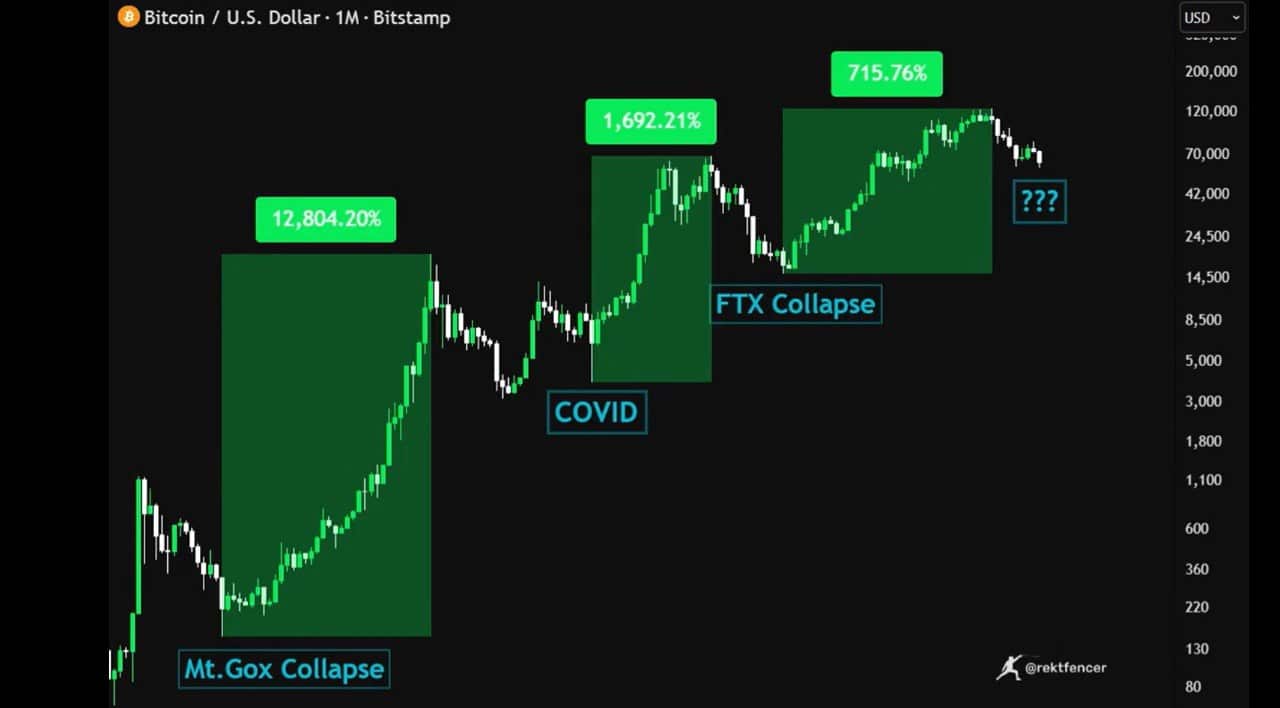
The collapse of Mt Gox marked the first major collapse of Bitcoin
The hacking and subsequent collapse of Mt. Gox, the world’s largest Bitcoin exchange at the time, was one of the industry’s earliest black swan events. Hackers stole about $850,000 $BTC It withdrew from the platform and was forced into bankruptcy in 2014.
This incident appeared to signal the final capitulation phase of Bitcoin’s initial bear market. After the collapse, Bitcoin ultimately soared over 12,804%, rising to around $24,500 during the ensuing bull cycle.
The coronavirus disease (COVID-19) crash triggered a historic recovery.
Similarly, the COVID-19 pandemic caused a sharp decline across global financial markets in March 2020, and Bitcoin was no exception. Major cryptocurrencies plummeted to around $3,800 as investors rushed to de-risk their portfolios.
However, the panic did not last long. As liquidity returned to the market, Bitcoin began a historic rally, soaring more than 1,692% and reaching nearly $69,000 by the end of 2021.
FTX implosion marks 2022 cycle bottom
Another decisive black swan event occurred in late 2022 when the cryptocurrency exchange FTX collapsed. The failure sent shockwaves through the digital asset industry, sending Bitcoin down to around $15,500 amid widespread fear and uncertainty.
However, that low marked the bottom of the cycle. From there, Bitcoin recovered more than 715%, eventually reaching over $126,000 in 2025.
Investors look for the next market catalyst
With Bitcoin once again trading in bear territory, investors are wondering whether it will take another black swan event to mark the next big bottom and ignite a new expansion phase.
The asset has already retreated significantly from its recent highs, and market observers see this period as a potential inflection point. As a result, the next major macroeconomic or industry-specific catalyst could determine whether Bitcoin enters another sustained rally or remains in a prolonged downturn.
The recent decline has not yet shown a definitive bottom.
Since hitting an all-time high in October 2025, Bitcoin has faced several sharp corrections, with some investors initially seeing it as a possible black swan event. These include the October 10th market crash, February’s geopolitical selloff, and this month’s selloff caused by Strategy 32. $BTC sale.
But unlike previous cycle-defining crises, these events have not been followed by the pattern of explosive recovery seen after Mt.Gox, COVID-19, and FTX.
At the time of writing, Bitcoin was trading at $64,097, up 0.3% over the past 24 hours. Despite daily gains, the cryptocurrency is still down 2.3% from the previous week and 14% from last month, highlighting continued uncertainty over the market’s next big move.


