




Bitcoin’s brief dip below $80,000 in the past 24 hours exposed market vulnerabilities after weeks of gains, but options traders are not yet treating the drop as the beginning of a deeper breakdown.
According to crypto slate The setback erased some of the bull run that had propelled Bitcoin up about 37% since early April, when traders began rebuilding their exposure following the first-quarter hit, according to the data. BTC has recovered to $80,360 at the time of writing.
However, if you dig deeper into option pricing, volatility metrics, and on-chain behavior, it becomes clear that the market is consolidating rather than capitulating.
Unlike past violent declines, which were often caused by macroeconomic headwinds, this week’s decline appears to be a mechanical byproduct of cryptocurrencies’ internal market structure.
While traditional stocks like the S&P 500 and Nasdaq Composite are hovering near all-time highs, Bitcoin’s localized weakness points to a combination of depletion, profit-taking, and the unwinding of overleveraged long positions.
How Bitcoin’s market structure fell below $80,000
Bitcoin’s brief dip below $80,000 was driven more by internal pressures within the crypto market itself than by changes in macro psychology.
The first source of stress came from profit taking. After rallying about 37% from its April lows, Bitcoin has returned a large group of recent buyers to profits, giving traders who have been underwater for months a reason to reduce their exposure.
According to CryptoQuant data, investors realized a profit on 14,600 Bitcoins on May 4th, making it the largest single-day profit-taking event since December 2025. The short-term holder expense return, which tracks whether recent buyers are selling the coin at a profit or loss, rose to 1.016, remaining above 1 since mid-April.
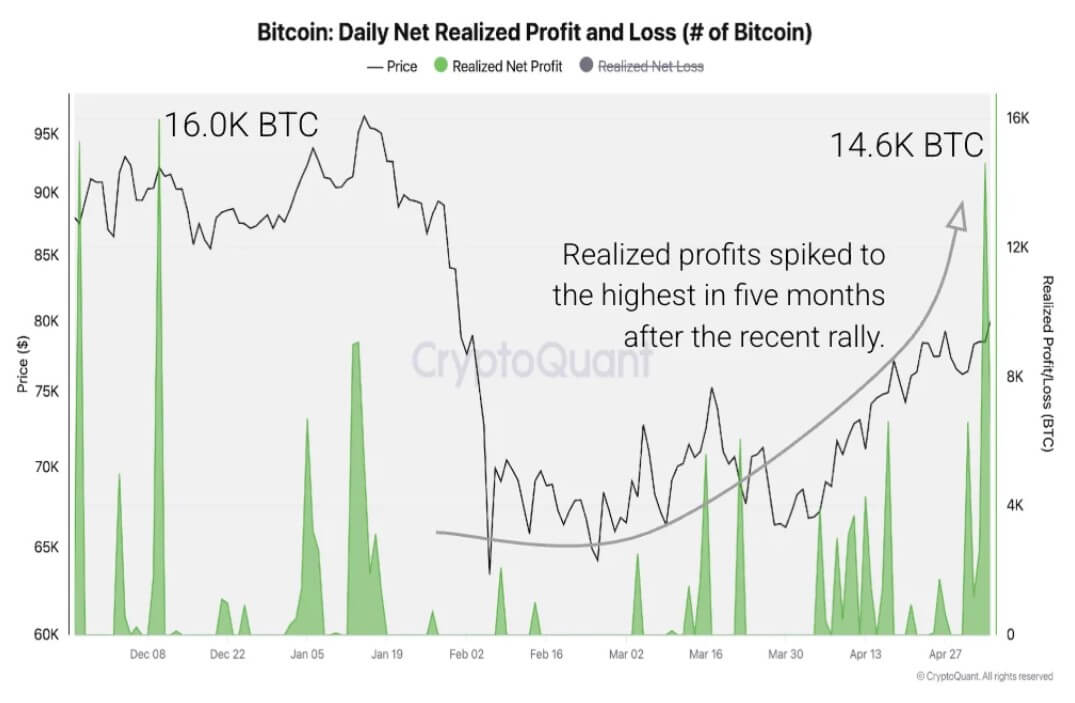
This change is important because it indicates that new holders are no longer selling due to distress. Instead, they were touting the strength of the market.
This behavior reflects the damage left by the first quarter’s drawdown.
From February to March, many short-term traders had unrealized losses of 20% to 30%. April’s recovery repaired much of that damage and created a natural exit for investors who had been waiting to return to breakeven or secure decent profits.
On the other hand, a similar pattern can be seen in unrealized gains. The total profit margin for Bitcoin traders is currently around 18%, the highest since June 2025.
CryptoQuant said similar levels have historically coincided with concentration of distributions as traders take advantage of bailout rallies to take away funds.
However, this product has not yet been widely distributed to the general public. Flows to exchanges remain subdued, suggesting that large holders are not actively moving their coins to centralized platforms. This limits any bearish signals from recent profit-taking and instead indicates that the market is digesting gains after a sharp rally.
At the same time, a second source of pressure came from the derivatives market, as Bitcoin’s early May rally was fueled by the rapid return of leverage to the perpetual futures market.
According to data from CryptoQuant, BTC’s open interest, or the total amount of outstanding derivatives contracts, recorded the largest increase in 2026. This expansion was even larger than the increase seen near Bitcoin’s 2025 all-time high.
Binance remained at the center of the activity, accounting for around 34% of the market, with average monthly open interest reaching $2.5 billion. Gate.io and Bybit have also seen increased trading activity, reflecting a broader return to risk appetite across major trading venues.
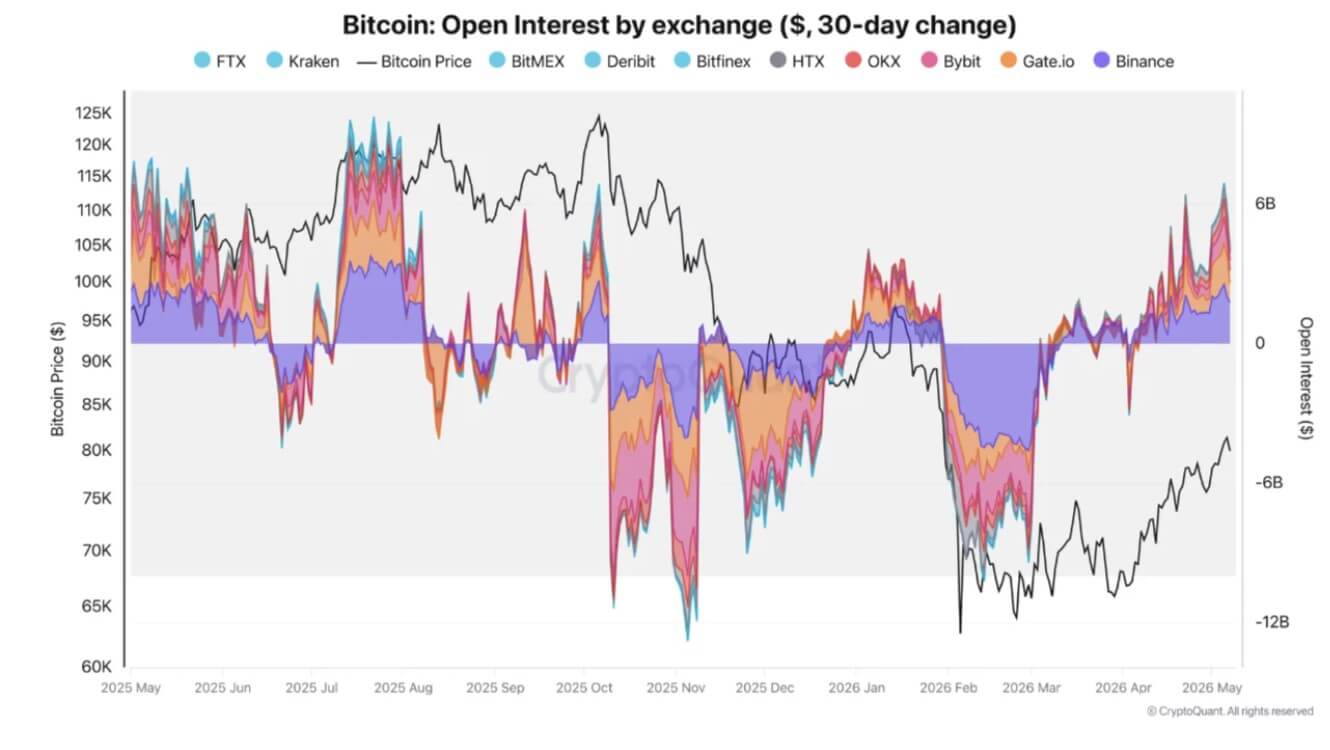
That influence helped fuel the rise, but also made the movement more fragile.
CryptoQuant analyst IT Tech noted that BTC funding rate fell to -0.031% per hour between May 2nd and May 4th, the lowest level since the post-COVID-19 market stress in 2020. The sharply negative funding shows that traders were flocking to short positions just as liquidity was outpacing the market.
Once Bitcoin broke above $78,600, the shorts were forced to unwind. Approximately $535 million in short positions were liquidated between May 4th and May 6th, accelerating the move towards the $82,000 to $83,000 range.
Open interest jumped from $26.5 billion to $29.1 billion during the squeeze, showing how much of the increase was driven by derivatives positioning rather than stable spot demand.
The move below $80,000 was the flip side of that process.
As the pressure faded, open interest cooled to about $26.7 billion. This decline washed away some of the speculative accumulation that had driven Bitcoin higher, reducing some of the leverage risk for the time being.
Option traders ignore the pullback
While spot markets were digesting selling pressure, options markets were clearly telling a more optimistic story. Volatility, which had been compressed to its lowest level since October 2025, is rising again at a ferocious pace.
According to Glassnode data, this spike in volatility is driven entirely by the front end of the curve. One-week implied volatility is up significantly from recent lows, indicating renewed appetite for short-term options.
At the same time, the 25 delta skew, a measure of the cost difference between bullish call options and bearish put options, is positively normalizing. After briefly showing a 5% premium on puts, the front-end skew has compressed towards neutral.
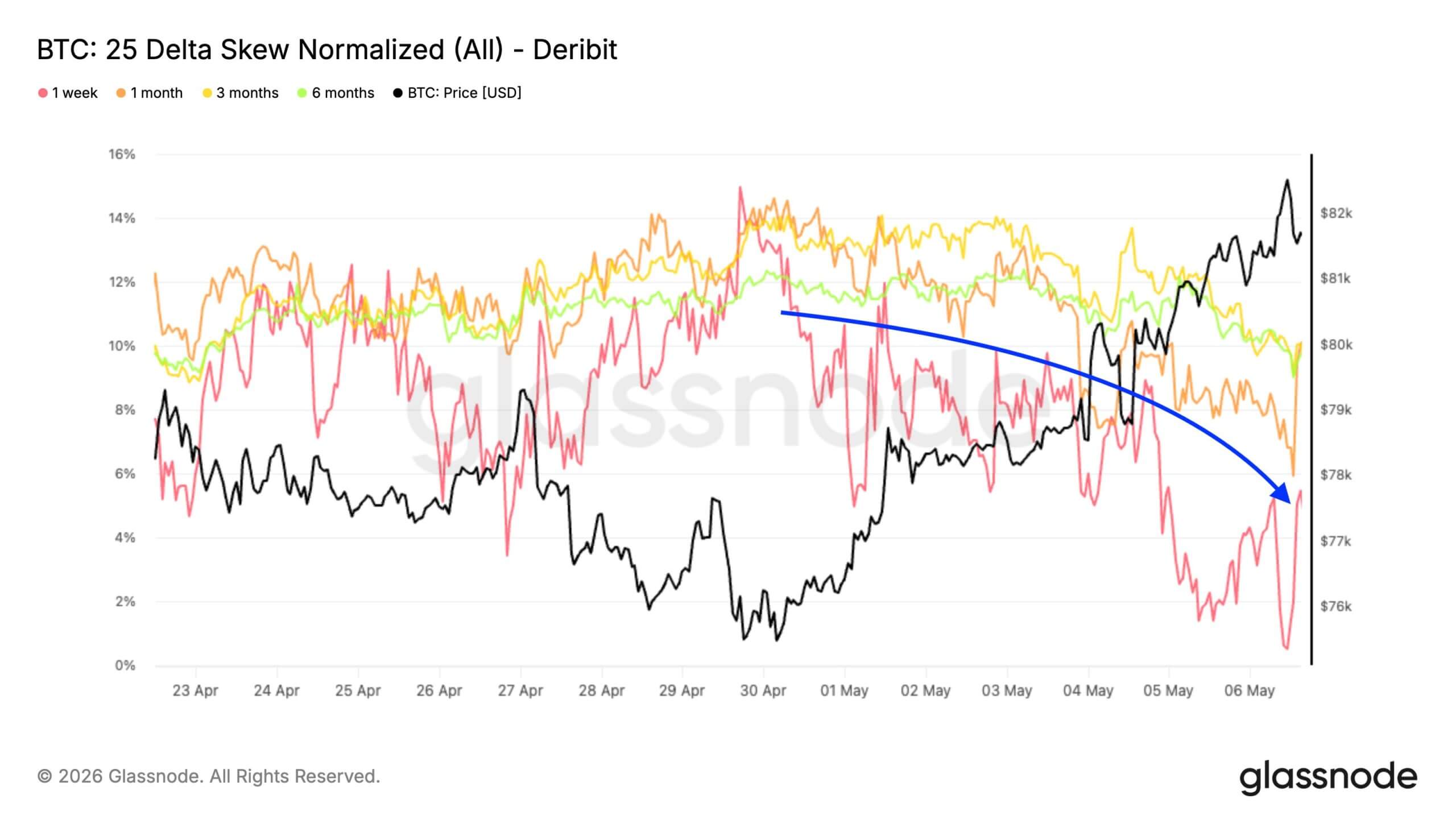
A broader skew index that evaluates the entire option curve provides a clearer picture. Downside hedges are being aggressively unwound and demand for upside exposure is steadily increasing.
The market effectively indicates that while traders maintain some baseline protection, they view the temporary decline below $80,000 as a temporary aberration rather than a structural collapse.
Further complicating the price movement is a large cluster of short gamma located near the $82,000 strike. This concentration, totaling nearly $2 billion, will force option dealers to dynamically hedge their books.
In practice, this means that dealers are forced to buy on market strength and sell on market weakness, a mechanical reflex that naturally amplifies price movements in this particular trading range.
Trading volumes confirm new possibilities for engagement. Daily derivatives trading volume, which had hovered between $800 million and $1.2 billion, soared to well over $4 billion while pushing toward $83,000, according to Blockscholes data.
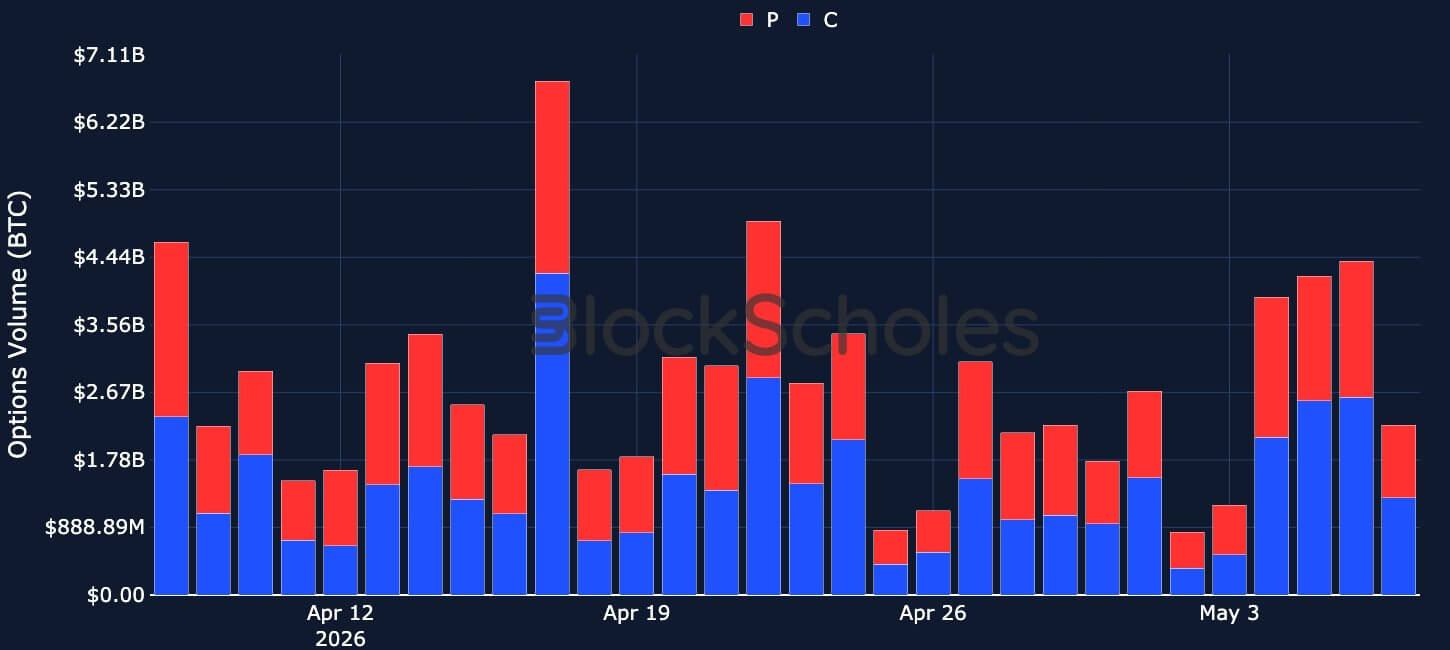
Despite the subsequent price decline, Brock-Scholes’ Internal Risk Appetite Index remained very strong, registering a value of +1.1720.
Road to $88,000
Given the above, a common question in the market is whether this entire sequence signals the beginning of a sustained macroeconomic bull market, or just the last euphoric breath of a long bear market rally.
The answer probably lies in cost-based cluster behavior.
CryptoQuant data shows that the age of unspent transaction outputs (UTXOs) provides a map of where different groups of buyers acquired their coins.
A very bullish divergence is currently forming. The cost basis for the 1-4 week holder cohort rose from $67,000 to $76,000, recently exceeding the $68,000 for the 1-3 month holder cohort.
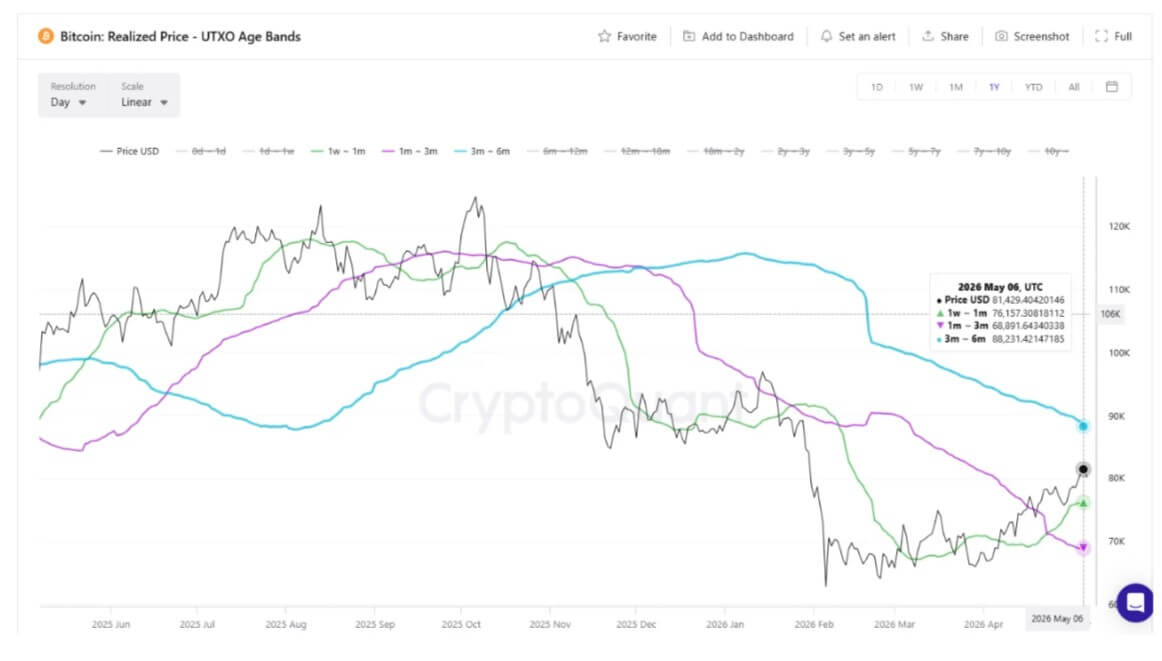
Technically speaking, this is a structural golden cross of on-chain sentiment. There is no doubt that short-term holders are the driving force behind market momentum.
When their overall position is underwater, there will be relentless selling pressure. However, when their positions match from the bottom up in terms of profits, they form the basis for a sustainable uptrend.
This fundamental adjustment is now locked in place, setting the stage for the next major psychological and technical battleground: $88,000. This level represents the cost basis for the 3-6 month holder cohort and exists as the ultimate resistance barrier.
If derivatives demand continues to absorb spot profit-taking and Bitcoin succeeds in collecting and holding $88,000, all short-term cohorts will be able to profit at the same time.
Historically, that particular catalyst has been the undeniable catalyst for a true trend reversal, turning cautious optimism into widespread retail elation.
(Tag Translation) Bitcoin


