

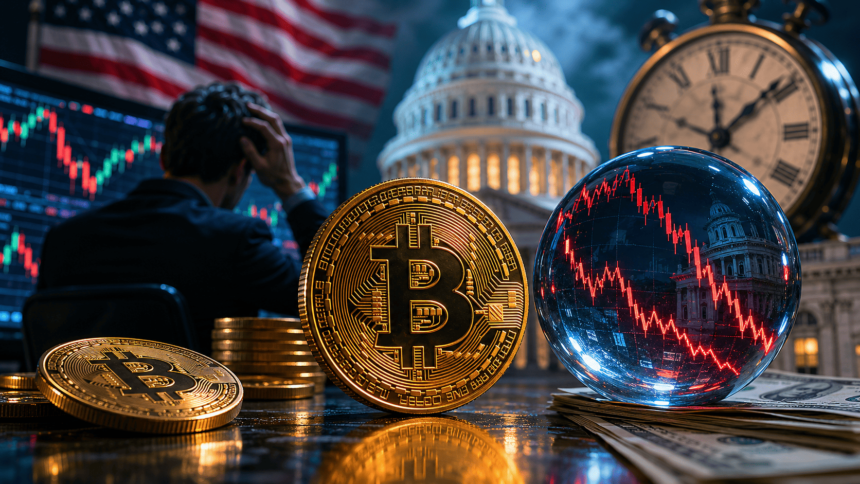
Bitcoin faces one of the most sensitive weeks in recent weeks for financial markets as expectations for US inflation and Federal Reserve interest rates return to the spotlight. BTC price movements will largely depend on a series of macroeconomic indicators that have the potential to redefine Wall Street’s risk appetite and, by extension, the performance of cryptocurrencies.
The primary focus will be on the Personal Consumption Expenditures (PCE) Index, the Federal Reserve’s recommended inflation measure to measure price developments in the United States. The April report is scheduled to be released at 7:30 a.m. ET on Thursday, May 28, a particularly sensitive time for the market. Those still trying to decide whether the Fed has room to start cutting rates In the second half of this year.
Consensus now expects headline PCE to be 3.5% YoY and underlying PCE to be 3.2%. Any deviation can quickly change financial expectations. Sustained inflation would prolong the idea of higher interest rates, while an economic slowdown would restore momentum to the monetary easing that has recently boosted risk assets.
The market’s implicit probabilities continue to point to the Fed keeping interest rates unchanged in June. However, uncertainty regarding future interest rate cuts has increased market sensitivity to various macroeconomic indicators. In that context, Bitcoin is particularly exposed to sudden changes in expectations regarding liquidity, yields, and monetary policy..
There are also a number of economic mentions this week that could increase volatility. Along with the PCE, Thursday, May 28 will also release the number of first-time applications for unemployment benefits, estimated at 212,000 compared to 209,000 previously, as well as the number of new home sales for April. These data help gauge whether the U.S. economy remains strong enough To maintain high interest rates without rapidly deteriorating.
Internationally, attention will also be focused on Australian inflation data, Canadian GDP, Chinese manufacturing indicators, and financial decisions in other relevant countries. All of this could impact global risk sentiment in markets that are particularly sensitive to signs of growth and inflation.
Geopolitical tensions in the Middle East also complicate the outlook.which keeps oil prices and the risk of new inflationary pressures under pressure. If energy prices continue to rise, it will be harder to slow U.S. prices and the Fed may be forced to maintain its tightening stance for an extended period of time, creating a historically unfavorable environment for Bitcoin and other risk assets.
At the same time, markets will continue to focus on Kevin Warsh’s new phase as head of the Federal Reserve following his confirmation. Although the focus is on macroeconomic data, any change in the central bank’s tone could have a direct impact on interest rate expectations and BTC movements.
What will happen to market sentiment?
From a technical perspective, Bitcoin has been showing signs of vulnerability this week after registering bullish momentum from April to May. The cryptocurrency failed to consolidate above $80,000 and ran into resistance near the 200-day moving average near $81,000. In addition to this, some momentum indicators weakened and the Relative Strength Index (RSI) returned to neutral levels after losing its bullish strength.
If the PCE report shows higher-than-expected inflation, the market could interpret it as meaning the Fed needs to keep interest rates high for an extended period of time. In this scenario, U.S. Treasury yields would rise, risk assets would become less attractive, and Bitcoin could head toward the support zone between $75,000 and $76,000.
Conversely, if inflation becomes a more moderate indicator, risk appetite could rise rapidly. That would give traders more arguments to bet again on future rate cuts, a trend that has historically favored both technology stocks and the crypto market. Under that scenario, Bitcoin could try to recover $80,000 to $82,000 range There is even room for a broader recovery if other economic indicators lead to slower inflation.
This means Bitcoin enters a week where inflation, economic growth, and monetary policy will once again drive market trends. The PCE report is seen as a major short-term catalyst and could determine whether cryptocurrencies regain momentum or face a new phase of pressure from high interest rate expectations in the US.


