




Investors are flocking to leveraged ETFs at a record pace, and Bitcoin’s risk-on boom is a test of whether speculative demand can withstand rising inflation and fading expectations for Fed rate cuts.
According to a report from Glassnode, Bitcoin is trading around $81,000 as of May 15, close enough to the $86,900 resistance ceiling to allow for a breakout and the $76,900 support floor to necessitate a rejection.
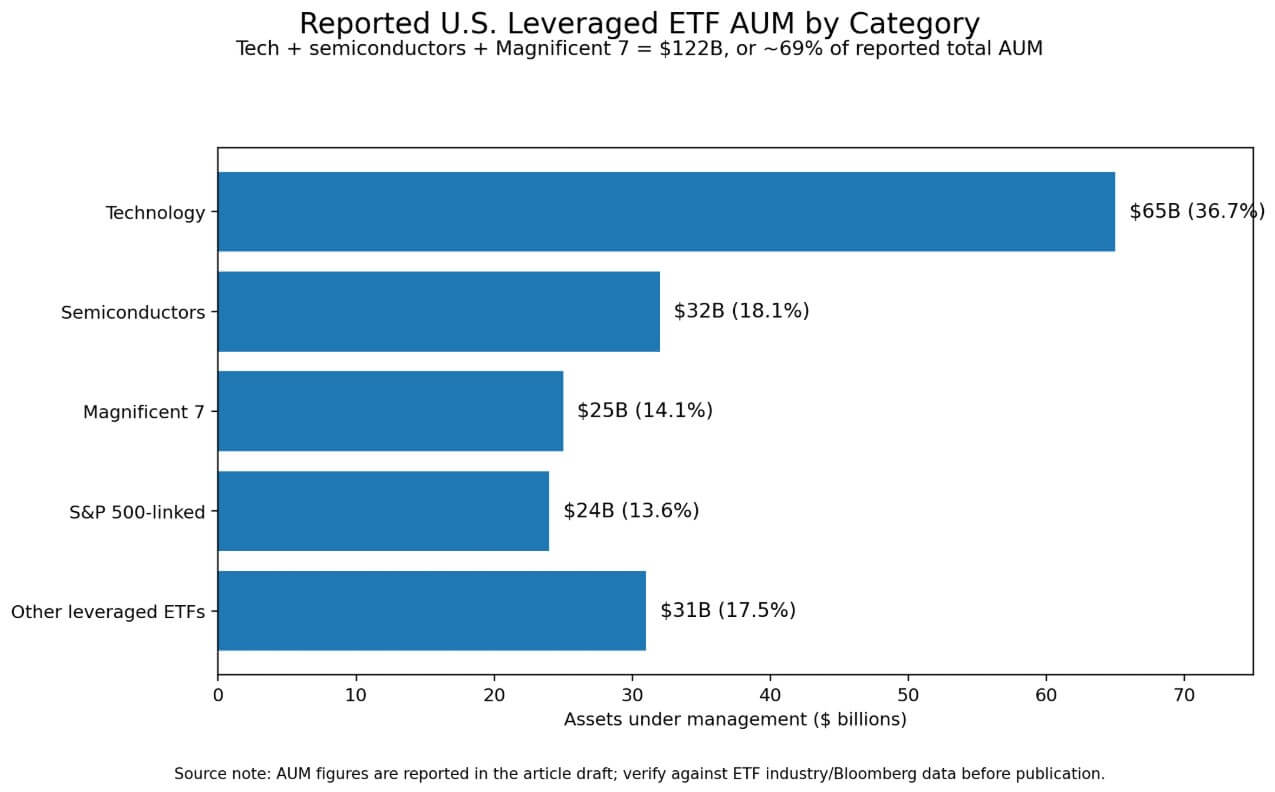
U.S. leveraged ETFs reportedly have $177 billion in assets under management, an increase of $45 billion from the March market lows.
Technology-related funds hold approximately $65 billion, semiconductor-focused funds hold $32 billion, and Magnificent 7-related products hold $25 billion, accounting for approximately 69% of leveraged ETFs’ total assets under management. Leveraged funds linked to the S&P 500 add another $24 billion.
Investors are paying the price for the broader gains in the sector that led the bull market since 2020, with Bitcoin trading as an extension of the same AI/technology/liquidity complex.
When the demand for leveraged stocks is so concentrated in growth and technology, speculative capital typically flows into high-beta assets, and Bitcoin remains one of those assets.
However, leveraged ETF products target returns of 2x or 3x per day, meaning that increased AUM increases momentum in both directions. The $45 billion added since March represents a 34% surge in a market already known for sharp reversals, and the risk appetite embedded in these flows is only as durable as the macro environment that sustains them.
Bitcoin’s risk-on boom is being tested against the backdrop of the Fed
The Bureau of Labor Statistics reported that headline inflation was 0.6% month over month and 3.8% year over year, up from 3.3% in March.
Core CPI increased by 0.4% from the previous month and by 2.8% from the same month last year. Energy led the acceleration, with gasoline rising 5.4% in April alone and 28.4% year-on-year, while the broader energy index rose 17.9% for the year.
Brent crude oil traded around $104.90 on May 14 as supply risks from the Strait of Hormuz continued to put upward pressure on oil prices.
At its April 29 meeting, the Fed kept its target range at 3.50% to 3.75% and said it would evaluate future data and balance risks.
Traders are pricing in a roughly 71.5% chance the Fed will hold the stock through the end of 2026, with UBS calling for its first rate cut in March 2027. Interest rate markets are currently pricing in the possibility that there will be no rate cuts this cycle.
The yield on the U.S. 10-year Treasury note is at an 11-month high of around 4.484%, with some investors predicting it could trend towards 5% if inflation persists.
A rise in real yields increases the opportunity cost of holding non-yielding assets and strengthens the dollar. Historically, both compress Bitcoin’s risk premium.
| macro input | latest reading | Directional pressure on BTC | why is it important |
|---|---|---|---|
| Overall CPI | 3.8% compared to previous year | bearish | Higher inflation reduces the Fed’s room to cut interest rates. |
| Monthly CPI | 0.6% m/m | bearish | With sharp monthly increases, inflation risk is always at the forefront. |
| Core CPI | 2.8% compared to previous year | Slightly bearish | If the underlying price trend remains stable, it becomes difficult to justify policy easing. |
| gasoline prices | +28.4% YoY | bearish | Energy inflation may raise household inflation expectations. |
| brent crude oil | ~$104.90 | bearish | The risk of stagflation persists due to rising oil prices. |
| Federal funds range | 3.50%~3.75% | bearish | Restrictive policies keep liquidity tight. |
| 10 year government bond yield | ~4.484% | bearish | Higher yields increase the opportunity cost of holding non-yielding assets. |
| Fed hold probability | ~71.5% until 2026 | bearish | Markets are no longer assuming short-term monetary easing. |
| Payroll calculation | +115,000 | neutral | The labor force is declining, but not collapsing. |
| unemployment rate | 4.3% | neutral | Calls for a recession remain premature. |
The University of Michigan Consumer Confidence Index hit an all-time low of 49.8 in April, while the Conference Board Consumer Confidence Index rose to 92.8. This split reflects how sensitive households have become to inflation.
Fears of a recession remained premature as employment rose by 115,000 people in April and the unemployment rate remained at 4.3%. The number of people working part-time for economic reasons increased by 445,000 to 4.9 million, the number of new unemployment insurance claims rose to 211,000, and the number of continued claims rose to 1,782,000.
Reheating inflation and softening labor undercurrents, along with pessimistic consumers, are a combination that makes for a worst-case scenario for the Fed, a debate between holding rates steady and raising rates.
In Glassnode’s May 13th update, Bitcoin’s immediate support was set at $76,900, derived on a 30-day cost basis, and short-term resistance was set at $86,900, tied to the November to February cumulative range.
In the zone around $82,000, Bitcoin is around 6.5% below resistance and 5.7% above support. Bitcoin has benefited from excessive risk appetite, but liquidity expectations need to be maintained to turn that appetite into a sustained breakout.
Glassnode noted that BTC’s recovery above $80,000 is constructive, but capital inflows are weaker than during previous bull market expansions. The wave of leveraged ETFs provides a speculative tailwind, but all Bitcoin expansions to date have required monetary easing to sustain the breakout.

opposite result
If Bitcoin can break above $76,900 to $86,900, the market is pricing in risk appetite to outweigh the risk of a Fed headwind.
Speculative demand concentrated in tech, semiconductors, and Mag7 has spilled over into Bitcoin, the 10-year Treasury yield stabilized before hitting 5%, and spot and ETF inflows have improved enough to absorb indirect supply.
A close above $86,900 would break out of the November-February accumulation zone and pave the way for all-time highs.
Bitcoin could reach that level if inflation slows enough to stabilize the Fed’s stance and leveraged positioning sustains long enough to shore up inflows.
| BTC level/zone | market signals | Macro readthrough | Article excerpt |
|---|---|---|---|
| Over $86,900 | Breakout above resistance | Risk appetite dwarfs Fed concerns. | If leverage risk demand spreads to cryptocurrencies and yields stabilize, Bitcoin could rise further. |
| Around $86,900 | resistance test | The market is testing whether speculative appetite can absorb indirect supply. | A rejection here would prove that the Fed and liquidity headwinds remain important. |
| Approximately $82,000 | current battlefield | BTC sits between risk onflow and liquidity crunch. | The price movement here reflects macro indeterminacy. |
| $76,900 – $86,900 | Trading within a range | Neither leverage demand nor Fed pressure can be completely controlled. | Bitcoin is waiting for the next inflation, interest rate, or ETF flow catalyst. |
| Around $76,900 | support test | The market is testing whether short-term holders will protect their cost base. | If we hold this level, the bullish case will survive. |
| Under $76,900 | Support failure | Fed/liquidity pressures are overwhelming speculative demand. | A breakdown would subject BTC to an even tougher retest towards its post-March lows. |
If Bitcoin rejects around $86,900 and loses $76,900, the Fed and liquidity constraints have won. With the CPI remaining high, the 10-year Treasury yield rising toward 5%, and expectations for interest rate cuts declining, financial conditions will tighten enough to overwhelm the appetite for speculation.
A break below $76,900 will see Bitcoin retest levels seen since the March lows. At that point, the reported $177 billion in leveraged equity assets under management becomes a risk amplification factor. This is because during times of stress, correlations between assets tighten, forcing the deleveraging of technology and semiconductors, which will drive down the price of Bitcoin.
The leverage boom and inflation data are products of the same macro uncertainties as the economy heats up enough to keep Fed policy on hold. At the same time, investors are looking for amplified upside as if a rate cut is inevitable.
Bitcoin sits at the intersection of these contradictions, and the $76,900 to $86,900 range will be the answer to whether speculative liquidity can sustain the rally even without monetary easing behind it.
(Tag translation) Bitcoin


