


After approaching $40 per petahash per second (PH/s) in hash price terms, Bitcoin’s recent price decline has caused a decline in hash prices, making mining less profitable since May 14th. The day after the difficulty adjustment arrived, conditions became even tougher, with mining difficulty increasing by 3.12% over the previous epoch.
Important points:
- Bitcoin difficulty reached 136.61T on May 15th as miner revenue decreased by 9.44%.
- According to data from Hashrateindex.com, the value of PH/S fell from $38.97 to $35.29 in four days.
- Bitcoin fees account for only 0.59% of rewards, so we will continue to monitor BTC price trends.
Bitcoin Petahash value drops to $35 due to increased mining difficulty
While the previous week was more favorable for the miners, things have gotten much tougher over the past four days. Bitcoin’s network difficulty rose to a block height of 949,536 on May 15th, marking the first upward revision in more than a month, or two full epochs. The 3.12% increase raised the difficulty rating from 132.47 trillion to the current 136.61 trillion.
This was also the fourth difficulty increase in 2026 and the third largest adjustment recorded so far this year. Bitcoin’s mining difficulty of 136.61 trillion means that it is now approximately 136.61 trillion times harder to mine a block on the network than it was when Satoshi Nakamoto first launched Bitcoin in 2009. Still, adjusting difficulty is not the only pressure weighing on Bitcoin mining participants.
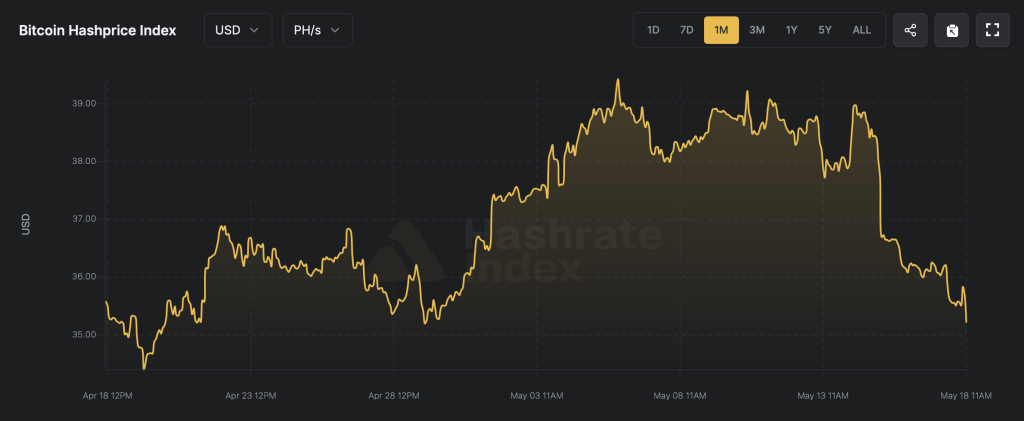
Tensions have intensified over the past four days following the recent increase in difficulty epochs as revenues associated with Hashprice continue to decline. Simply put, hashprice represents an estimated daily value of 1 PH/s of hashing power. According to data recorded by hashrateindex.com, the hash price on May 14th was $38.97. Since then, Bitcoin miners’ income has fallen by 9.44% as mining difficulty has increased, and one Petahash is now worth about $35.29 per day.
This comes as Bitcoin has retreated from an intraday high of over $82,000 on May 14th and is currently trading at $76,680 per coin as of 3:00 PM ET on Monday, May 18th. Current statistics indicate that difficulty may drop with the next epoch adjustment expected on or around May 29th, but with 1,576 blocks left to mine at the time of writing, those predictions could change significantly by then.
The block interval is moving at a slightly slower pace, contributing to the expected reduction, but only by a small amount, with an average time of around 10 minutes and 12 seconds. Bitcoin transaction fees associated with on-chain transfers are also relatively negligible, accounting for only 0.59% of total block rewards over the past 24 hours. From a revenue perspective, the profitability of mining ultimately depends on the difficulty epoch and hash price conditions, which in turn depend on Bitcoin’s market performance.
In terms of hashrate, the network briefly crossed the 1,000 exahash/second (EH/s) or 1 zettahash/second (ZH/s) threshold on May 11th, a few days before May 14th. Since then, computing power has declined and remains at 959.03 EH/s as of 3:30 PM ET on May 18th. Both decreased revenue and increased difficulty contributed to this factor.
The current environment leaves little margin for error for miners already operating on tight profit margins, as efficiency and energy costs become increasingly decisive. While a slight rebound in Bitcoin prices or a loosening of difficulty adjustments may provide temporary relief, the sector’s immediate direction appears to still be tied to whether market momentum can outweigh the network’s relentless computational expansion in the coming days, weeks, and months.


