




Bitcoin’s 2026 macro setting has just flipped from waiting for a rescue to pricing in new threats.
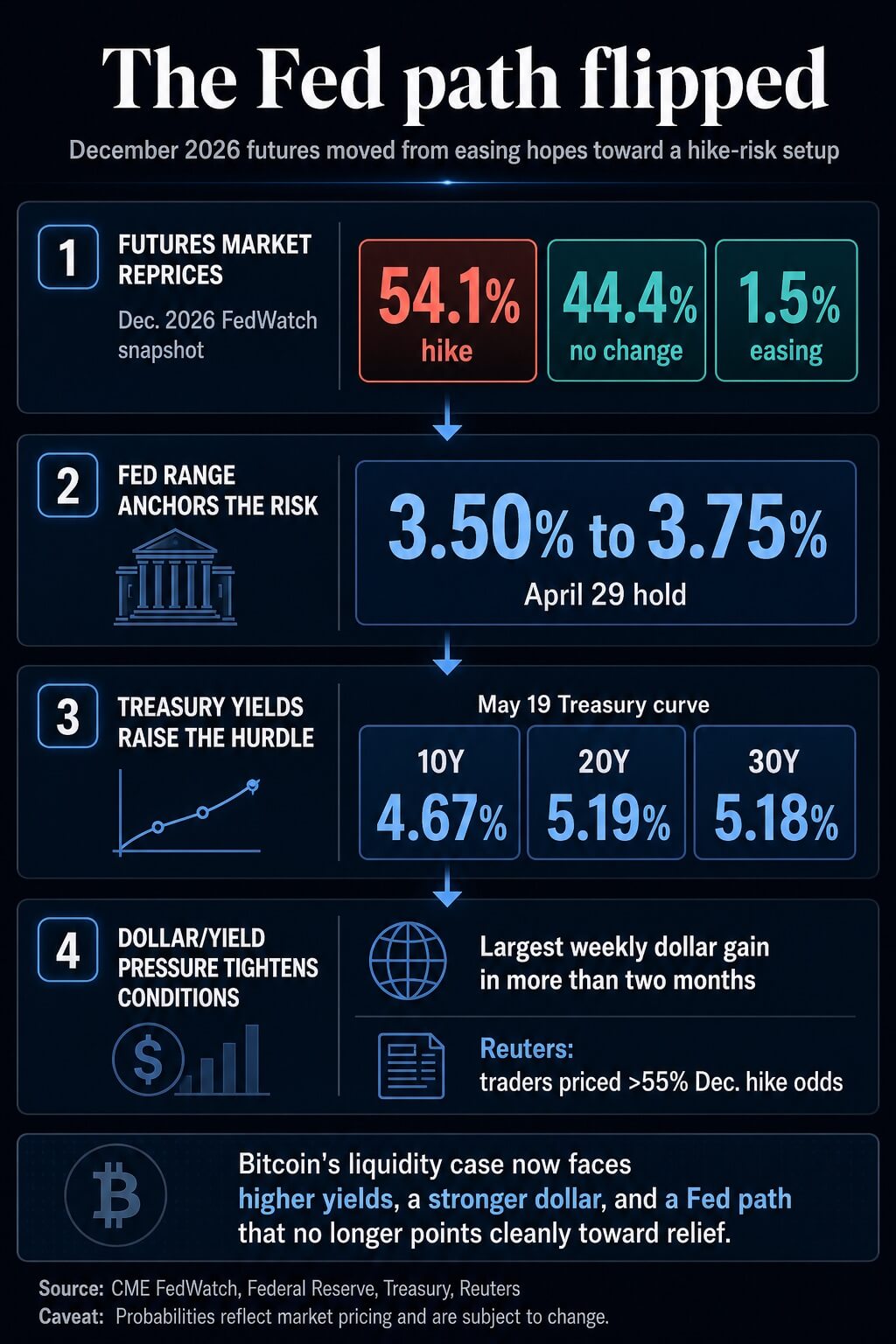
As of May 20, 2026, CME FedWatch indicated that the probability of a rate hike at the Federal Open Market Committee meeting in December 2026 is 54.1%, while the probability of no change is 44.4% and the probability of easing is only 1.5%.
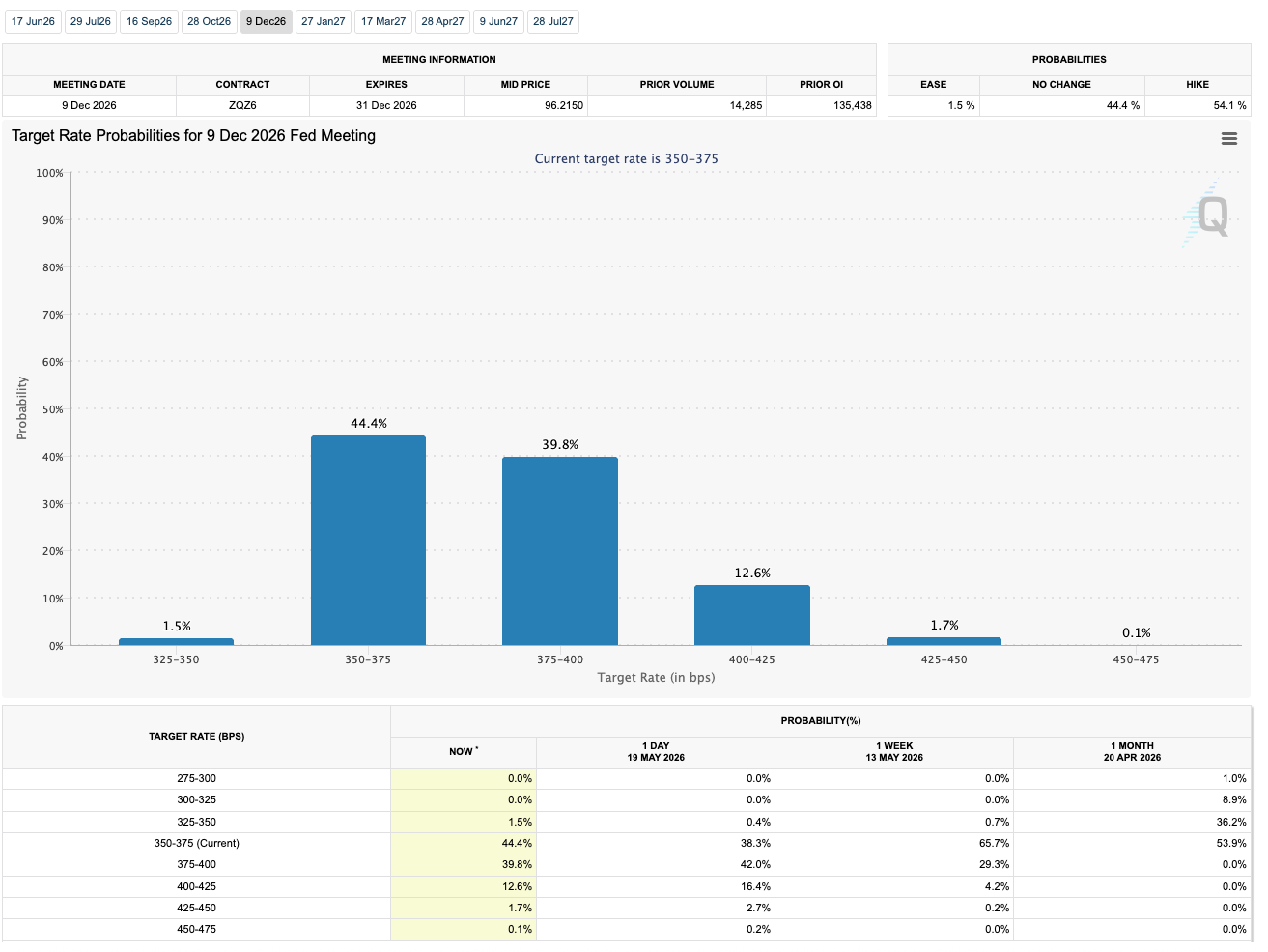
In the case of Bitcoin, the important signal is the direction of travel, not the accuracy of a single snapshot of the futures market.
The trade that many holders expected was simple. Inflation will subside, the Federal Reserve will eventually ease, liquidity will improve, and Bitcoin will benefit from both its hard money story and new access points in brokerage accounts through spot ETFs.
This mechanic now has a more difficult opponent. It’s an interest rate market that has stopped treating easier money as the next step.
The Fed’s latest policy anchor is raising the stakes. On April 29, the central bank kept the target range of policy interest rates unchanged at 3.50-3.75%.
If December futures lean towards a higher target range from there, it would mean that the market is not just talking about a smaller rate cut, but further tightening.
This puts Bitcoin near $77,000 and beyond. This will be a test of whether BTC demand in the ETF era can simultaneously absorb a strong dollar, rising government bond yields, and visible capital outflows.
Macro pitfalls exposed under ETF trading
Rate movements are already occurring in areas other than virtual currencies. According to curves created by the Treasury Department on May 19, the 10-year bond yield is 4.67%, the 20-year bond yield is 5.19%, and the 30-year bond yield is 5.18%.
These levels make cash and government bonds more competitive with non-income-producing assets.

At the same time, Reuters reported that the dollar was heading for its biggest weekly gain in more than two months as rising energy prices and U.S. Treasury yields fueled expectations for a Fed rate hike. At the time, traders were pricing in a more than 55% chance of a rate hike in December, the report said.
In the case of Bitcoin, this combination weakens the liquidity case on multiple fronts. As the 10-year Treasury yield rises, the hurdles for owning volatile non-yielding assets will rise.
A strong dollar tightens global financial conditions. The Fed’s move back to raising interest rates will delay talk of monetary easing, which has supported risk appetite.
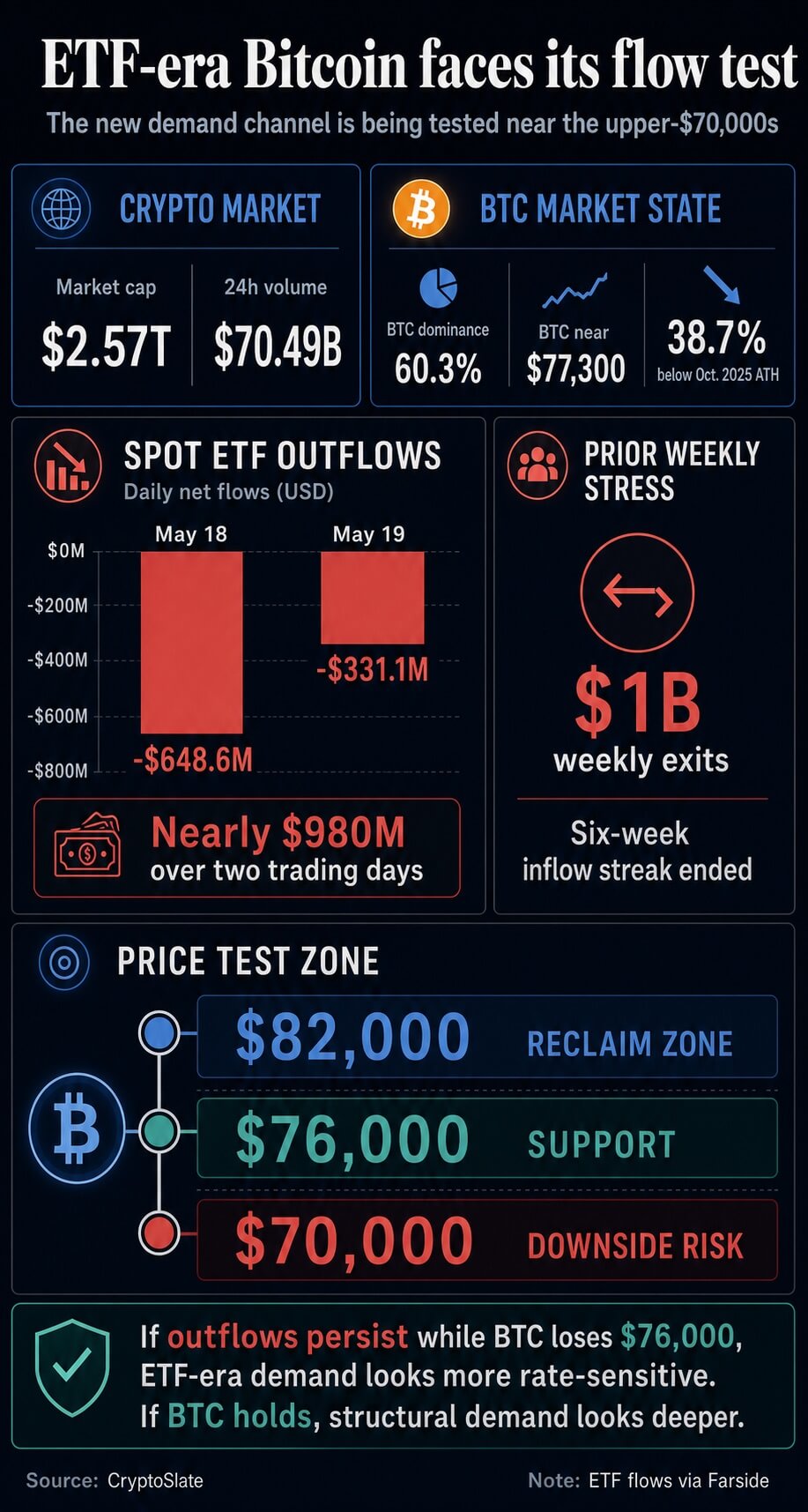
The current market snapshot shows how extensive testing has become. According to firememecoins’s general market page, the cryptocurrency market is close to $2.57 trillion, with a 24-hour trading volume of about $70.49 billion, and BTC’s dominance at 60.3%.
The company’s Bitcoin price page shows BTC at around $77,300 as of May 20, about 38.7% below the all-time high in October 2025.
| signal | current snapshot | Why Bitcoin is important |
|---|---|---|
| FedWatch Snapshot for December 2026 | Odds of interest rate hike 54.1%, odds of interest rate unchanged 44.4%, odds of easing 1.5% | Futures markets believe that there is a higher possibility of further tightening than easing. |
| Fed target range | 3.50% to 3.75% | A hike in interest rates from here would signal renewed pressure after leaving them unchanged in April. |
| 10 year government bond yield | 4.67% on May 19th | Higher risk-free yields raise the bar for BTC exposure. |
| bitcoin price | Around $77,300 on May 20th | BTC is currently sitting near a support zone that is undergoing macro testing. |
| US Spot Bitcoin ETF Flow | $648.6 million on May 18th and $331.1 million on May 19th. | ETF demand is a visible pressure valve for institutional exposure. |
Before spot ETFs, it was difficult to read Bitcoin’s macro sensitivity from traditional portfolio plumbing. Prices, derivatives, stablecoin liquidity, and exchange flows were all counted, but they did not exhibit the same regulated wrapper behavior that stock and bond investors already understand.
The era of ETFs has changed that. The Spot Bitcoin Fund offered investors a familiar way to hold BTC and also provided the market with a daily scoreboard of marginal demand.
That scoreboard turned red again. Pharcyde Investors revealed that the US Bitcoin Spot ETF recorded $648.6 million in outflows on May 18th, and a further $331.1 million in outflows on May 19th.
In total, the value of products shipped in two business days is approximately $980 million. subsequent movement crypto slate According to reports, there were weekly outflows of $1 billion, ending a six-week streak of inflows.

This reversal of trends does not prove that the ETF demand channel has disappeared. This indicates that stress testing has become easier for the buyer group.
If rising yields and a strong dollar continue to draw money into defensive and income-producing assets, spot ETF flows could indicate whether regulated demand for Bitcoin is pausing, reversing, or simply waiting for the next macro signal.
The distinction is important. A period of strong inflows followed by temporary outflows would appear to be risk management.
A longer redemption period, with odds of a Fed rate hike still high, would signal even more discomfort for bulls. Demand in the ETF era may be more sensitive to interest rates than the hard money narrative alone suggests.
Bitcoin price map became part of the Fed story
The $76,000 area is a short-term support zone to watch, with a breakout increasing the risk of a fall toward $70,000.

On the positive side, the failure to regain the $82,000 area has prevented the recent decline from breaking beyond what looks like a routine consolidation.
These levels now have macro meanings. As ETF outflows continue and Treasury yields remain high, sustaining around $76,000 to $77,000 would suggest that structural demand is still absorbing pressure.
It won’t settle the digital gold debate, but it will show buyers are willing to defend Bitcoin even when talk of rate cuts loses steam.
Breaking sends another signal. The recent ETF outflows would then look more like a conduit from the bond market to Bitcoin than a tactical hesitation.
In that version of the story, BTC trades not as a simple inflation hedge, but as a liquid asset that remains sensitive to the same forces that move stocks, credit, the dollar, and U.S. Treasuries.
That’s the uncomfortable part of Bitcoin’s mainstreaming. The ETF wrapper didn’t just bring more money to the market;
This made it easier to compare Bitcoin to everything else a portfolio could own. At a time when U.S. Treasuries are offering higher yields and the dollar is rising, Bitcoin needs to justify its place in the portfolio and not rely solely on the promise of future liquidity relief.
This does not invalidate the case for long-term scarcity for Bitcoin. There may still be room for fixed supply assets in markets concerned about inflation, deficits and sovereign debt.
However, this argument is easier to hold over the years than the trading day. In the short term, the test will be ETFs, yields, and the dollar.
The next signal will be whether the outflow forms a pattern.
December rate hike will not automatically destroy Bitcoin. A more practical warning is that the market is starting to price in punishment before many holders have exited their bailout positions.
That’s why the next few data points are unusually important. If FedWatch pricing stays above the 50% line for December rate hikes, macro pressures will still be present.
If Treasury yields or the dollar continue to rise, the bar for BTC exposure will remain high. If ETF outflows continue, the institutional demand channel that has supported Bitcoin’s mainstream adoption will look more cyclical than many bulls expected.
The opposite path is still possible. A pullback in yields, a weakening dollar, or a return to ETF inflows would quickly weaken the bearish interpretation.
A return to the $82,000 area would also change the tone, especially if it happens while a rate hike remains likely.
For now, Bitcoin is torn between two claims about what happened to it. Some people point out that in the ETF era, BTC is maturing into a macro asset that can withstand the Fed’s hawkish price changes because structural demand is stronger than before.
Another argues that new access channels have made Bitcoin more exposed to the same allocation calculations that govern traditional risk assets.
The market is now testing both claims in real time. The Fed futures curve, which has stopped pricing accommodation and started pricing new tightening, has turned Bitcoin’s $76,000 to $77,000 zone into a place where the ETF-era thesis must prove its resilience.
(Tag translation) Bitcoin


