


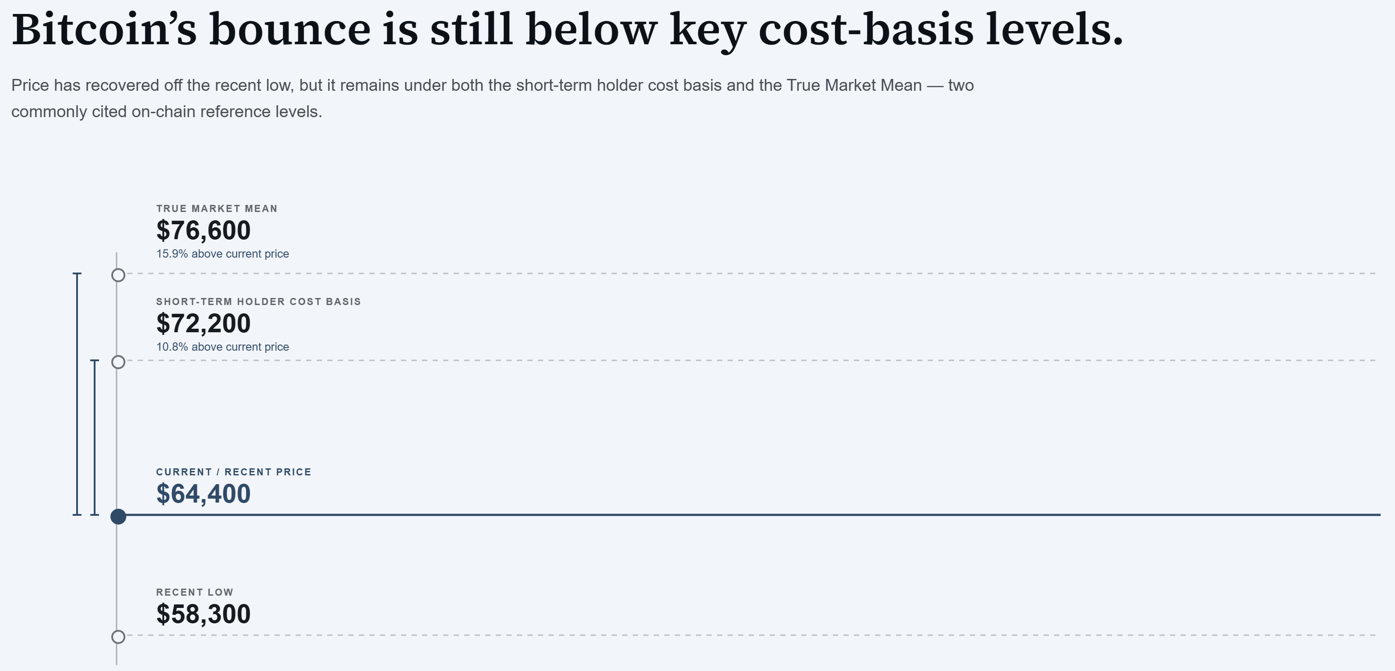
Bitcoin’s rise from $58,300 to $64,400 and then back to $62,700 last week was a rebound, and the price still remains below two key levels tracked by Glassnode: the true market average around $76,600 and the short-term holder cost standard around $72,200.
The company believes Bitcoin is in the late stages of a bottoming process, which is underway.
The Fed released minutes from its June meeting on July 8, showing that all participants supported maintaining the federal funds target range at 3.50% to 3.75%, and the committee removed language from previous statements that suggested a bias toward easing.
Glassnode’s on-chain data shows the market is moving past the type of depletion typically seen before a bottom, and the Fed’s language suggests the policy environment is still considering whether a more decisive response to inflation is needed.
Warning signal for long-term holders
Bitcoin trading below the true market average is significant because Glassnode treats that level as a cost-based anchor for the entire cycle. A sustained regeneration would represent a more extensive repair than the current recovery has produced.
Glassnode’s framework shows the pace at which long-term holder loss realization, or holders who bought Bitcoin more than 155 days ago, sell at a loss.
This metric now accounts for 43% of total realized value on the network, up from 15% in early February and recently reached nearly $280 million per day, its highest level since December 2022.
Glassnode says the current wave of long-term holders capitulating continues and that number needs to be compressed significantly to ensure the market returns to bull market conditions.
Spot Bitcoin ETF net flows have improved from a low of nearly $193 million per day in early June to a current 30-day average of nearly $88.9 million per day, a substantial recovery, but the market is still in a net outflow regime.
Trading volume has hovered around $650 million to $950 million per day on a 30-day average, well below its October 2025 peak of nearly $4.4 billion.
Returning to that peak would require approximately $3.45 billion to $3.75 billion in additional ETF trading volume per day, which is far from production at the current scale of activity.
The options market’s open interest put/call ratio fell to 0.56, the lowest in 2026, while perpetual futures funding remains well below the 0.01% level that Glassnode uses as a neutral benchmark, both of which are less bearish than the spot and ETF data.
The same options market is still priced with substantial downside protection, with a 25 delta skew that holds bids across expirations, meaning traders are paying puts on calls in all time frames tracked by Glassnode.
| signal | Current measurement value | what it means |
|---|---|---|
| Losses for long-term holders | Up to $280 million per day | Yield rate remains on the rise |
| LTH loss as a percentage of realized value | 43% | Long-term holders account for most of the real stress |
| ETF net flow | ~-$88.9 million/day 30-day average | Outflows eased but remain negative |
| ETF trading volume | $650 million to $950 million/day | Institutional activity remains well below peak |
| Comparison of ETF volume gap and October 2025 peak | ~$3.45 billion ~ $3.75 billion/day | Significant volume recovery will be required to return to peak demand |
| Option put/call ratio | 0.56 | Positioning not as bearish as spot/ETF data suggests |
| permanent funding | Neutral level less than 0.01% | Leverage demand remains subdued |
| 25 delta skew | Place bids over multiple maturities | Traders are still paying for downside protection |
Contents of Fed Minutes and What Bitcoin Needs
In the minutes, participants acknowledged that inflation is rising and well above the Fed’s 2% target, with tariffs, supply disruptions related to the Strait of Hormuz, and AI-related demand driving factors, with many participants saying high commodity prices and supply disruptions could last longer than officials expected.
Most participants described a scenario in which inflationary pressures would be sufficiently eased to leave interest rates unchanged or eventually lower them. The two leaders also discussed a second scenario in which inflation remains high due to demand for AI, conflict in the Middle East and tariffs, which they said would justify tightening policy.
If investor capitulation cools first, losses for long-term holders will compress sharply from $100 million to $150 million per day, ETF flows will turn from neutral to positive, volume will recover above $1 billion per day, and incoming inflation data will soften enough to take the Fed policy scenario off the table.
Along that path, Bitcoin will first regain cost standards for short-term holders and then work toward testing the true market average itself.
If the macro backdrop keeps sellers active and long-term holder losses remain near or above $250 million per day, the ETF’s net flows will remain negative and the Fed’s rhetoric will keep policy decision risk alive until the next inflation print.
Along the way, Bitcoin remains structurally vulnerable and could retest the lower end of the bear market range near the realized price.
Using absolute values to express market stress, Glassnode’s two pressure points, long-term holder losses of nearly $280 million per day and ETF net outflows of nearly $88.9 million per day, result in a total stress measure of nearly $369 million per day.
| situation | bull path | bear road |
|---|---|---|
| Losses for long-term holders | Compressed to $100-150 million per day | Stay close to or above $250 million per day. |
| ETF net flow | change from neutral to positive | remain negative |
| ETF trading volume | Over $1 billion per day and rising | Stays below $1 billion per day |
| Fed background | Inflation will ease. Policy decision risk fades | Robust scenario persists due to inflation risks |
| First technical/on-chain recovery | Cost basis for short-term holders is approximately $72.2,000 | Prices remain below the break-even point for recent buyers |
| Confirmation level increases | True market average is approximately $76,600 | Lower bear market range still in play |
| Article excerpt | Verification of the bottoming process will begin | Bottoming process is extended |
If three conditions develop simultaneously: losses for long-term holders are compressed, ETF outflows approach neutrality, and institutional volume rises towards the levels reached in October 2025, Bitcoin’s bottoming process will start to look more credible.
The Fed’s June minutes gave markets less reason to expect easing.
(Tag translation) Bitcoin


