


As Bitcoin aggressively fell below $70,000, the market moved from a debate over buy-on-the-dip to a more defensive question of how far traders need to insure against the next low.
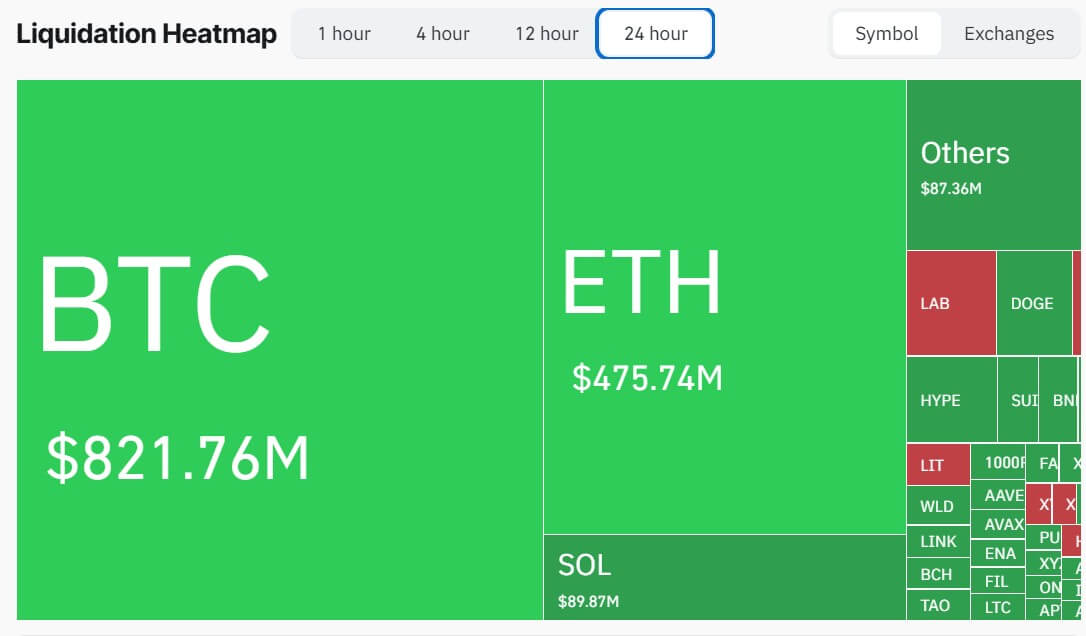
data from crypto slate Over the past day, the largest cryptocurrency fell to $65,404, triggering $1.8 billion in liquidations and wiping out the bullish leverage that had been built around hopes for a quick recovery.
This failed rebound has led traders to look for protection at levels that seemed far away until recently.
Options positioning is currently showing increased demand around the $60,000 and $50,000 strikes, a sign that investors are bracing for a deeper reset as the first bitcoin sell-off by strategies in years, ETF outflows, AI-driven capital rotations, and unresolved macro pressures weaken the support that supported the market at the beginning of the year.
How BTC’s failed rebound turned $70,000 into resistance
Analysts at BIT Official noted that Bitcoin was already trading defensively after falling towards $72,000 last week, when geopolitical tensions related to the Strait of Hormuz prompted a significant withdrawal from risk assets.
The firm noted that core PCE inflation in April was 3.3% year-on-year, in line with expectations, despite a brief respite provided by President Donald Trump’s threat to lift the U.S. naval blockade.
This data and political developments eased immediate macroeconomic concerns, forcing overleveraged bears to cover their shorts.
As a result, Bitcoin soared towards $73,400 at one point over the weekend, giving bulls the power to claim the sell-off is over.
But that story collapsed when the recovery failed to attract meaningful spot volume.
The geopolitical relief trade disappeared when Iran’s foreign ministry explicitly denied nuclear negotiations, disputed President Trump’s uranium claims, and insisted it would reopen the strait strictly on its own schedule. Unless formal mitigation occurs, Bitcoin remains fully exposed.
As a result, the market quickly pulled back to $70,000. This is a critical juncture where option positioning, market sentiment, and the cost base of short-term holders converge.
In fact, that level served as both a psychological floor for the bulls and a prime target for the bears looking for a forced liquidation.
Once Bitcoin broke below that support, the automated liquidation engine began aggressively unwinding under-collateralized long positions.
The decline accelerated even more rapidly as spot buyers proved unwilling to absorb selling pressure, creating a vacuum.
Strategy sale gives Kuma a cleaner script
BTC’s sub-$70,000 drop also occurred at a very vulnerable moment when the corporate financial narrative collapsed.
This week, Strategy confirmed that it had sold 32 BTC for $2.5 million to fund cash distributions and dividend payments on high-yield perpetual preferred stock.
The sale shocked the market, as Strategy positioned itself as the definitive corporate agent for Bitcoin accumulation transactions.
Over the past few years, the Michael Saylor-led company’s business model has relied heavily on equity issuance, preferred stock, and free access to capital markets to build the largest public company Bitcoin vault in existence.
To the broader market, the company was not only a major shareholder, but also a symbol of persistent demand independent of price.
But that perception is now under heavy strain as the company, synonymous with a “never sell” philosophy, liquidated coins to meet routine cash obligations.
said Jeff Dorman, CIO of Arca.
“From a sentiment perspective, how do you think the average Bitcoin investor would react if every major news outlet and social media influencer started writing, ‘MicroStrategy is now a BTC seller?’ This company has purchased over $50 billion in Bitcoin and currently owns about 4% of the total outstanding Bitcoin of 21 million.”
This pivot armed the bears with a clean and simple argument when Bitcoin fell below a major support level.
Market participants argued that the sale complicates the market’s fundamental assumption that Strategy functions as a continuous buyer in all macroeconomic environments.
In fact, some speculate that the company could grow sales even further in the future as it actively manages its balance sheet.
Bitcoin loses ETF cushion due to AI liquidity hike
This structural shift in sentiment coincides with the evaporation of Bitcoin’s most reliable safety net: the institutional ETF bidding that underpinned the early stages of the bull market.
Bitcoin ETFs lost more than $4 billion in the following four weeks, according to data from SoSoValue. This is the most aggressive redemption cycle since the advent of spot products, leaving the market without the stable funding needed to absorb periodic declines.
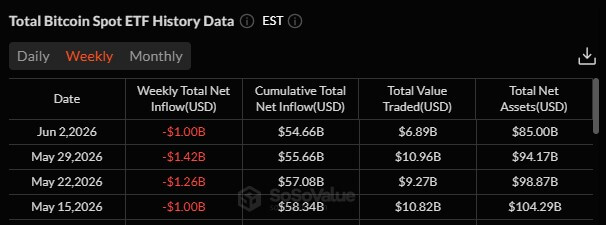
Market analysts believe that this severe capital flight is due to the generational shift to artificial intelligence.
Institutional investors are aggressively liquidating positions in cryptocurrencies to secure dry powder for the looming wave of tech mega-IPOs, primarily targeting high-growth ventures like SpaceX, Anthropic, and OpenAI.
Pierre Roshard, CEO of Bitcoin Bond Company, noted that the AI boom has increased the market capitalization of the top 50 public stocks by $19 trillion over the past 12 months, which is about 13 times the market capitalization of Bitcoin.
He said the capital investment cycle has shifted attention away from liquidity and Bitcoin, making Bitcoin’s resilience remarkable despite the pressure.
Independent Bitcoin analyst Matthew Case described the move as an “AI IPO liquidity vacuum,” arguing that financial institutions that have increased their exposure to Bitcoin and cryptocurrencies now have a rare opportunity to take positions in key private market and pre-IPO opportunities related to SpaceX, Anthropic, and OpenAI.
This turnover of capital actively depletes Bitcoin of marginal buyers. During periods of strong ETF inflows, institutional demand acts as a shock absorber, cushioning the blow from macroeconomic frictions, geopolitical headlines, and derivatives volatility.
The auction was abruptly canceled, leaving the market in a dangerous situation. A standard technical decline may cascade further before encountering strong spot support.
$60,000 will be the next insurance level on the market
As a result, traders have fundamentally revised the pricing of risk models. The market is no longer structured around high leverage bets hoping for a quick return to $70,000.
Instead, capital is actively repositioning itself in preparation for the reality that Bitcoin’s next durable line of defense may be significantly lower.
According to Deribit data, traders have amassed about $1.2 billion in open interest around the $60,000 strike, and about half of that at the $50,000 strike. Cumulatively, there is $1.8 billion worth of open interest at these strike prices.
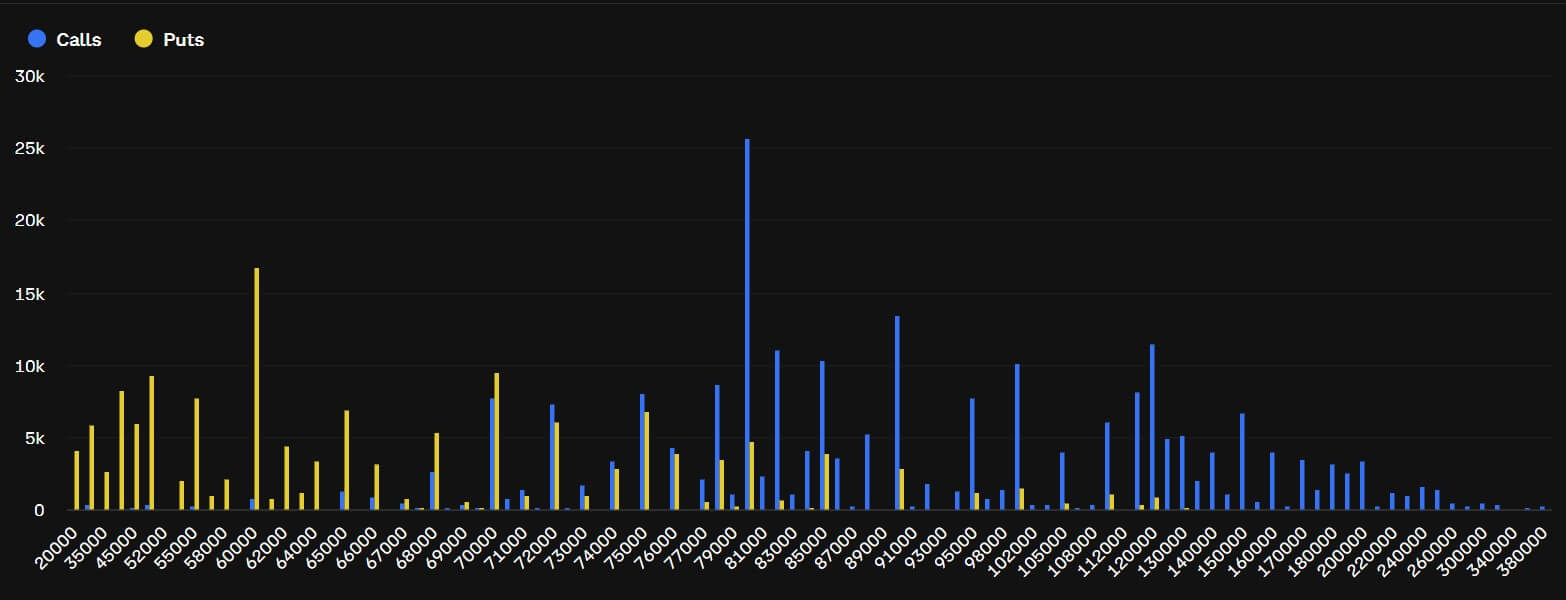
This positioning marks a change from the structure that prevailed in the early stages of the rally. When ETF inflows were strong and Strategy remained a clear buyer, price pullbacks were treated as an opportunity to add exposure.
After a wave of liquidations, ETF redemptions, and the sale of Strategy, the same decline is being treated as an insured event.
As a result, traders with large Bitcoin exposures are moving to put and collar structures designed to preserve some upside while limiting losses if drawdowns accelerate.
(Tag translation) Bitcoin


