

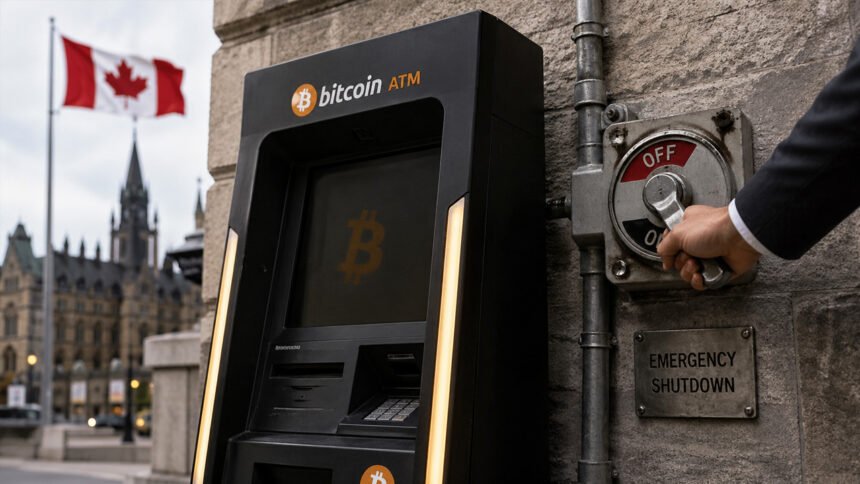


The country that first introduced virtual currency ATMs to the world is now preparing to phase them out completely. In April 2013, a Vancouver coffee shop installed what would become the most famous retail outlet for cryptocurrencies, a machine that allows ordinary people to exchange cash for Bitcoin without a bank account, broker, or much friction.
Thirteen years later, Canada has approximately 4,000 of these machines in operation across the country, the highest concentration per capita in the world. And the federal government’s 2026 Spring Economic Update proposes banning them altogether.
This proposal did not come out of nowhere. Canadians reported losing more than $704 million to fraud in 2025, bringing total losses reported since 2022 to more than $2.4 billion. The government estimates that only 5 to 10 percent of fraud cases are reported. This means that the actual number is almost certainly a multiple of the number on paper.
In an update, officials described virtual currency ATMs as “a primary vehicle for fraudsters to defraud victims and criminals to deposit their criminal proceeds.” This kind of language sounds like a public verdict on a product category that operates under a compliance framework designed for currency exchange counters and Western Union branches.
Crypto ATMs: Machines that make it easy to account for fraudulent activity
To understand why Ottawa moved to these machines before the rest of the crypto space, we need to consider how regulators communicate risks to the public and what makes targets legible enough to act politically.
Crypto ATMs physically exist. They are installed at convenience stores, gas stations, and shopping malls across the country. You don’t need a bank account to use it. Most transactions under $1,000 require only a phone number, and unlike a bank teller, there is no human intervention to recognize fraud in progress.
The combination of visibility and low verification thresholds makes them uniquely exposed to political action. Regulators can point to a machine and explain the problem in a single sentence, an advantage that no other corner of the cryptocurrency ecosystem currently has. You don’t need to understand how DeFi, cross-chain bridges, and stablecoins work to know how your money can be scammed. That simplicity is now the industry’s biggest drawback.
A 2023 internal analysis by Canada’s financial intelligence agency FINTRAC found that Bitcoin ATMs will likely continue to be a “primary vehicle” used by fraudsters to collect and launder funds from victims. That conclusion remained in the background for years as operators continued to expand, and industry-specific regulation never materialized.
Last fall, CBC News requested interviews with Finance Minister François-Philippe Champagne and FINTRAC to ask what steps they were taking, but neither request was granted. The Spring Economic Update was, in effect, an answer neither agency wanted to give on the record.
The industry’s own compliance record complicates defense. Nearly a dozen former employees of a cryptocurrency ATM company operating in Canada told CBC News that scammers tricking victims into transferring money through the machines was a known issue within the company, and half of them said they doubted the operator they worked for would make money without transactions linked to fraud.
If this claim is accurate, it reframes the ATM problem in a way that cannot be easily addressed by compliance measures alone. Warnings, cooling-off periods, and identity checks can deter fraud at the last minute, but they don’t address models that may structurally rely on them.
The FBI has long warned that cryptocurrency ATM fraud is on the rise, and the state of California has set a cap on Bitcoin ATM transactions at $1,000 per day in 2023 because it causes friction before irreversible transfers can be completed. Ottawa’s approach is more assertive than either of these answers.
Who really loses when the entrance ramp closes?
The government’s proposal includes a carve-out that would allow Canadians to continue purchasing digital assets through other regulated channels, such as brick-and-mortar money services businesses, which are subject to existing oversight frameworks.
This makes this ban essentially a restriction on unattended cash-to-crypto pipelines, rather than a ban on crypto access itself. This is an important difference, but less so for users who relied on these machines because no alternatives were available.
Some Canadians use cryptocurrency ATMs because they don’t have deep bank accounts or rely on cash, are making small purchases and don’t want to verify their identity on a regulated exchange, or simply because the machines are located at corner stores where they already buy groceries.
An outright ban removes a legitimate access point for that population without creating a meaningful equivalent alternative. According to the Canadian Fraud Prevention Center, fraud victims reported $14.2 million stolen in crypto ATM fraud in 2024, with losses exceeding $4.2 million in the first three months of 2025 alone.
These numbers represent only an estimated 5 to 10 percent of actual incidents, and the harm is real and significant. The question is whether that concentration justifies eliminating channels that also have legal use, but the Canadian government has decided to do so.
There is precedent for that decision. Bybit’s withdrawal from Canada and the fines imposed on Bybit and KuCoin for failed securities transactions demonstrate a regulatory environment that accepts access reductions as a byproduct of law enforcement. This pattern suggests that if Ottawa deems a compliance issue to be sufficiently serious, it will prioritize the problem over the product.
A handbook Canada is writing for others
If passed, Canada’s ban would be one of the most comprehensive responses to the crypto ATM fraud problem in a major economy.
The UK effectively restricted virtual currency ATMs in 2021 by requiring all operators to register with the Financial Conduct Authority (FCA), but as of 2026, no operators have obtained such registration, making each machine effectively illegal and subject to crackdowns.
Australia has adopted a more flexible approach, with AUSTRAC imposing per-transaction cash limits in mid-2025 following a joint review focused on fraud and consumer protection. While the UK approach achieved exclusion through bureaucratic friction rather than legislation, Australia opted for gradual regulation.
Canada’s route is more direct, with the government providing $352.7 million in funding over five years and creating a Financial Crimes Agency with a mandate to track illicit money wherever it goes.
The logic and motivation behind this proposal is not only immediately applicable, but also worth taking seriously.
If a retail crypto product becomes associated in the public consciousness with fraud, particularly fraud targeting vulnerable populations, Canada’s current answer is immediate removal.
This is a significant departure from the regulatory stance the industry has faced in the past, and it is not limited to machines in corner stores. Prepaid crypto cards, self-custody apps, stablecoin onramps, and any product with a simple retail interface and low verification requirements all operate within the same political risk envelope, even if none has yet reached the level of prominence of an ATM.
Canada’s evolving regulatory record suggests that when fraud organizations persist, products will follow.
The country that installed the world’s first Bitcoin ATM in a Vancouver coffee shop may be on the verge of becoming the first major economy to make Bitcoin ATMs completely illegal. This is a stunning reversal, and a signal worth noting even beyond Canada’s borders.
(Tag translation) Bitcoin


