


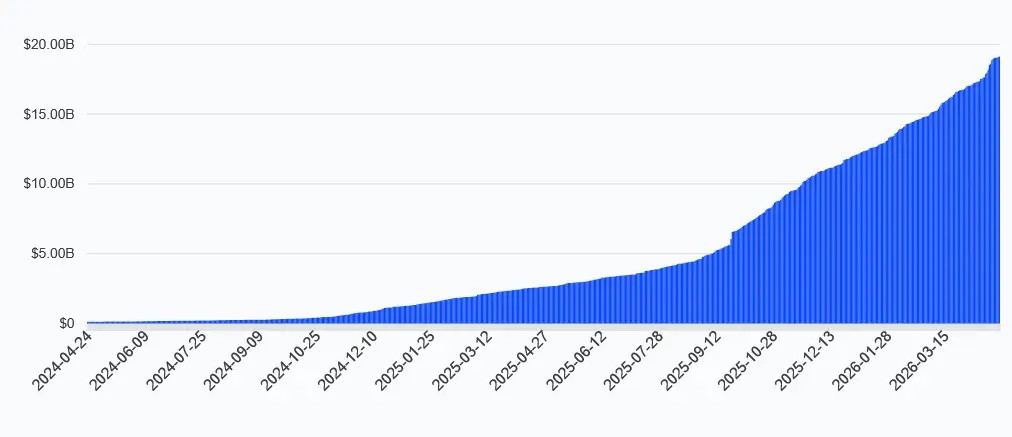
Chainlink’s Cross-Chain Interoperability Protocol (CCIP) has generated over $19 billion in cumulative transfer volume, of which $1.3 billion was moved in one week. With a 260% increase over the previous week, CCIP has reached the $20 billion level, indicating a sharp acceleration in cross-chain demand.
The numbers are Posted by @chain link Announced on April 28th and confirmed on the CCIP Metrics Dashboard, the protocol marks a protocol that has quietly become established as the default conduit for moving value between blockchains.
What is Chainlink CCIP?
CCIP is Chainlink’s cross-chain communication standard, built on the decentralized Oracle network. This allows developers to transfer tokens, arbitrary data, or both in a single programmable transaction between different chains without having to spin up custom bridges or liquidity pools.
The protocol was launched on mainnet in 2023 and has since recorded 100% uptime with zero loss of value. Defense-in-depth security includes rate limiting, time-locked upgrades, and Sybil-resistant node operators.
As of April 28, CCIP is live on 77 chains and connects over 60 public and private blockchains through a single integration. There are 226 cross-chain tokens (CCTs) on the network, with a total value of $61.84 billion, and over 50 million CCIP-enabled wallets.
How big is the recent spike?
The week ending around April 27th was a sharp acceleration for CCIP.
- $1.3 billion in 7-day trading volume
- Over 260% growth compared to the previous week
- Cumulative transaction value: $19.12 billion ($19,116,317,581 to be exact)
- Cumulative fees collected were $1.82 million.
This number is based on Chainlink’s announcement. CCIP metrics dashboardLast updated on April 28th. The cumulative chart shows steady growth, with cumulative trading volume exceeding $19 billion this month and trending towards $20 billion.
“CCIP operated seamlessly during last week’s surge in cross-chain demand, with 7-day trading volume of over $1.3 billion, trading volume increasing by over 260%, and cumulative trading volume of over $19 billion,” Chainlink wrote in an official post.
Who actually uses it?
both DeFi protocols and traditional financial institutions. On the DeFi side, Aave routes its GHO stablecoin via CCIP, Lido uses it for wstETH direct staking, and Lombard Finance and Solv Protocol rely on it to scale BTCFi with cross-chain lending, yield optimization, and collateral movement running on the same rails.
On the institutional side, ANZ Bank used CCIP for delivery-to-pay and privacy-enabled tokenized commercial paper as part of Project Guardian. SWIFT tested CCIP for the transfer of tokenized assets. UBS and SBI Digital Market used it for tokenized funds settlement. JP Morgan and others are conducting trial operations.
Why is this important for cross-chain infrastructure?
The market has been dealing with bridge hacking for years. Eight- and nine-figure exploits have hit Ronin, Wormhole, Nomad, Multichain, and more, and most of the cross-chain volume has historically moved through systems that have lost user funds at some point.
CCIP’s argument is that this is not the case. A total of $19 billion in transfers with zero value lost is a headline number that financial institutions are paying attention to, and explains why the protocol continues to appear in pilots at the largest banks and payment networks.
Chainlink’s extensive oracle infrastructure has already secured tens of billions in value and enabled on-chain transaction volume of over $14 trillion. CCIP is now a cross-chain layer of the same stack, with the same operator and the same security model.
What comes next?
The $20 billion milestone is clearly a short-term indicator. Additionally, its trajectory points to real-world assets, CBDC interoperability, and cross-border payments as use cases that will drive next steps. The combination of modular design, programmable token transfer and arbitrary messaging is better suited for these workloads than older bridge designs.
Data shows that cross-chain demand is real, fast-growing, and concentrated in proven infrastructure, with Chainlink’s CCIP seeing an influx of institutional money.
source:
- chain link – Officially announced weekly sales of $1.3 billion and cumulative milestone of $19 billion
- chain link ecosystem – CCIP metrics dashboard including live volume, pricing, chain count, and CCT data
- chain link documentation – Technical documentation on CCIP architecture, security models, and ecosystem integration.


