

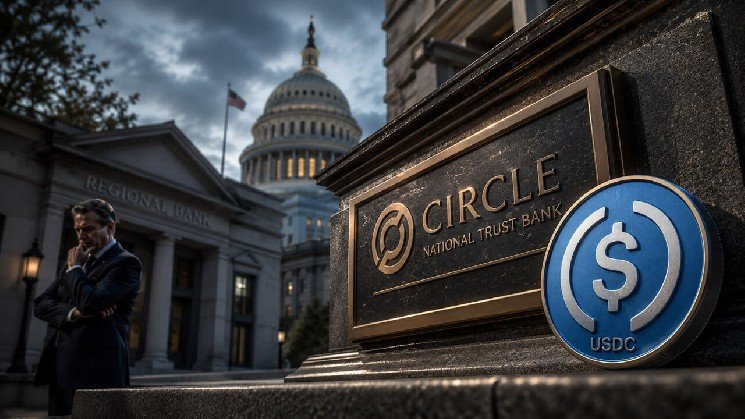
Washington has just given one of the world’s largest digital currencies a more official status in the US financial system.
On July 10, Circle received final approval from the Office of the Comptroller of the Currency to open a national trust bank under federal supervision.
The circle called this a big step. $USDCbecause this approval makes things easier for banks, payment companies, asset management companies, and corporate treasury desks. $USDC As something solid enough to build upon.
However, banks look at the same authorization and draw different conclusions. Standard Chartered said in January that stablecoins could remove around $500 billion from U.S. bank deposits by the end of 2028. The Federal Reserve has outlined a wider range of possible outcomes.
A December 2025 FEDS note said stablecoin implementation could reduce lending by $65 billion to $1.26 trillion, depending on the extent of adoption and where issuers store their reserves.
As such, Circle currently has a federal banking charter, but not one that would make it a lender with branches, checking accounts, and guaranteed deposits. The new organization is the National Trust Bank.
According to Circle’s own announcement, Circle National Trust will begin fiduciary custody of digital assets for Circle and its affiliates, while reserve management remains on the list of future capabilities. The OCC’s conditional approval, issued on December 12, 2025, described the proposed entity as a “trust bank” that would conduct “trust company” activities and made clear that the bank itself would remain independent from stablecoin issuance functions.
Circle acquired a Federal Trust Bank structure focused on custodial and fiduciary services. It did not do its usual business of collecting retail deposits and recycling them into mortgages, business loans, and community credit. However, this remains a meaningful victory for the company, as federal oversight provides a clearer regulatory framework for financial institutions’ counterparties to take advantage of. $USDC.
For banks, especially smaller banks, this further sharpens long-standing concerns. Stablecoins can gain formal legitimacy and widespread institutional adoption while competing with deposit-taking institutions that still maintain old obligations and old funding models.
This Charter essentially enhances the credibility of the Circle. Stablecoins have spent years in an awkward category somewhere between crypto trading infrastructure and full-fledged financial infrastructure, but OCC oversight is giving them a boost. $USDC It also falls into the second category.
This is consistent with Washington’s broader direction, as reported in CryptoSlate’s coverage. $genius Activities. The policy debate goes beyond the question of whether stablecoins should exist; the main debates now are how they should be supervised, where they fit into the financial system, and to what extent they should be allowed to approach products like deposits.

Circle’s transparency page, updated on July 13, shows $72.95 billion. $USDC The total value of distribution and spare parts is approximately $73.15 billion. Approximately $11.55 billion was held in bank deposits. The remaining $61.6 billion was held in overnight reverse repos and Treasury bills with maturities of less than three months. This reserve structure keeps dollars in the financial system, but also funnels most of it out of regular bank deposit funds.
Circle changed loan funder
A common shortsight is that stablecoins take money out of banks, but that’s not exactly how they work.
Customers can withdraw $1,000 from their local bank and use it to make purchases. $USDC. The circle then puts the reserve behind it $USDC in cash, repos, or Treasury bills. Sellers of these Treasury bills may end up depositing them with another bank. So the dollars are still in the system. It’s just that the funds have moved.
But that’s also the main problem banks have with stablecoins.
Regional financial institutions do not lend based on the country’s total amount, but based on the deposits they can actually hold. If these balances move to large financial institutions, Treasury-heavy reserve institutions, or other short-term parking lots, local banks will lose a source of cheap, stable funding. In this way, stablecoins can change the credit landscape even if the total stock of dollars remains largely unchanged.
The December 2025 FEDS note treats the issue as a funding issue rather than a culture war battle between bankers and crypto companies. The paper shows that the outcome depends on three fundamental things: where demand for stablecoins comes from, what users give up when they buy stablecoins, and where issuers place their reserves.
The firm’s lending estimates range from $65 billion to $141 billion in the low introduction case, $190 billion to $408 billion in the medium case, and $600 billion to $1.26 trillion in the high introduction case, assuming the issuer has access to a Federal Reserve master account.
Due to the wide transmission mechanism, its range is very wide. Stablecoins can change the composition of funds long before there is a dramatic change in the amount of dollars. For local and regional banks, structure is everything. There will still be deposits transferred to systemically important banks and reserve structures dominated by repos and Treasury bills, but they will no longer serve as low-cost funding for local financial institutions.
Circle’s unique reserve mix makes it easy to check pressure. As of July 13, about 84% of reserves were held in repos and Treasury bills, and about 16% in bank deposits. That’s the kind of structure stablecoin issuers want in 2023 and beyond. $USDC This shock is relevant to Silicon Valley banks because they value liquidity, short-term horizons, and assets that can be easily defended under stress.
But from a small financial institution’s perspective, that structure means trading balances are taken away from relationship banking and directed into government-backed reserve assets.
This change also affects trust. Small banks that lose deposits have limited options. They may have to pay more to retain depositors, compressing profit margins. It can be an alternative to wholesale market financing, which is usually more expensive and less stable. Balance sheet growth may decline or loan amounts may decline.
That is why the stablecoin debate is essentially a trust debate. As stablecoins become easier to use, it becomes harder to maintain deposits, and as it becomes harder to maintain deposits, it becomes harder to supply credit.
Stablecoin yields only further complicate this for banks. Stablecoins, primarily used for payments, are already competing with regular transaction balances as they offer speed, portability, and 24-hour settlement. When you add third-party rewards, exchange incentives, or adjacent tokenized cash products, that product begins to compete with your savings.
CryptoSlate coverage $genius This bill already scratches the surface of how big a policy concern this could be. We are now seeing banks and regulators wondering how closely private digital dollars should be allowed to resemble bank deposits before regulators decide they should be treated like bank deposits.
Banks often compare stablecoins to money market funds, and the Federal Reserve’s May 2026 follow-up note shows why. Stablecoins move on programmable cross-border rails and can be settled instantly. They can spread through digital platforms much faster than their previous deposit competitors. Foreign demand for dollar stablecoins also has an international dimension, as the accumulation of cash reserves in U.S. banks can offset some of the domestic outflow.
Banks are already well aware of this threat and have started building their own tokenized deposits and bank-backed stablecoins. This is exactly what the industry does when a new product category comes directly into its funding stream.
The Circle’s Charter gave the institution’s trading partners a strong reason to ensure that: $USDC As something that can be integrated into storage, payments and treasury operations without taking the same reputational leap as it did a few years ago. It does not guarantee mass adoption, nor does it resolve all outstanding legal issues surrounding stablecoins.
However, it will be easier to visualize the next step. More institutions are actually use $USDCand with stronger federal support than before, a greater amount of payments and settlements will be able to move through privately issued digital dollars.
A better-monitored dollar infrastructure could deepen liquidity, widen the scope of use, and make on-chain dollars more useful in normal financial activities. CryptoSlate’s recent coverage of stablecoin demand and payments growth is already pointing in that direction.
However, banks have a very different view. Improving payment rails in one sector can weaken the deposit franchise in another.
Circle’s OCC approval is therefore much more than a regulatory milestone for a single issuer. This shows where the US is headed for stablecoins.
The Washington government no longer treats them as a temporary byproduct of crypto trading, giving at least some cryptocurrencies a path to federal oversight, even as banks continue to warn that the same products could chip away at the capital base behind regional credit.
The battles over legitimacy of the past are disappearing. A tougher battle over who owns the dollar and who loses the lending power that comes with it is just beginning.


