



Ethereum has consolidated around $2,300, a level that represents a significant recovery from February lows, but remains well below the previous cycle-defining highs. Price movements are temporary and do not break or break out. Markets tend to be in some kind of cautious evaluation mode prior to a definitive move in either direction. Arab Chain’s report adds a layer of order flow context that begins to explain what’s going on beneath the surface.
Binance’s cumulative volume delta recorded a positive value of approximately +48,400. This means that buy orders exceed sell orders in terms of total volume. The reading is not offensive. It is not about a market swamped with new demands or a rise in institutional belief. It explains something more subtle, and perhaps more important. It means that buying pressure is gradually and quietly returning to a market that has not had any buying pressure at all recently.
The correlation between price and order flow is 0.66, a reasonably strong correlation that confirms that prices are starting to respond to underlying demand, but also reflects that other factors are still at play. Derivatives activity, external liquidity conditions, and the broader macro environment are all still impacting Ethereum price, along with improving spot order flow.
The market is rebalancing. Demand is coming back. Neither process is complete.
The buyer is back. they just aren’t in a hurry
The Arab Chain report places CVD readings in context so that they cannot be misread in either direction. A positive value of +48,400 indicates that buy orders exceed sell orders. This is a directional signal. But its size is deliberately modest, and the report is precise about what that modesty means. This does not mean new institutional capital will flood into Ethereum. This is consistent with demand gradually improving and the market recovering rather than accelerating.

This distinction is important for how to evaluate the current price recovery. Slow and steady improvements in demand tend to create a more durable price structure than rapid, aggressive inflows. The latter often reverses quickly once momentum weakens, while the former tends to accumulate into something more persistent. The pace of improvement in CVD reflects the pace of price recovery, and is more like a true rebalancing phase than a dead-end rebound.
The correlation coefficient of 0.66 adds an honest warning that spot order flow is not the only thing driving Ethereum at the moment. Derivatives’ positioning, external liquidity conditions and macro factors all contribute to price movements, and the report notes that this mix is typical of transition periods when markets have not yet set a clear direction.
The outlook the report offers is dualistic and suitably honest. As CVD continues to improve and the correlation strengthens towards 1.0, demand gradually recovers, a confirmed trend. If momentum stalls and the positive CVD reading plateaus, Ethereum will remain range-bound until a catalyst arrives and breaks the equilibrium.
Currently, the data supports the first scenario as the more likely path, but we are not convinced enough to rule out the second scenario.
Recovery test compresses Ethereum below resistance, structural ceiling
Ethereum continues to consolidate near the $2,300-$2,350 range, maintaining its highest gains since its February capitulation, but has not been able to break through the resistance level cleanly. The chart shows a clear recovery structure from the $1,800 low, with price forming higher lows and gradually regaining lost ground. However, that progress currently faces significant technological barriers.
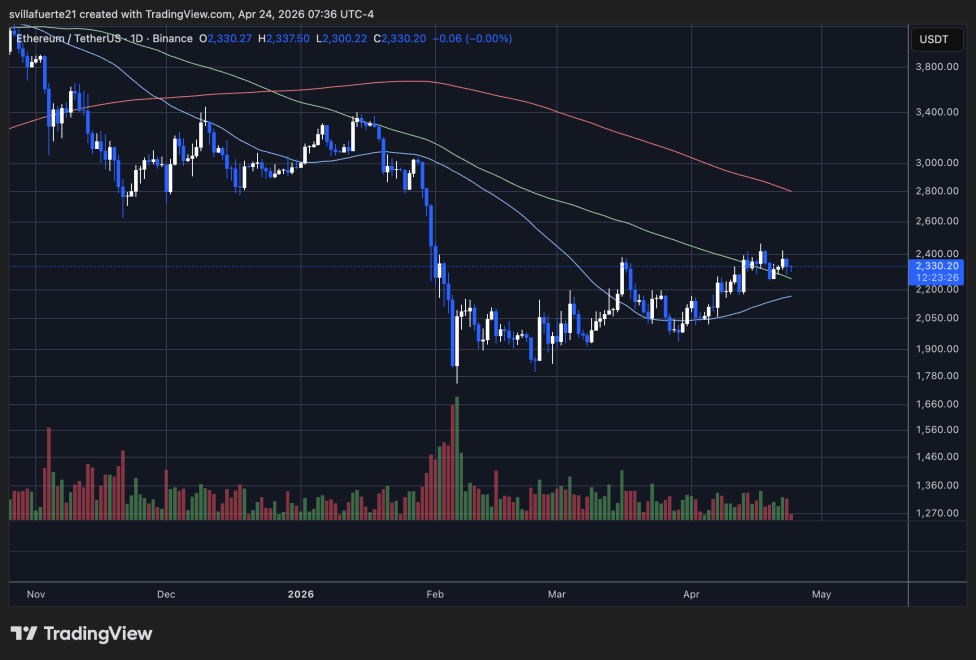
The $2,400 level aligns closely with the descending 100-day moving average and has emerged as a solid resistance zone. Each recent attempt to move beyond this area has been rejected, indicating that supply remains strong and willing to absorb demand at these levels. At the same time, the 50-day moving average is trending up below the price currently near $2,150, providing dynamic support and confirming near-term bullish momentum.
Volume trends further reinforce the current indecision. The most vigorous volume spike is still related to the February decline, but the recovery phase is developing based on relatively low participation. This suggests that demand is returning but has not yet reached the strength needed to force a structural breakout.
If Ethereum successfully recovers $2,400 with confidence, the next resistance level lies near $2,800. Otherwise, the downside risk could return to the $2,100 support zone, potentially widening the consolidation.
Featured image from ChatGPT, chart from TradingView.com
editing process for is focused on providing thoroughly researched, accurate, and unbiased content. We adhere to strict sourcing standards, and each page is carefully reviewed by our team of top technology experts and experienced editors. This process ensures the integrity, relevance, and value of your content to your readers.


