



Ethereum has struggled to overcome resistance as the market faces a wave of uncertainty and prices remain below levels that would suggest a full-fledged recovery. The price movement has been frustrating, with buyers continuing to arrive but failing to maintain the momentum needed to break out. And CryptoQuant’s data has highlighted signals in the staking numbers that reshape what current consolidation is actually built on.
The total amount of Ethereum locked in staking contracts reached approximately 39 million ETH. This number has increased rapidly since the beginning of 2026 and represents ETH’s largest ongoing commitment to the network’s validator infrastructure in the asset’s history. Almost a third of Ethereum’s total circulating supply is currently locked in staking positions, held by participants who have made a deliberate and structural decision to commit to the network rather than keeping their assets available for immediate trading or sale.
The impact of that effort on supply is direct and consequential. 39 million ETH staked means 39 million ETH that cannot be sold immediately. This means that there is significantly less liquid float on the market, i.e. ETH that can actually change hands in response to price movements, than the total supply numbers indicate.
A structural reduction in available supply is the basis for Ethereum’s current consolidation. To fully understand it, we need to look at what the staking data is starting to warn us about.
Records are kept. But the direction has changed
CryptoQuant analysis identified a development in May 2026 that prevented the 39 million ETH staking record from being read as an unconditionally positive signal. Staking lines, which have been rising consistently and rapidly since the beginning of this year, are starting to plateau, with the latest data showing a slight decline. Even if historically high levels continue, the direction has changed.

That change involves the interpretation of certain behaviors. If the amount of staking that was increasing levels off and starts to decrease, it usually reflects participants withdrawing their assets from the validator. This decision requires careful action and a waiting period. In other words, it reflects a considered decision rather than a reactive sell.
The most common motivations are liquidity needs and portfolio restructuring. Holders committed their ETH to staking earlier this year and are now choosing to regain that liquidity for reasons that cannot be determined by on-chain data, but the price environment helps explain.
The compression identified in the analysis can be confirmed by a combination of two measurements. Staking at all-time highs reflects structural confidence that has been building for months. Prices are still hovering around $2,250, well below previous peaks, reflecting the market not pricing in that confidence. The gap between record network commitments and depressed prices is the compression that defines the current phase.
Staking plateaus add volatility warnings that recording alone does not generate. When supply dynamics change at historically extreme levels, however small, markets tend to react with amplified price movements, regardless of which direction the next catalyst goes.
Ethereum remains solid above major supports, but momentum continues to decline
Ethereum is trading around $2,250 after weeks of sideways price movement under a heavy resistance cluster that continues to limit bullish momentum. The daily chart shows that ETH has stabilized above its 100-day moving average while remaining below its 200-day moving average, which continues to serve as the key technical ceiling for the broader trend.
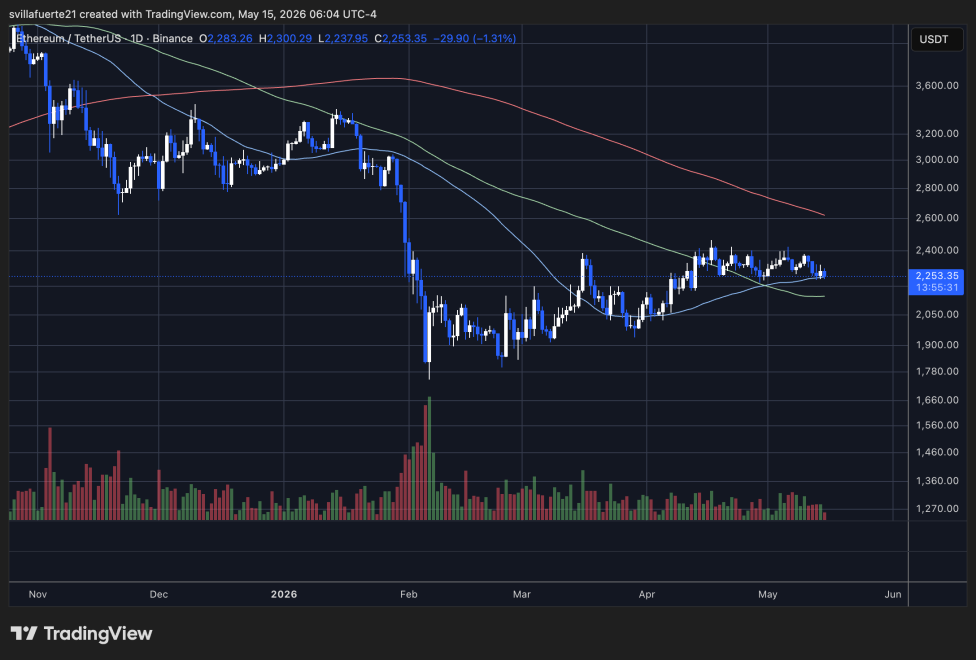
After an aggressive sell-off in February that briefly pushed Ethereum below $1,800, buyers managed to regain key support levels and set up a gradual recovery structure throughout March and April. This recovery brought ETH back to the $2,300-$2,400 range, but the price has now repeatedly stalled. The failure to break out of this zone reflects deep-seated uncertainty across the market, with traders remaining reluctant to aggressively increase exposure despite improving conditions.
Additionally, volume has declined significantly during the recent correction, suggesting that neither the bulls nor the bears have definitive control at the moment. Although the recovery structure remains intact, Ethereum continues to record low-momentum highs near resistance, indicating that upside pressure is fading unless stronger demand enters the market.
Featured image from ChatGPT, chart from TradingView.com
editing process for is focused on providing thoroughly researched, accurate, and unbiased content. We adhere to strict sourcing standards, and each page is carefully reviewed by our team of top technology experts and experienced editors. This process ensures the integrity, relevance, and value of your content to your readers.


